


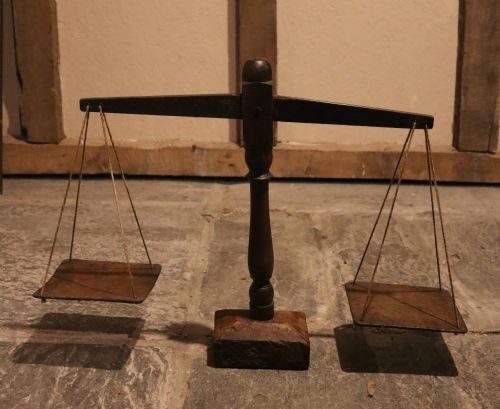


Vintage Beam Scales
These vintage beam scales are precision instruments of brass, iron, and wood, prized for their mechanical clarity and enduring utility in trade and science.
Vintage Beam Scales
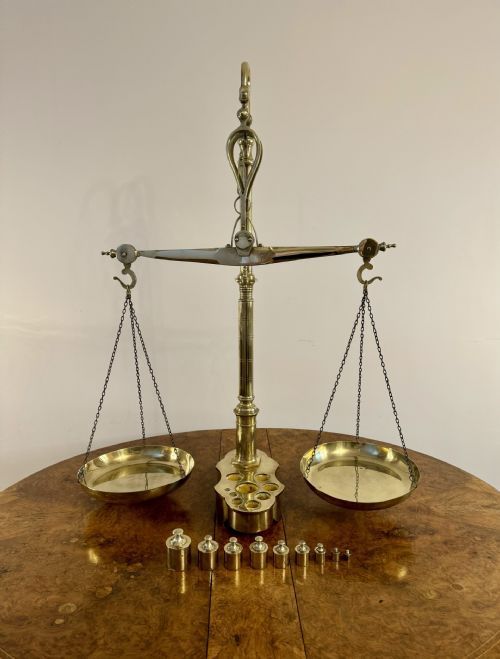
Vintage beam scales operate on the simple principle of balance, utilising a central fulcrum and two suspended pans to determine mass. When buyers search for vintage beam scales, they encounter a range of forms spanning domestic, commercial, and scientific spheres.
The selections available here lean heavily toward Victorian brass and mahogany apothecary sets, Edwardian shopkeeper balances, and sturdy industrial iron instruments. Regional variations such as Dutch bushel balances and Welsh dairy scales also appear, reflecting specialised local measures.
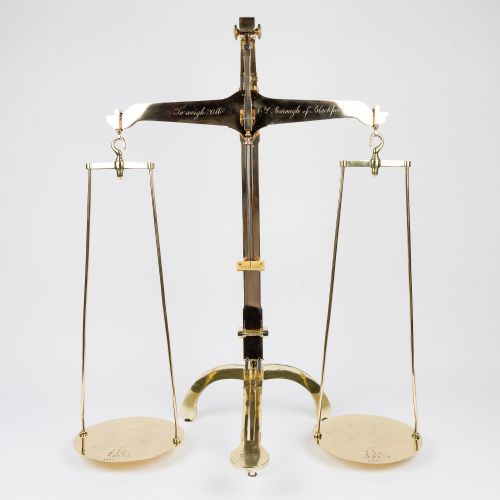
Forms extend from heavy inspector and verification balances used by municipal authorities down to delicate letter scales and chemist precision instruments. Each variation tells a story of commercial standardisation and domestic administration through the centuries.
Materials and Construction
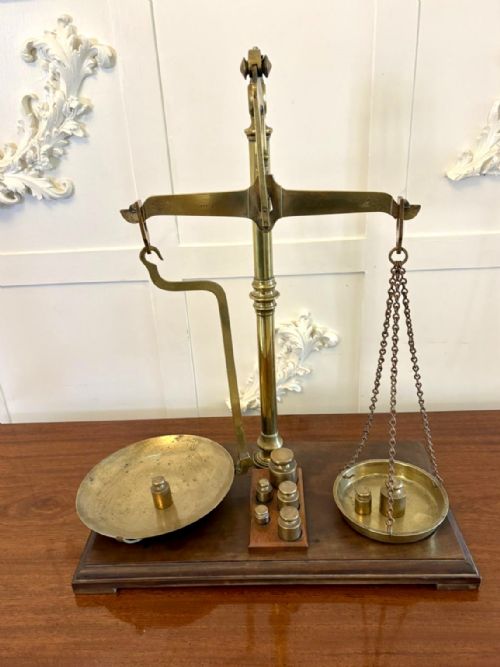
Makers built the structural beams and sensitive indicators predominantly from polished brass, mounted upon mahogany, oak, or hardwood bases that provided stability. Cast iron and wrought iron frequently form the heavier support frames and bases of larger industrial and trade scales.
Glass panels often enclose delicate chemist and apothecary balances to protect the swinging pointer and pans from air currents. Fine craftsmanship is evident in the inscribed verification marks, adjustable levelling feet, and hand-tooled calibration points.
The documented pieces encompass domestic letter scales alongside heavy municipal verification balances dating from the eighteenth to the twentieth century.
Evaluating Quality
Quality in these instruments rests upon the precision of the central bearing and the absolute symmetry of the beam. Superior pieces maintain smooth articulation without lateral play in the fulcrum.
Maker provenance elevates an example significantly, particularly when bearing the signatures of renowned firms or municipal verification stamps. The inclusion of matching original brass weights complete with fitted wooden boxes also separates standard utility pieces from collector grade examples.
Day & Millward·Parnall & Sons of Bristol·De Grave Short & Co·Oertling·Bartlett & Sons
The Vintage Beam Scales Glossary
- Fulcrum
- The central pivot point upon which the balance beam oscillates. Its precise knife-edge construction dictates the sensitivity of the entire instrument.
- Bushel balance
- A heavy agricultural or market scale designed to measure volumetric grain or produce rather than simple weight. These Dutch variants often incorporate substantial brass bowls.
- Apothecary balance
- A sensitive instrument housed within a glass case, utilised by pharmacists for compounding medicinal formulas. The enclosed cabinet prevents ambient draughts from skewing minute measurements.
- Verification balance
- An official instrument used by municipal inspectors to check standard weights and measures for commerce. They carry specific city or borough inscriptions.
- Stick balance
- A portable weighing device utilising a sliding counterweight along a graduated wooden or metal rod. These uncommon forms offer compact utility for trade.
Vintage Beam Scales: Frequently Asked Questions
How do beam scales work?
Beam scales rely on equal moments acting across a central fulcrum to establish equilibrium between an unknown mass and known standard weights. When the pointer rests vertically at the centre of the scale, balance is achieved.
This mechanical equilibrium provides a reliable measurement of mass that remains immune to the electrical fluctuations or calibration drifts common in modern digital alternatives.
Were these used in shops?
Many surviving examples served daily duty on Edwardian and Victorian shop counters for weighing groceries, mail, and dry goods. Shopkeeper balances were built for rapid service while maintaining trade accuracy.
Heavier models regulated city markets and verified local commercial standards, bearing the official stamp of municipal inspectors to protect consumers.
How do I clean brass scales?
Maintenance requires gentle dusting with a soft, dry cloth to preserve the aged patina that collectors value on antique brass and wood surfaces. Avoid harsh chemical polishes that strip historical character and leave abrasive residue in delicate pivot joints.
Wooden bases benefit from occasional application of microcrystalline wax to nourish the grain without attracting dust to the mechanical components.
Are weights usually included?
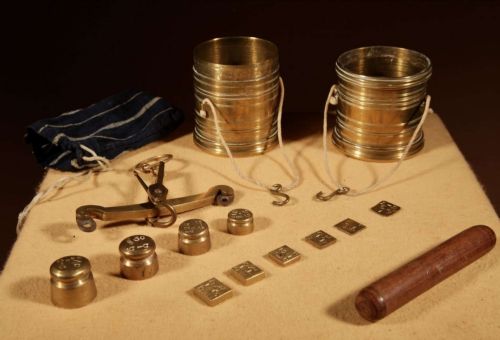
Many complete sets retain their original matching brass weights nestled inside custom fitted mahogany or oak storage blocks. These accompanying weights often bear corresponding municipal verification stamps and maker marks.
When weights are absent, the instrument remains a decorative or mechanical display piece, though replacement sets can be sourced to match the original capacity.