
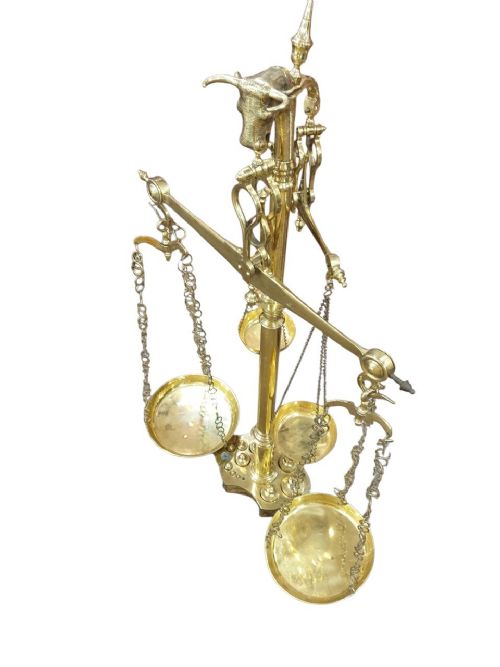
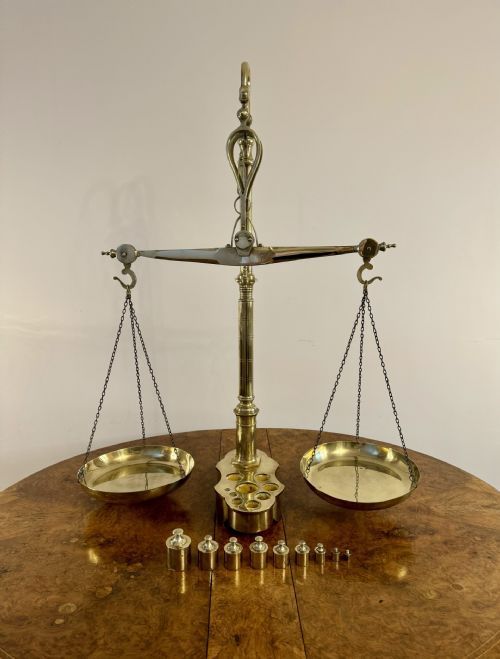
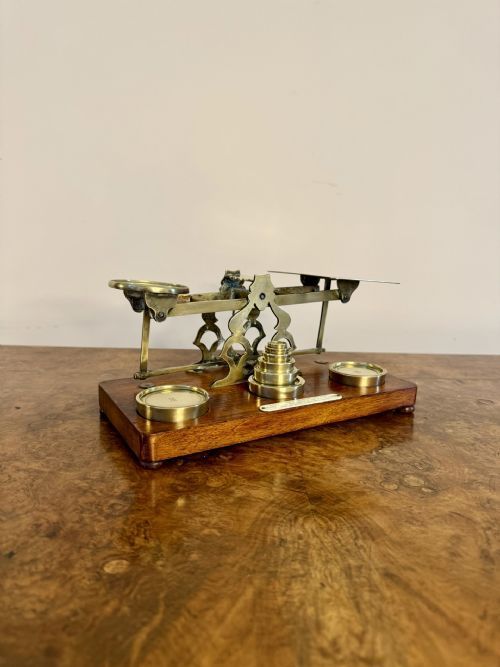


Large Brass Scales
Large brass scales are substantial weighing instruments that bring industrial presence and period utility to any interior.
Large Brass Scales
When hunting for large brass scales, buyers encounter robust measuring devices spanning the Victorian, Edwardian, and early twentieth-century periods. These heavy instruments range from utilitarian postal and bank counters to massive butcher and dairy balances.
The most frequent examples on this page are Victorian beam scales and postal scales mounted on mahogany or oak bases, often accompanied by their original weights. They survive from commercial counting houses, shops, and apothecaries where precision mattered.
Beyond standard postal and counter models, the category stretches to monumental floor-standing butcher scales and travelling apothecary sets. Each form reveals the specific trade or domestic task it was built to perform.
Materials and construction
These instruments rely on heavy cast and turned brass paired with dense hardwoods such as mahogany and oak for their structural bases. The gleaming metal beams and pans contrast with rich timber plinths, sometimes incorporating glass, leather, or iron components.
Makers achieved mechanical accuracy through finely balanced metal beams, pivoting pivots, and precise calibration. Timber bases were often fitted with specific compartments to house matched sets of bell or dump weights.
Listings for large brass scales span the Victorian era, 1880, 1890, 1900, 1910, and 1920, utilising brass, mahogany, oak, glass, and leather.
Assessing quality and finish
Quality in large brass scales rests on the crispness of the casting, the proportion of the brass beam to the wooden base, and the presence of signed maker details. Finer examples display careful engraving, substantial timber thickness, and complete, matching sets of contemporary weights.
The distinction between standard commercial instruments and superior pieces lies in the refinement of the brass work and the integration of materials like malachite or serpentine. Maker signatures from known firms further elevate the standing of an individual set.
S Mordan London·Parnall and Sons of Bristol·Negretti and Zambra London·W Watson and Sons London·De Grave and Co London·Doyle and Son London·J and E Ratcliff
The Large Brass Scales Glossary
- Beam scale
- A weighing device consisting of a central pivoting lever from which two pans are suspended at equal distances. This traditional mechanism forms the basis of most antique balances.
- Postal scales
- Specialised letter-weighing devices featuring graduated platforms and calibrated indicators to calculate postage rates. They frequently sit upon shaped mahogany or oak bases.
- Bell weight
- A heavy, cup-shaped metal weight designed with a central handle resembling a bell. These are commonly found accompanying Victorian commercial scales.
- Dump weight
- A short, solid, cylindrical weight used with postal and counter scales. Their stout proportions make them visually distinct on nineteenth-century wooden bases.
Large Brass Scales: Frequently Asked Questions
How do I date large brass scales?
Dating relies on the style of the wooden base, the shape of the weights, and any stamped maker marks or registration numbers. Victorian and Edwardian examples often feature distinct turned feet and brass pillar designs.
Changes in postal rates and commercial regulations over the nineteenth century also dictated the layout of the scale plates and indicator dials.
Were these scales used in homes or businesses?
Most large brass scales served commercial functions in banks, post offices, grocery shops, and apothecary dispensaries. Their sturdy construction was essential for daily trade and measuring commodities accurately.
Smaller postal variations occasionally sat in domestic libraries or writing rooms for private correspondence and parcel preparation.
How should I clean antique brass?
Antique brass benefits from gentle dusting and minimal intervention to preserve its historic patina. Heavy polishing removes the aged surface that collectors value.
If cleaning is necessary, use a non-abrasive cloth specifically recommended for historic metals, avoiding harsh chemical dips that strip the surface entirely.
Can these scales still be used for weighing?
While many beam scales remain mechanically sound, antique balances are primarily acquired for display and interior decoration. Over decades of use, internal pivots and balances can drift out of calibration.
They function well as decorative objects on sideboards or desks, where their substantial brass components catch the light.