


Brass Pan Scales
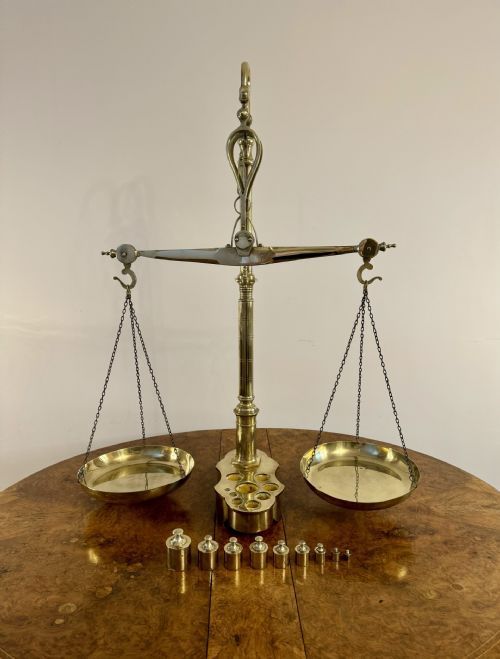
Brass pan scales are heavy working balances designed for trade and domestic use, prized for their gleaming metal work and honest engineering.
Brass Pan Scales
When you search for brass pan scales, you encounter traditional weighing devices built for shops, kitchens, and commercial trade across various periods. These mechanical balances rely on a central beam with suspended pans to measure mass accurately.
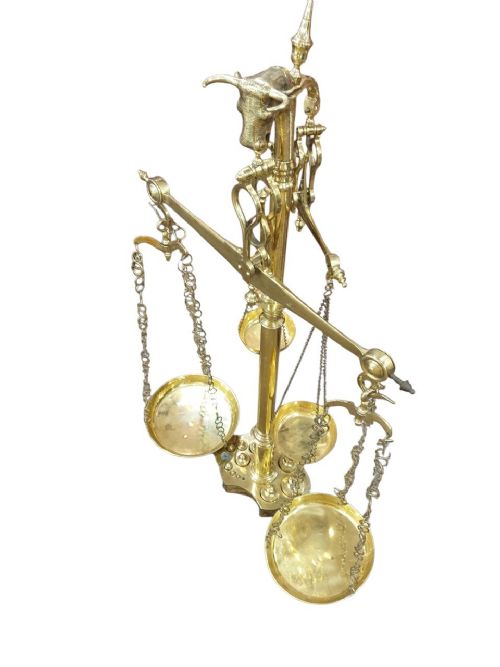
You are most likely to meet Victorian and Edwardian examples on this page, alongside earlier French and Dutch designs. The selection ranges from robust butcher and grocer models to decorative garden scales.
Forms span from freestanding counter balances with fitted wooden bases to free-hanging beam scales designed for specific trade environments. Each piece reflects the functional requirements of its original setting.
How they were made
Makers constructed the primary beams and hanging pans from polished brass, often pairing them with sturdy cast iron or iron bases to ensure stability during use. Some domestic and commercial iterations incorporate mahogany plinths or copper elements.
Workshops utilised durable metals and precise balancing techniques to create reliable instruments that could withstand daily trade. Structural components frequently feature steel pivots and bronze fittings to reduce friction at the fulcrum.
Listings feature brass pan scales spanning the Victorian, Edwardian, and mid-twentieth-century periods, constructed from brass, iron, copper, and mahogany.
What varies in quality
Quality in these balances depends on the precision of the mechanics and the integrity of the original construction. Superior examples maintain a true, balanced beam without excessive play in the pivots.
The finish of the metalwork and the presence of maker markings distinguish standard utility pieces from finer workshop productions. Heavier gauges of brass and well-proportioned wooden bases elevate the overall standard of the object.
Bartlett and Sons·De Grave and Co London
The Brass Pan Scales Glossary
- Beam scales
- A weighing device utilising a horizontal lever with arms of equal length, suspended from a central pivot point. This mechanism forms the core of traditional balance design.
- Counter balance
- A scale designed to sit stably upon a shop counter or tabletop for daily retail transactions. These versions typically feature a fixed base supporting the weighing mechanism.
- Free-hanging balance
- A scale intended to be suspended from a ceiling hook or bracket rather than resting on a surface. This configuration was common in specialised trade and domestic spaces.
- Plinth
- The solid base block, frequently fashioned from mahogany, that supports the upright pillar of the scale. It provides both structural stability and a finished appearance.
Brass Pan Scales: Frequently Asked Questions
How do brass pan scales work?
These balances operate on the principle of equilibrium, where an unknown weight in one pan is measured against known weights placed in the opposing pan until the central beam levels completely.
The precision of the movement relies on the knife-edge pivots housed within the central beam, which allow the arms to swing freely with minimal friction.
Where were these scales used?
Commercial iterations appeared extensively in Victorian grocery shops, butcher stalls, and market environments where goods were weighed directly for customers.
Domestic and garden variations served lighter household duties, while specialised hanging formats suited specific trade practices in regions like France and the Netherlands.
How do I date an antique scale?
Dating relies upon stylistic markers in the ironwork, the shape of the brass beam, and any incorporated maker stamps or registration marks found on the metal.
Victorian and Edwardian models often display distinct casting techniques and base materials that separate them from mid-century or earlier continental examples.
How do I clean brass pans?
Maintenance typically involves gentle dusting and occasional polishing with a suitable metal cleaner if you prefer a bright, reflective surface.
Many collectors prefer to leave a settled patina on older brass and iron components to preserve the historic character of the piece.