
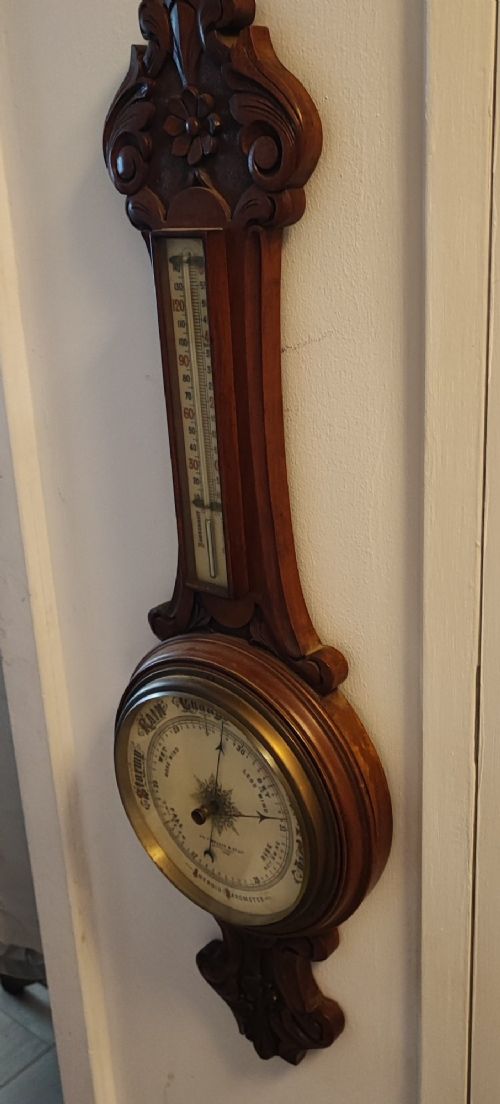
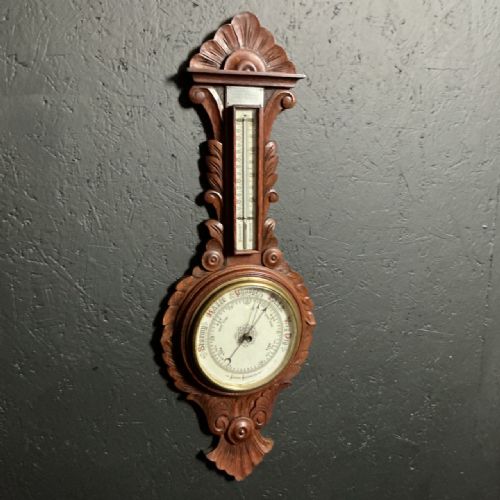
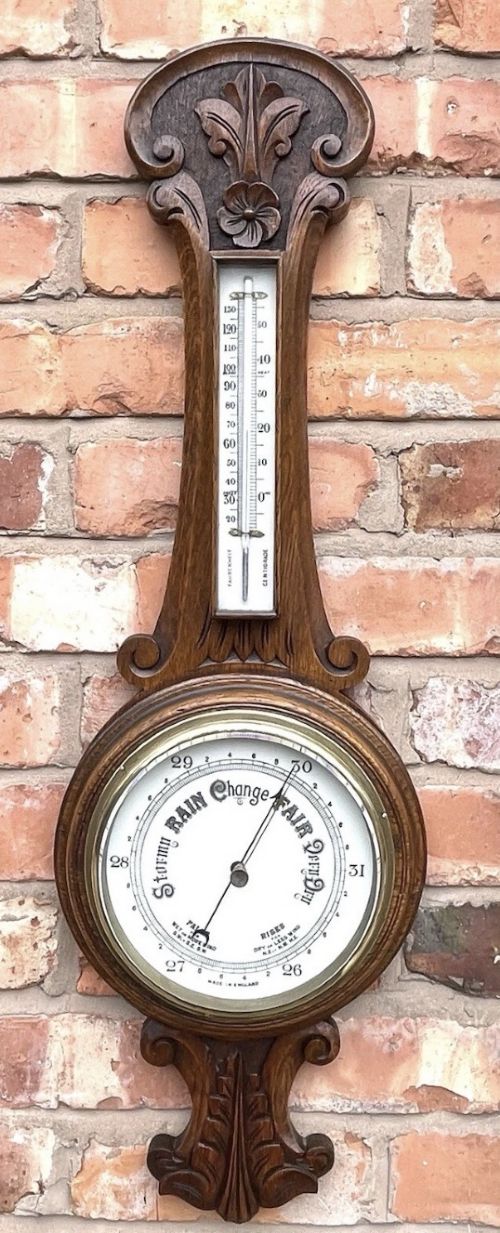

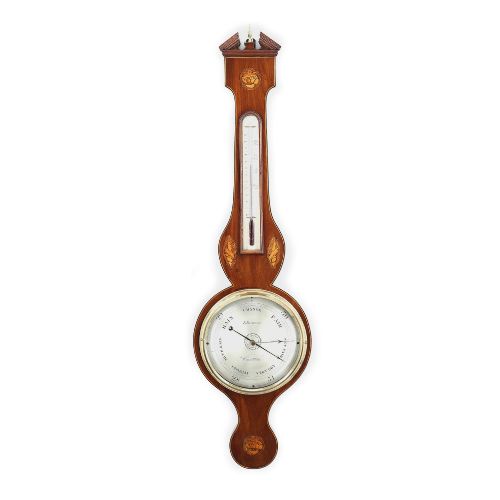

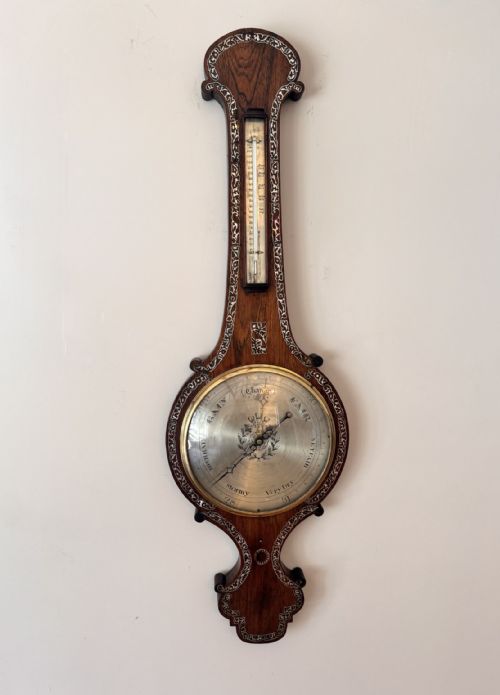


Vintage Banjo Barometer
A vintage banjo barometer brings practical weather tracking and striking wall presence into a room, shaped like the stringed instrument it mimics.
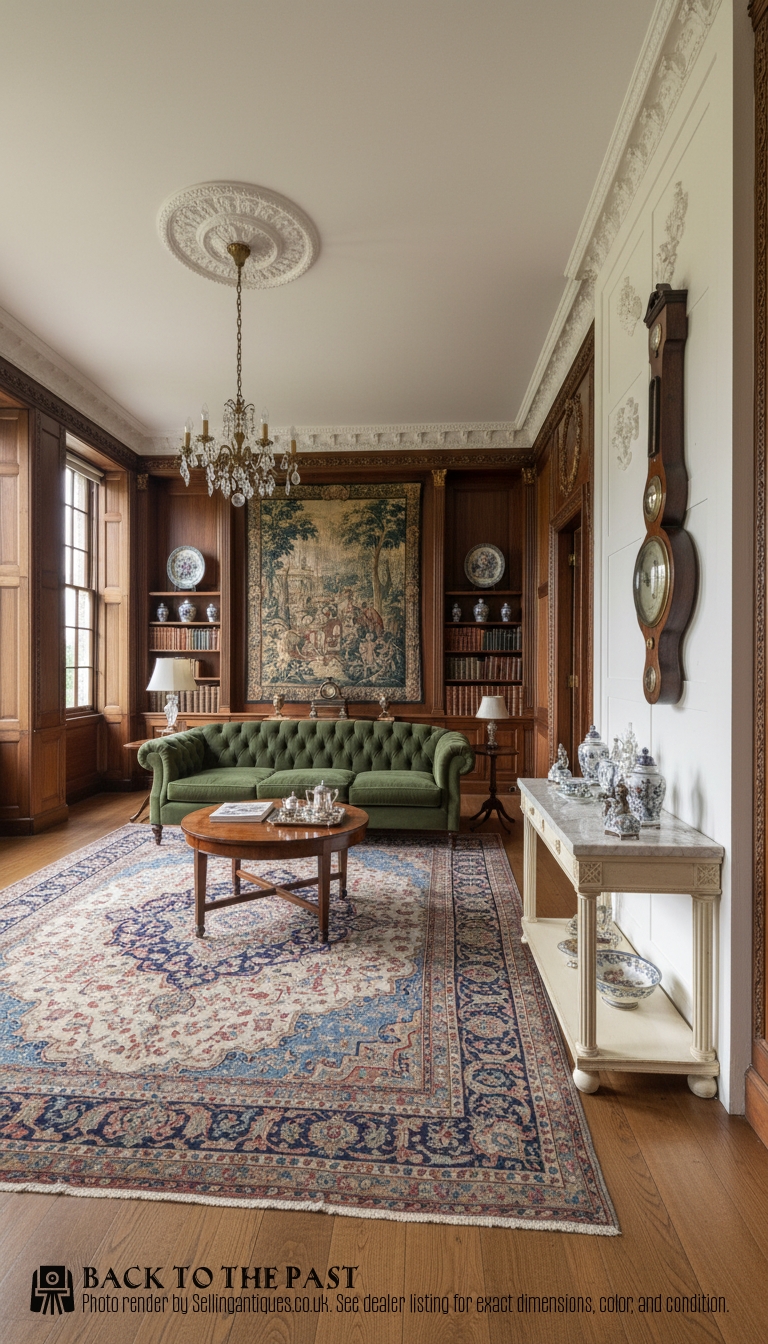
Vintage Banjo Barometer
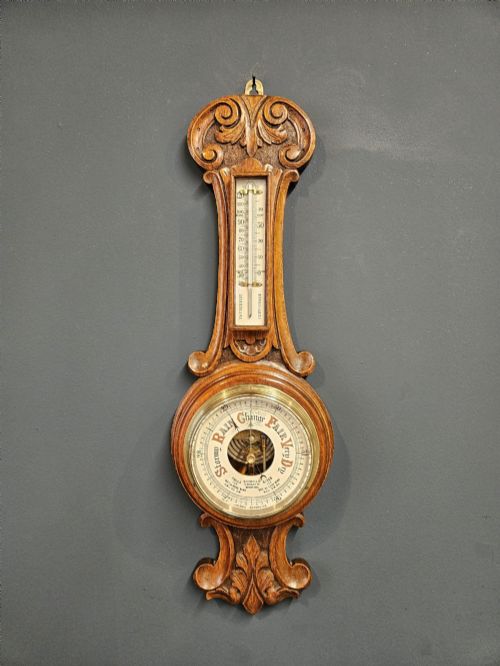
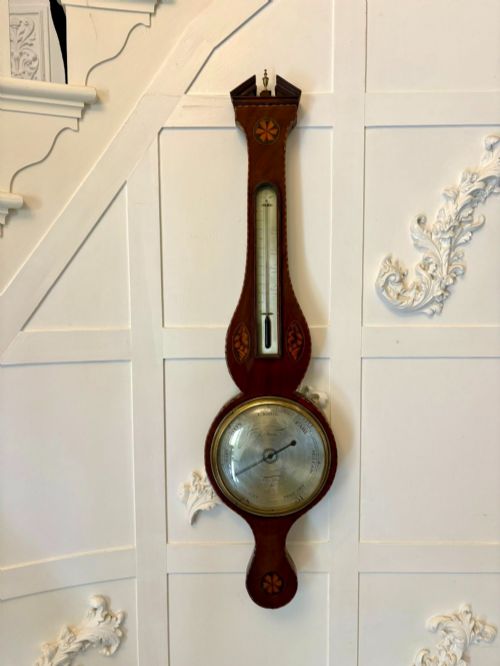
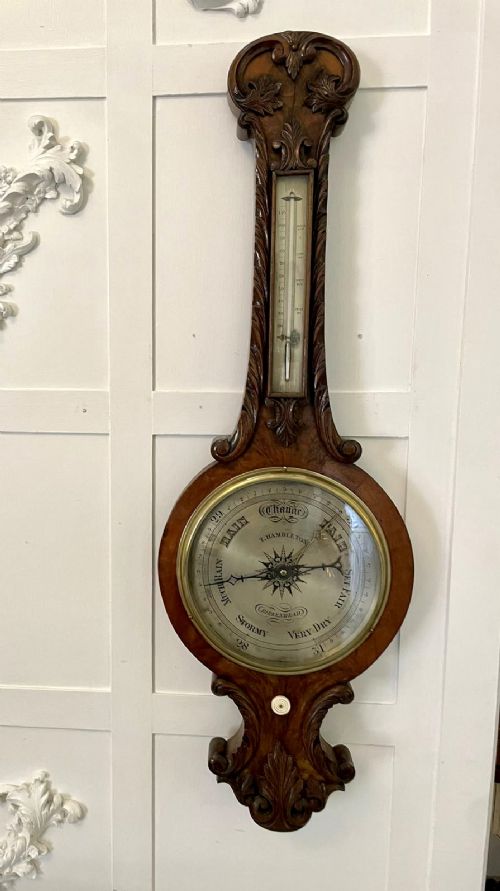
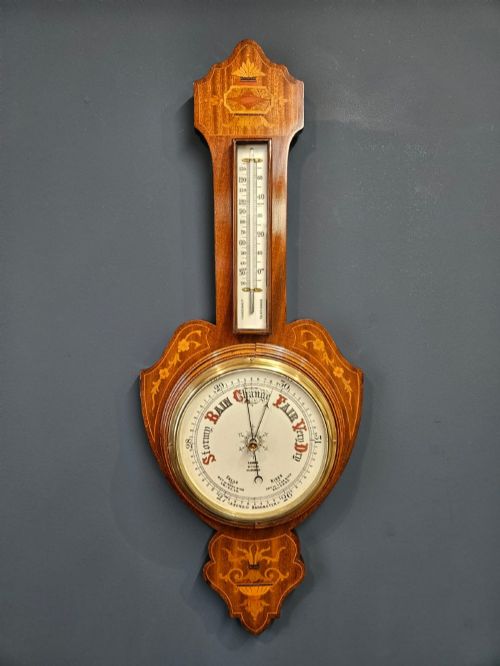
A vintage banjo barometer takes the form of a wall-hanging instrument with a circular dial at the top and a long, tapering trunk below that often houses a thermometer or hygrometer. These pieces appear frequently in mahogany, burr walnut, and carved oak, spanning periods from the George III era through the Victorian and Edwardian decades.
The layout generally places the weather dial prominently at the crest, sometimes topped with an onion top or architectural pediment, while the trunk below displays decorative stringing or floral carving. Buyers encountering these instruments on this page will find both mercurial and aneroid mechanisms housed within these distinctive wooden frames.
Materials and construction
Cabinetmakers constructed the distinctive cases primarily from dense hardwoods like mahogany, rosewood, and oak, often enriching the surfaces with contrasting shell inlay or delicate mother-of-pearl floral motifs. Artisans shaped these timbers into sweeping curves for the trunk and circular upper chambers, applying polished finishes that highlighted the natural grain.
Internal instrumentation relied on sensitive weather-reading technology, pairing silvered metal dials with brass bezels and protective glass covers. Makers integrated mercurial tubes or aneroid capsules alongside mercury-filled thermometers to register atmospheric pressure and temperature shifts accurately.
Distinctions in craftsmanship
Quality reveals itself in the crispness of the wood carving and the precision of the marquetry or shell inlay set into the trunk. Finer examples display carefully selected timber veneers, such as burr walnut or figured mahogany, matched with engraved silvered metal dials rather than plain printed faces.
The distinction between standard production and superior work also rests in the cabinetry details around the bezel and the retention of original glass, brass fittings, and maker signatures on the dial. Well-executed instruments maintain balanced proportions between the circular head and the lower body.
B Besozzi of Weymouth·Ganthony of London·Prada of High Wycombe·Molton of Norwich·Fagioli of Clerkenwell London·W Watson & Sons·Jenkins Of Old Swindon·Maple & Co·James H Kelly of Glasgow·Roncoroni·WE Pain of Cambridge
The Vintage Banjo Barometer Glossary
- Aneroid barometer
- An instrument that measures atmospheric pressure using a flexible metal box called an aneroid cell, which expands or contracts without the use of liquid mercury.
- Wheel barometer
- Another term for a banjo barometer, so named because the movement of the internal mechanism turns a visible indicator wheel or pointer around a dial.
- Marquetry
- Decorative woodwork where pieces of contrasting veneer are fitted into a design, frequently seen on the trunks of these wall instruments.
- Silvered metal
- A treated metal surface, often brass, finished with a silver coating and fine engraving for the dial face.
- Pediment
- The decorative architectural crest positioned at the very top of the barometer case above the main dial.
Vintage Banjo Barometer: Frequently Asked Questions
How do I read a banjo barometer?
The main dial displays descriptive weather words such as stormy, rain, change, fair, and very dry alongside numeric pressure readings. A movable brass pointer, adjusted by a small key on the glass, lets you track whether the pressure rises or falls from day to day.
Changes in the weather cause the internal linkages to move the main needle relative to your set marker. Monitoring this shift indicates whether improving or deteriorating conditions approach.
Where should I hang a wall barometer?
Select an interior wall that remains free from direct sunlight, heavy drafts, and sudden temperature fluctuations from radiators or fireplaces. Stable ambient conditions ensure the internal mechanical parts continue to function smoothly.
Ensure the hanging point secures the weight of the timber case firmly to the wall. Positioning the dial at eye level also makes daily reading effortless.
How do I distinguish a Georgian model from a Victorian one?
Georgian models, particularly those from the George III period, often favour clean mahogany cases embellished with symmetrical shell inlay and simple architectural lines. They frequently utilise mercurial column movements visible through open glass channels.
Victorian and later Edwardian examples tend towards heavier oak or burr walnut frames featuring deep relief carving, onion tops, and sturdy aneroid mechanisms. These later pieces also incorporate thermometers and mother-of-pearl detailing with greater frequency.
Are these barometers still accurate?
Many surviving instruments retain functional movements that respond reliably to shifts in barometric pressure. Aneroid versions often require minimal calibration, while mercurial examples need careful handling to ensure the mercury column remains unbroken.
Even when historical instruments require professional adjustment to match modern readings, they continue to serve as dependable indicators of general weather trends.