


Vintage Anatolian Prayer Rug
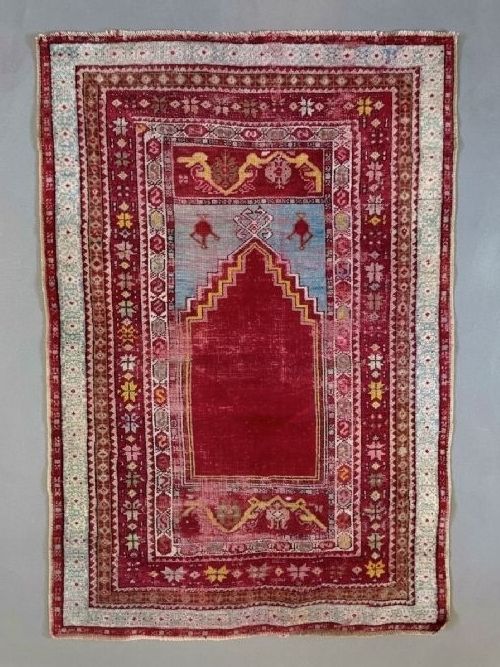
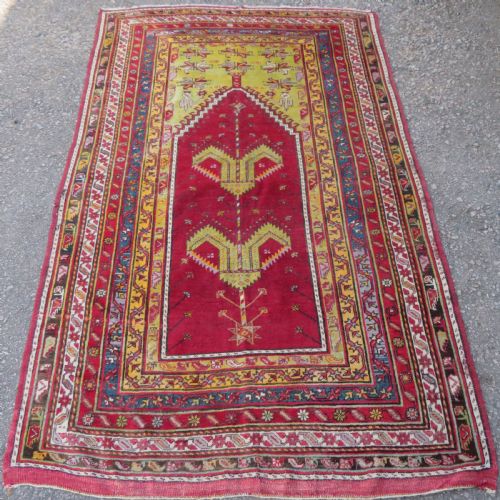
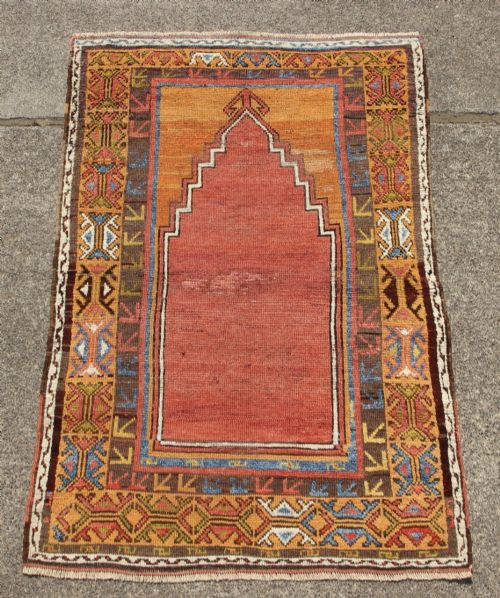
When you search for a vintage anatolian prayer rug, you are looking at woven floor coverings defined by distinct architectural mihrab niches from Turkish weaving centres.
Vintage Anatolian Prayer Rug
A vintage anatolian prayer rug is a woven textile featuring a central niche or arch, known as a mihrab, designed to direct the placement of the head during daily prayers. These pieces originate from various historical regions across Anatolia, including Konya, Kirsehir, Ghiordes, Ladik, and Milas.
The format is typically rectangular, scaled for individual use, and often displays specific regional symbols such as floral motifs, stepped arches, and star borders. Buyers meeting these pieces on this page will encounter examples woven in village workshops as well as town centres during the nineteenth and early twentieth centuries.
Regional weaving traditions dictate the specific palette and geometric vocabulary found within the field and borders of each rug. Some specimens incorporate prayer kilims or flatweaves alongside piled constructions.
How They Were Made
Weavers utilised hand-spun wool for the pile, foundation warp, and weft threads, occasionally incorporating cotton or angora wool alongside silk in later or more urban examples. The structural integrity relies on hand-knotted techniques tied firmly onto parallel warps.
Natural dyes provide the foundational colour palette, drawn from plant and insect sources that yield saturated blues, reds, greens, and ivory grounds. These organic colourants interact with the wool fibres to develop subtle shifts in tone over time.
Some nineteenth-century weavers thoughtfully tucked tiny protective amulets directly into the wool pile of their prayer rugs.
What Varies in Quality
The intricacy and precision of the regional design execution separate finer examples from simpler village pieces. Knot density and the handling of the wool pile determine the crispness of the mihrab outline and secondary border patterns.
The purity and depth of the natural dyes significantly influence the visual impact of the textile. Harmonious colour saturation and well-preserved pile integrity elevate certain regional weaves above standard production.
The Vintage Anatolian Prayer Rug Glossary
- Mihrab
- The architectural arch or niche design at one end of a prayer rug that symbolises the direction of prayer. This directional motif is the primary visual identifier for the group.
- Warp
- The vertical threads stretched tightly on the loom that form the structural skeleton of the rug. Weft threads are then interlaced across these vertical foundation lines.
- Weft
- The horizontal threads passed through the warp threads to secure the knots in place. Together with the warp, they create the durable grid foundation of the textile.
- Kilim
- A flatwoven textile produced without a pile by tightly interweaving warp and weft strands. Some regional prayer examples utilise this slit-weave technique rather than traditional knotting.
- Natural dye
- Colourants derived from organic sources such as plants, roots, and insects rather than synthetic chemicals. These dyes yield complex, varied hues that mature gracefully.
Vintage Anatolian Prayer Rug: Frequently Asked Questions
What is a mihrab on these rugs?
The mihrab is the arched niche depicted at one end of the rug field. It represents the prayer niche found in mosques and directs the orientation of the piece.
Historically, this architectural motif helped the user align the textile toward Mecca during personal devotional practices.
How do regional styles differ?
Different towns and districts across Anatolia developed distinct colour palettes and geometric vocabularies. For instance, Kirsehir and Konya pieces often feature characteristic borders and field arrangements unique to central districts.
Village workshops in Milas or Bergama utilised local design idioms, resulting in varied star motifs and alternative floral treatments.
Where were these rugs made?
They were woven across various provinces and towns in Anatolia, which encompasses modern-day Turkey. Major centres of production included Konya, Ladik, Ghiordes, Kirsehir, and Milas.
Production took place both in established urban manufactories and smaller village communities, yielding diverse structural qualities.
How should I care for a wool rug?
Wool textiles require gentle maintenance, such as regular light vacuuming without a rotating brush bar to protect the pile. Keeping the rug out of direct, harsh sunlight prevents the natural dyes from fading prematurely.
Professional cleaning tailored to antique textiles ensures the hand-spun wool and natural colourants remain stable over decades of display.