

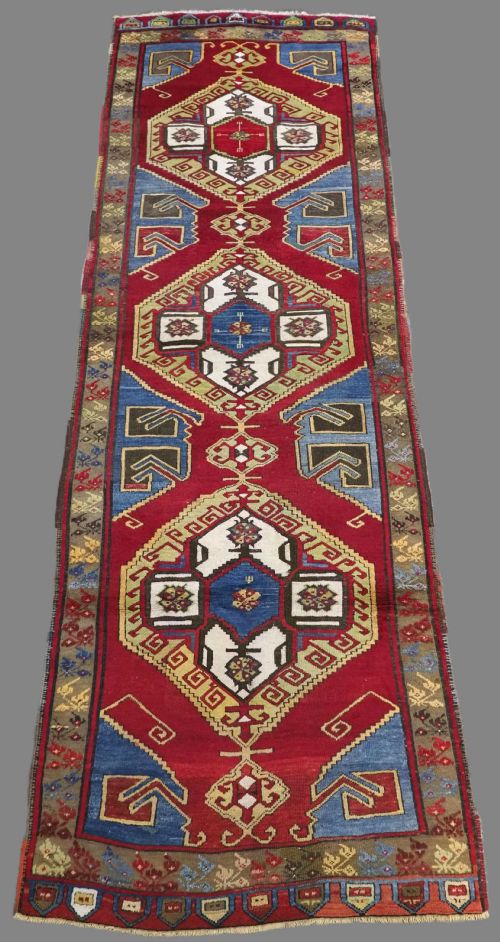


Traditional Konya Carpet
A traditional konya carpet brings the deep geometric symbolism and rich natural dye palettes of Central Anatolian weaving straight into a living space.
Traditional Konya Carpet
A traditional konya carpet encompasses room-sized floor coverings, long runner rugs, and specific formats like prayer rugs or flat-woven kilims originating from Central Anatolia. These pieces emerge from historical village weaving traditions rather than court workshops, bearing the distinctive aesthetic of the Konya region.
The selection here includes examples spanning the nineteenth century up to the early twentieth century, showing forms such as the yatak rug and the half-kilim runner. Buyers encounter varied formats ranging from compact village prayer rugs to large room-sized carpets displaying classic Anatolian tribal motifs.
How they were made
These textiles rely on traditional hand-knotting and flat-weaving techniques utilising natural wool for the pile and foundation, often paired with cotton elements. Weavers built these carpets on vertical looms within village environments, passing down specific structural methods through generations.
The creation process involved spinning local wool by hand and dyeing the fibres using plant and mineral sources to achieve the characteristic depth of colour seen across the region. Flat-woven kilim portions and pile sections required distinct weaving expertise to combine durability with intricate geometric patterns.
Traditional Konya Carpet Retail Price Guide 2026
Typical asking prices for traditional konya carpet among the pieces listed under this phrase on Sellingantiques today, from the lower quarter to the upper quarter. They describe what is for sale here now, not the wider market.
Listings feature pieces from the nineteenth century up to 1910, utilising wool and cotton materials in Anatolian tribal styles.
What varies in quality
The distinction between ordinary and exceptional weaving lies in the precision of the tribal geometry and the depth and complexity of the natural dye palette. Superior examples maintain structural integrity across the wool foundation while displaying harmonious colour transitions that develop character over time.
Village provenance and regional specificity also influence the standing of a piece, with certain locations yielding more distinctive designs and tighter knot densities. The overall visual impact depends on how successfully the weaver integrated traditional Anatolian motifs into the composition.
The Traditional Konya Carpet Glossary
- Kilim
- A flat-woven carpet or rug produced by tightly interweaving warp and weft strands without creating a pile. This technique yields a smooth, reversible textile.
- Prayer rug
- A small rug featuring a mihrab design or architectural arch motif indicating the direction of prayer. These pieces were traditionally used for personal devotion.
- Yatak
- A term used for a type of sleeping or bedding rug originating from Anatolian village traditions. These pieces generally feature softer, heavier piles suited to domestic use.
- Warp
- The vertical foundation threads stretched tightly on a loom before weaving begins. All other threads are built upon this structural grid.
- Weft
- The horizontal threads passed back and forth across the warp to hold the knots or flat-weave in place. Together with the warp, it forms the stable base of the textile.
Traditional Konya Carpet: Frequently Asked Questions
How do I identify a traditional konya carpet?
Look for specific Central Anatolian tribal motifs, village prayer formats, and traditional wool structures that reflect nineteenth-century and early twentieth-century production.
Examine the palette of natural dyes and the regional weaving characteristics, which often include specific village attributions like Karapinar or Sivrihisar.
How should I clean and maintain an antique rug?
Regular gentle vacuuming without a rotating brush helps remove dust and prevents grit from settling into the wool foundation.
Professional cleaning tailored to antique textiles is recommended when deeper maintenance is required to protect the natural dyes.
Where were these carpets originally made?
These textiles originate from Konya and surrounding villages in Central Anatolia, an important historic hub for Turkish rug weaving.
Local workshops and village households produced these pieces using materials sourced directly from the surrounding pastoral landscape.