


Vintage Amethyst Pin
A vintage amethyst pin brings rich purple depth to a lapel, offering the enduring appeal of deep-set stones in gold and silver settings.
Vintage Amethyst Pin
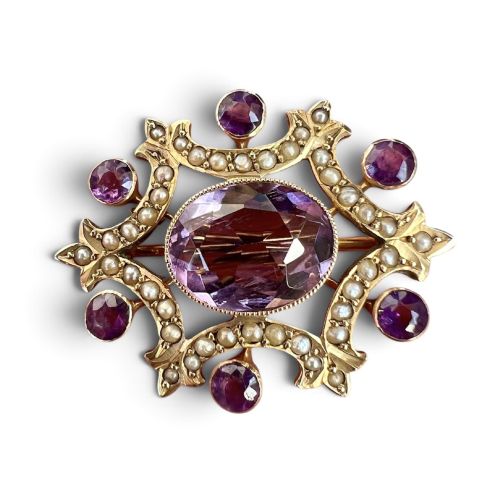
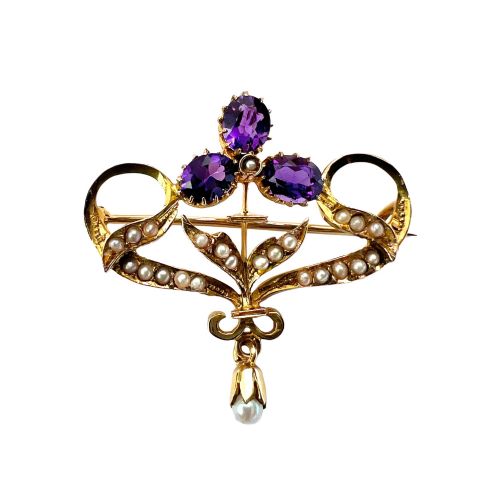
A vintage amethyst pin encompasses brooches, pendants, and cluster designs spanning Georgian, Victorian, Edwardian, and mid-century periods. These wearable ornaments showcase purple quartz set into yellow gold, sterling silver, and occasionally platinum or white gold.
Buyers on this page most frequently encounter Edwardian and Victorian creations in nine-carat gold, often paired with seed pearls, alongside occasional mid-century and Mexican silver interpretations. Heart shapes, double clusters, and spray motifs dominate the available forms.
How they were made
Goldsmiths shaped nine-carat and eighteen-carat yellow gold into delicate collet settings, heart frames, and multi-stone sprays to house the central purple gems. Stones were frequently hand-cut with step-cut facets or flat-cut profiles, reflecting the lapidary standards of their respective eras.
Makers integrated natural pearls, seed pearls, and small diamonds alongside amethysts using fine wirework, claw settings, and closed-back foils in earlier examples. Mexican silver pieces demonstrate regional hand-smithing techniques applied to bold modernist forms.
Listings span multiple eras from Georgian and Victorian times through Edwardian work to mid-century and Mexican silver designs.
What varies in quality
The saturation and clarity of the quartz dictate much of the visual impact, ranging from pale lilac to deep violet hues with varying degrees of natural inclusions. Setting integrity also distinguishes finer workshop production from standard commercial output.
The survival of original components, such as accompanying pearl drops, secure pin stems, and intact hinge mechanisms, elevates a piece. Harmony between the gold or silver mount and the cut of the stone separates masterwork jewellery from simpler decorative items.
Beto
The Vintage Amethyst Pin Glossary
- Amethyst
- A purple variety of quartz prized for centuries as a primary gemstone in European and international jewellery.
- Seed pearl
- A very small, natural or cultured saltwater pearl, frequently drilled and strung or pegged into Victorian and Edwardian cluster designs.
- Step-cut
- A gemstone cutting style featuring parallel facets that create rectangular or square reflections, often seen in mid-century stones.
- Cluster brooch
- A piece of jewellery featuring a central prominent stone surrounded by a tight ring of smaller gems, such as pearls or diamonds.
- Collet setting
- A metal band that wraps around the girdle of a gemstone to hold it securely in place within the mounting.
Vintage Amethyst Pin: Frequently Asked Questions
How do I date a vintage amethyst pin?
Dating relies heavily on material composition, hallmark stamps, and prevailing design motifs like Edwardian millegrain or Victorian heart clusters. Structural clues such as pin length and hinge construction also point directly to specific manufacturing decades.
Examining the back of the mount often reveals maker marks or gold purity stamps that clarify the historical context of the piece.
Were these pins worn daily?
Many Victorian and Edwardian brooches served as everyday fastenings for collars, cravats, and heavy winter wools. Their durable gold or silver construction suited regular social use.
More elaborate spray or diamond-accented versions were reserved for evening wear and formal gatherings.
Can a brooch be worn as a pendant?
Certain examples feature integrated loops or hinged drop rings specifically designed to accommodate a chain. This dual functionality was popular during the Edwardian era.
A jeweller can also fit a removable converter to a standard pin without altering the original antique metalwork.
What care does gold and amethyst require?
Amethyst is a durable quartz, but ultrasonic cleaning can damage fragile seed pearls or foil-backed stones often found in older settings. Warm soapy water and a soft brush provide a safe clean.
Store pieces individually in fabric-lined boxes to prevent softer pearls or gold surfaces from scratching against harder gems.