
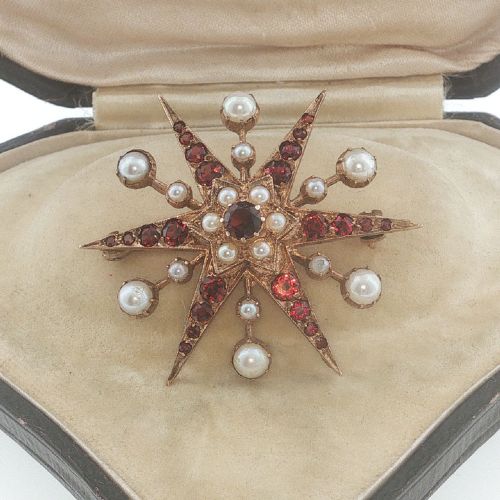


Retro Gold Brooch
A retro gold brooch brings bold mid-century character and heavy precious metalwork straight to a lapel.
Retro Gold Brooch
A retro gold brooch delivers substantial mid-century form, often taking shapes like ribbons, bows, stars, and playful animal figures. These jewels emerge from periods spanning the 1940s, 1950s, and 1960s, alongside Victorian revival and Edwardian expressions.
The selections available here showcase heavy yellow gold and white gold constructions, frequently paired with platinum elements. Gemstones such as garnets, seed pearls, diamonds, amethysts, turquoise, aquamarines, rubies, sapphires, emeralds, and citrines define the visual weight of these items.
How they were made
Goldsmiths utilised 9ct and 18ct yellow gold, 18k white gold, and platinum to build structural frames like wide tank bands, bows, and bar mounts. Metal casting and hand fabrication formed the solid foundations required for large central stones.
Setters mounted step cut stones, diamonds, and multi-coloured gem clusters directly into heavy metal settings. Artisans balanced high-carat coloured gemstones, including massive aquamarines, citrines, and amethysts, alongside delicate seed pearls and pavé diamonds.
A delightfully sculpted gold poodle studded with garnets proves that mid-century makers found space for genuine canine charm.
What varies in quality
The distinction rests heavily on the scale and carat weight of the central gemstones, ranging from modest seed pearls to substantial multi-carat aquamarines, emeralds, and citrines. Precision in the stone cutting, such as 29ct step cut stones or massive crystal windows, elevates the piece.
Execution of the metalwork defines the upper tier, seen in French fabrication, wide tank bracelet conversions, and complex multi-gem arrangements involving rubies, sapphires, and diamonds together.
Gubelin
The Retro Gold Brooch Glossary
- Retro
- A design movement spanning the 1940s and 1950s characterised by heavy gold construction and stylised floral or ribbon motifs. This period produced bold, sculptural jewellery after the geometric constraints of earlier decades.
- Step cut
- A gemstone cutting style featuring broad, flat rectangular facets arranged in concentric rows. This cut emphasises the clarity and depth of large stones like aquamarines and citrines.
- Seed pearl
- A very small, naturally or cultured spherical pearl often used in clusters or floral starburst patterns. These delicate pearls add subtle texture against yellow gold mounts.
- Tank bracelet
- A wide, rigid bracelet style originating in mid-century France, sometimes matched directly with companion brooches. The design echoes heavy machinery tracks through bold articulated gold links.
Retro Gold Brooch: Frequently Asked Questions
How do I style a retro gold brooch?
Pin these substantial pieces onto heavy wool coats, thick sweater lapels, or tailored blazer pockets to let the weight of the gold and gemstones sit securely. They also anchor scarves and collars effectively.
Because mid-century designs often feature wide forms or dangling drops, pairing them with simpler fabrics ensures the metalwork remains the focal point of an outfit.
What periods do these brooches come from?
The listings span the 1940s, 1950s, and 1960s, capturing the height of mid-century design alongside occasional Edwardian and Victorian revival pieces.
Art Deco influences also appear in items dated around 1945, bridging geometric styling with the heavier gold work typical of the mid-century era.
Which gemstones are common in these pieces?
Garnets, seed pearls, diamonds, amethysts, turquoise, aquamarines, rubies, sapphires, emeralds, and citrines frequently appear across the selection.
Stones are often chosen for high carat weights and dramatic visual contrast against yellow or white gold.
Are these pieces French in origin?
Several archival and listed items originate from French workshops working in 18ct yellow gold and platinum during the 1940s.
French pieces from this era often showcase intricate ribbon bows and double clip configurations.