


Vintage Agricultural Artwork
Vintage agricultural artwork captures the working countryside through rural landscapes, farmyard scenes and livestock portraits rendered in oil and watercolour.
Vintage Agricultural Artwork
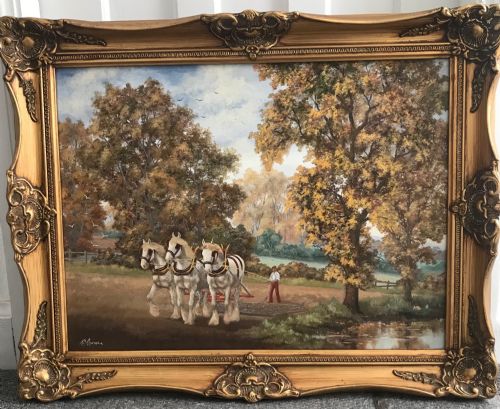
Vintage agricultural artwork brings together oil paintings and watercolours depicting farm life, ploughing teams, livestock and harvest scenes from the nineteenth and twentieth centuries.
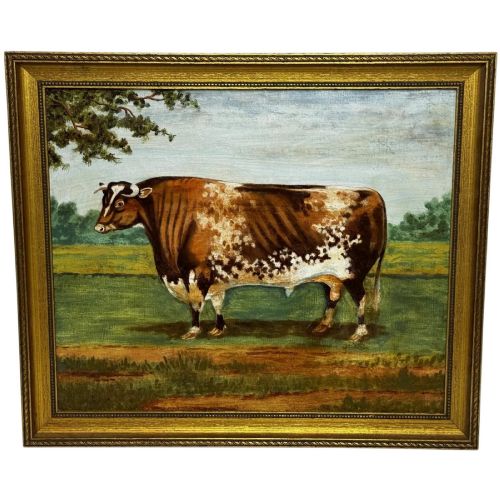
Buyers encounter works ranging from Victorian studies of prized bulls to mid-century naive landscape paintings executed on canvas or paper.
The subjects focus heavily on working horses, cattle, haymaking and the daily routines of rural labourers across British schools.
Canvas, paper and oil pigment
Artists painted primarily in oil on canvas or applied watercolour pigments to paper, often mounting finished works within traditional wood or ebonised frames.
Brushwork varies from the measured detail of Victorian realism to the looser application found in British impressionist and twentieth-century rural landscapes.
Listings span from the nineteenth century through the 1960s, featuring oil paintings and watercolours on canvas and paper.
Draftsmanship and handling of light
Quality rests upon the artist's ability to render animal anatomy correctly and capture natural light across open fields and farmyards.
Stronger pieces display confident brushwork and balanced composition, whereas weaker examples rely on stiff repetition and muddy colour mixing.
A M Gauci·James Kyd·James William Booth·Herbert Royle·Percival Glenfern·John Atkinson·J C Grey·George Soper·Arthur Winter Shaw·Rowland Henry Hill·W A Clark·Joseph Paulman·J L Van Leemputten·Frederick William Jackson·John Percy Cooke·Ernest Higgins Rigg·Walter Duncan·George Hamilton Constantine·William Greaves·Sonia Lawson·William Sidney Cooper·George Graham·George Cole·Fred Lawson·Frederick J Haycock
The Vintage Agricultural Artwork Glossary
- Oil on Canvas
- Pigment mixed with drying oil applied to stretched fabric. This medium allows for rich texture and deep colour layering.
- Watercolour
- Water-soluble pigment applied to paper support. It creates transparent washes that lend lightness to landscape scenes.
- British Impressionism
- A style focusing on natural light and outdoor settings. Practitioners adapted continental techniques to British rural subjects.
- Victorian Realism
- An artistic approach depicting everyday subjects without idealisation. It prioritises accurate detail in portraying rural workers and livestock.
Vintage Agricultural Artwork: Frequently Asked Questions
What subjects appear in these works?
The subjects include ploughing horses, shorthorn bulls, haymaking scenes and farmyard views from the nineteenth and twentieth centuries.
Artists documented traditional rural labour, livestock breeding and open countryside across Britain.
How do I hang these pieces safely?
Keep works on canvas and paper away from direct sunlight and damp environments to protect the pigments.
Ensure secure wall fixings support the weight of traditional wood and ebonised frames.
What is the difference between oil and watercolour?
Oils use pigment suspended in drying oil on canvas, offering thick texture and deep colour.
Watercolours use water-soluble paint on paper, providing lighter, translucent effects.
How can I tell the period of a piece?
Victorian works often display detailed animal portraits and dark traditional framing.
Mid-century pieces shift towards looser brushwork and naive depictions of farm landscapes.