
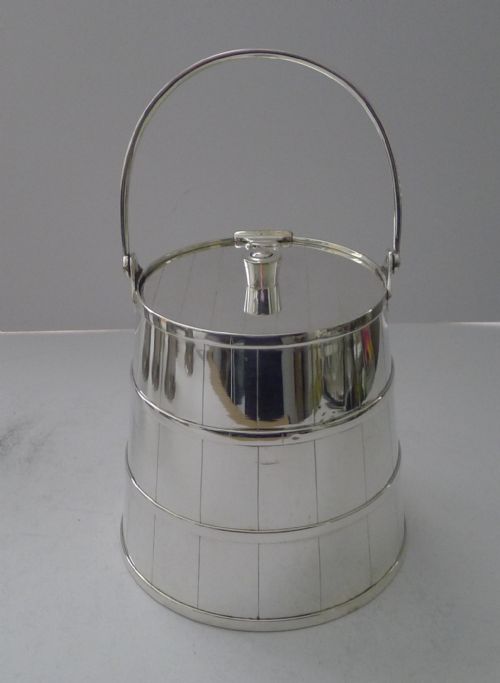


Victorian Wine Caddy
A victorian wine caddy is a functional piece for holding bottles, uniting period timber with metal fittings to serve the dining room.
Victorian Wine Caddy
When you search for a victorian wine caddy, you are looking at items designed to hold bottles for the table or sideboard. These objects encompass cellarettes, bottle holders, and coopered buckets originating from the nineteenth century.
The versions most likely to be met on this page are mahogany cellarettes of sarcophagus form alongside silver plated twin bottle holders. They draw upon Regency and Victorian styles, occasionally crossing into Edwardian periods or country house aesthetics.
Makers such as Freemans of Norwich produced notable inlaid examples, while simpler coopered oyster buckets and novelty biscuit boxes or ice buckets extend the range of vessels found in this category.
How they were made
These pieces rely heavily on solid timbers and veneers, predominantly mahogany and oak, shaped through traditional woodworking and cooperage techniques. Skilled hands built the barrels and sarcophagus bodies to house heavy glass bottles securely.
Metal components, including brass, silver plate, nickel silver, and iron, provide structural support and decorative contrast. These mounts and central shields are fixed to the wooden structures with careful joinery and metalwork.
Listings span the nineteenth century into the 1920s, featuring mahogany, oak, brass, and silver plate.
What varies in quality
The standard of timber selection and inlay work dictates the visual weight of each piece, distinguishing simple utility vessels from elaborate parlour furniture. Rich mahogany grain and precise contrasting woodwork elevate the presence of a cellarette.
The quality of the metal fittings, from heavy silver plate to cast brass handles, determines how well the object has endured. Heavier gauge metals and integrated shields point to more thoughtful initial construction.
Freemans of Norwich
The Victorian Wine Caddy Glossary
- Cellarette
- A lockable container or cabinet used to hold bottles of wine near the dining table. They frequently take a sarcophagus shape with hinged lids.
- Coopered
- Constructed from wooden staves bound together with metal hoops, a technique borrowed from barrel-making. This method creates curved vessels like oyster buckets.
- Sarcophagus form
- A monumental burial-chest shape adapted during the Regency and Victorian eras for bottle storage. These bodies sit on moulded plinths or bracket feet.
- Silver plate
- A thin layer of silver fused to a base metal such as copper or nickel silver. It gives the appearance of solid silver while providing durability for bottle holders.
- Veneer
- A thin layer of fine wood applied to a secondary timber base to create decorative surfaces. Burr walnut and mahogany veneers add rich grain patterns.
Victorian Wine Caddy: Frequently Asked Questions
What is a cellarette?
A cellarette is a lockable wooden chest designed to store and cool wine bottles near the dining table during formal meals.
They emerged in various architectural styles, often lined with lead or metal to hold ice or water for chilling.
How were bottle holders used?
Bottle holders kept wine and champagne upright and accessible on sideboards or dining tables.
Plated in silver or fashioned from brass and mahogany, they allowed hosts to pass multiple bottles easily.
How do I spot a sarcophagus form?
Sarcophagus form pieces feature heavy, tapered stone-chest profiles with domed lids and plinth bases.
Cabinetmakers adopted this classical silhouette in mahogany to project dignity and weight in dining rooms.
What is coopered construction?
Coopered construction uses curved wooden staves joined edge-to-edge to form round or oval vessels.
This traditional technique was essential for making watertight buckets and heavy bottle holders.