

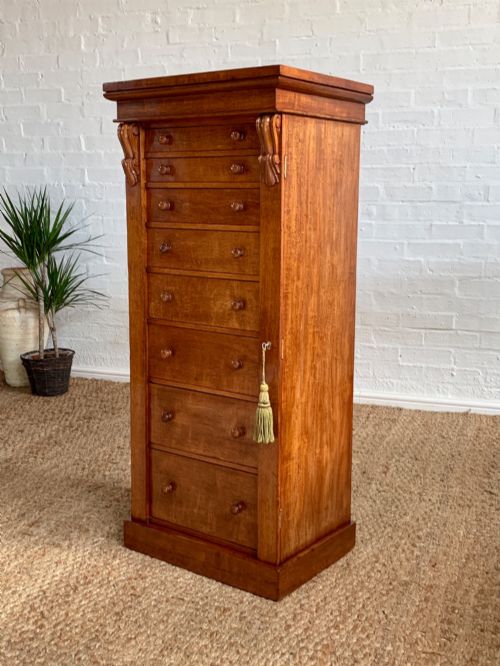
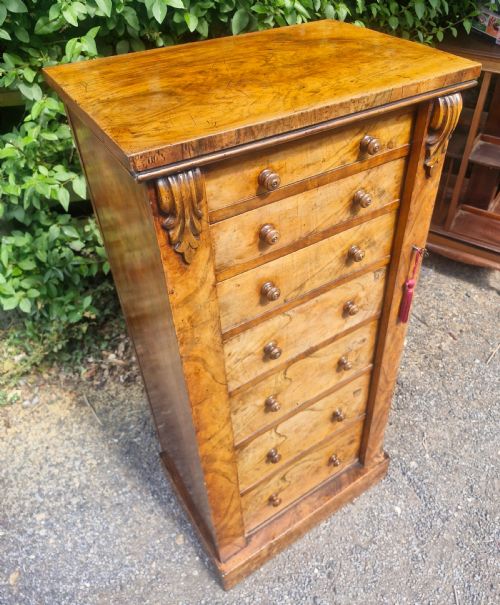
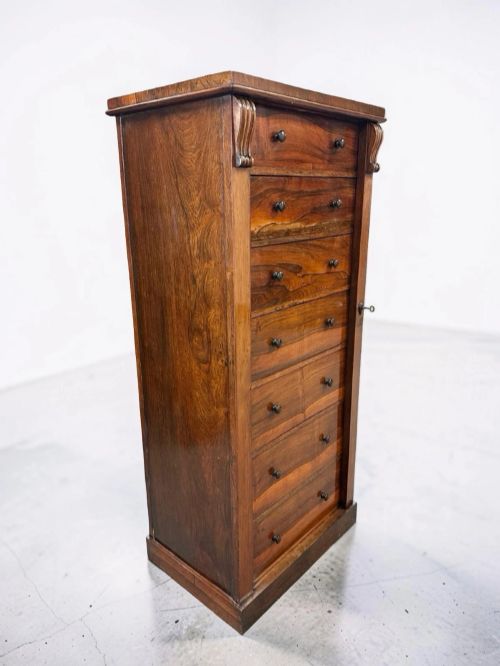
Victorian Wellington Chest Drawers
A Victorian wellington chest drawers provides a tall, narrow storage solution with a locking flap that secures all drawers at once.
Victorian Wellington Chest Drawers
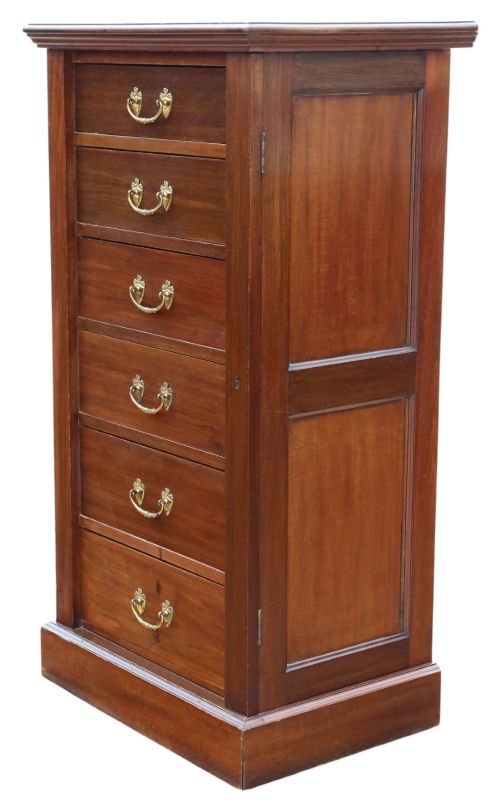
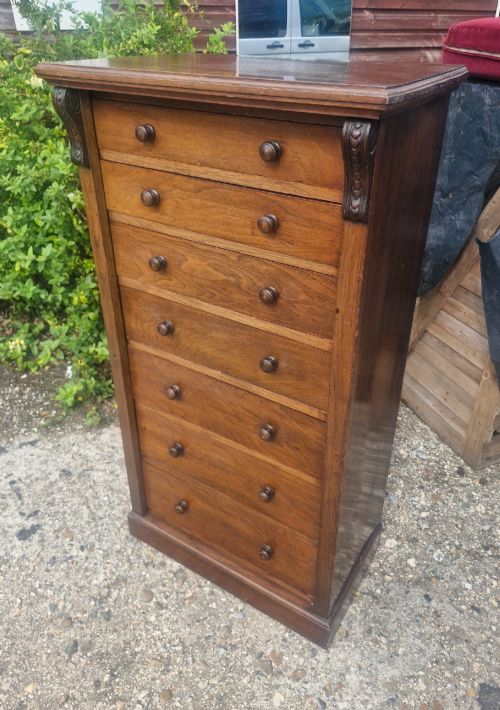
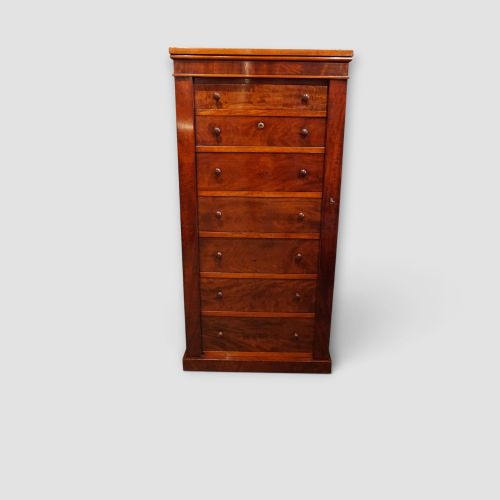
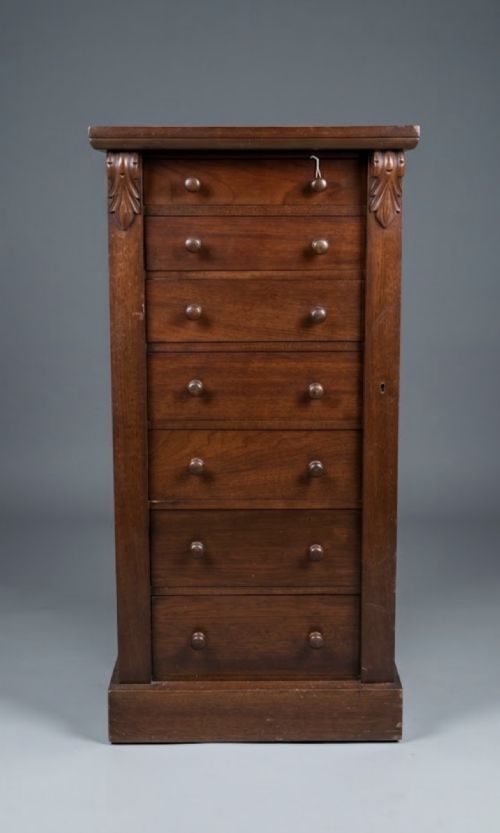
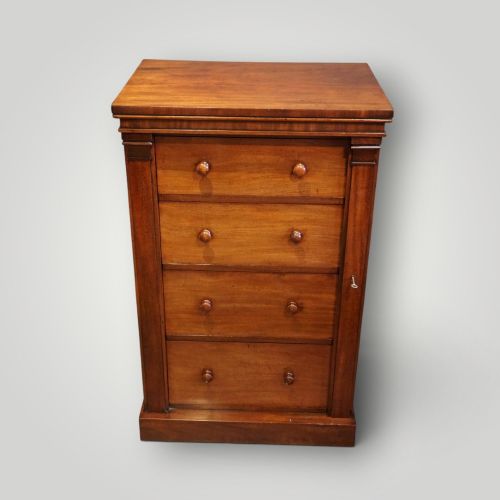
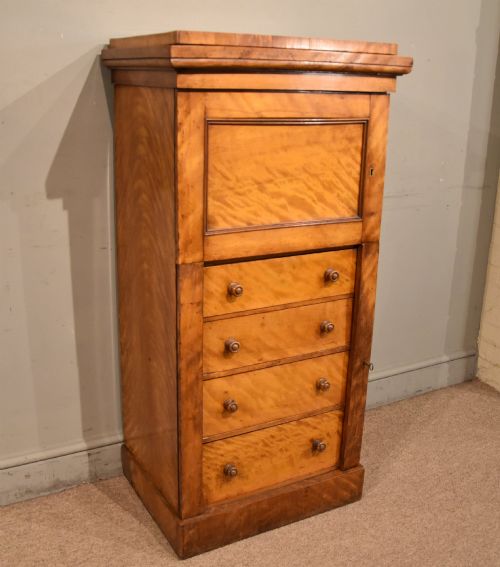
A Victorian wellington chest drawers stands as a tall, narrow case designed to maximise floor space while offering multiple tiers of storage. These pieces date predominantly from the 19th century and feature a characteristic hinged vertical locking stile on one side.
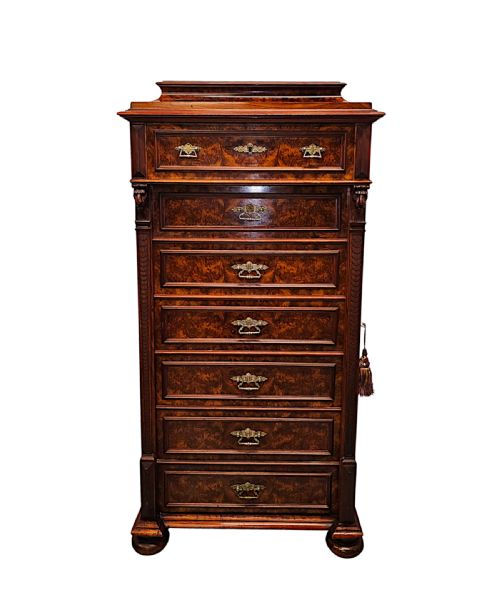
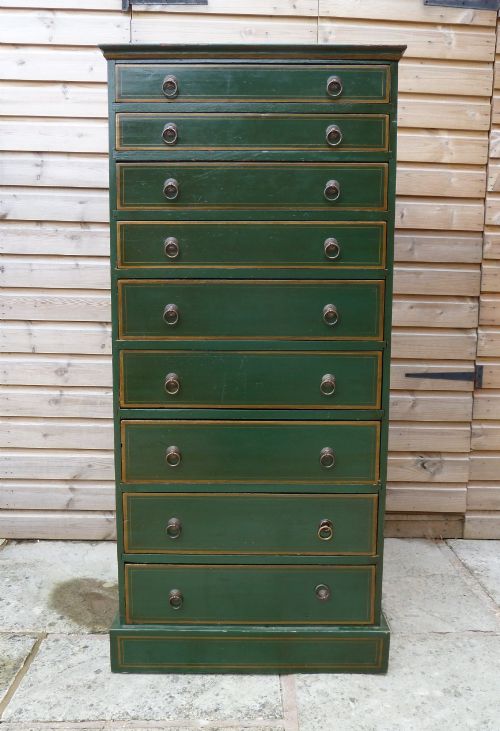
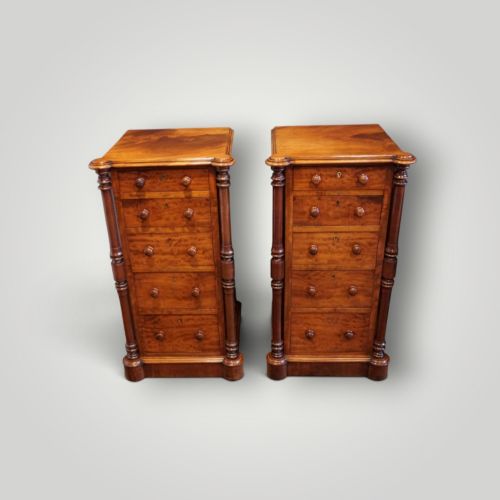
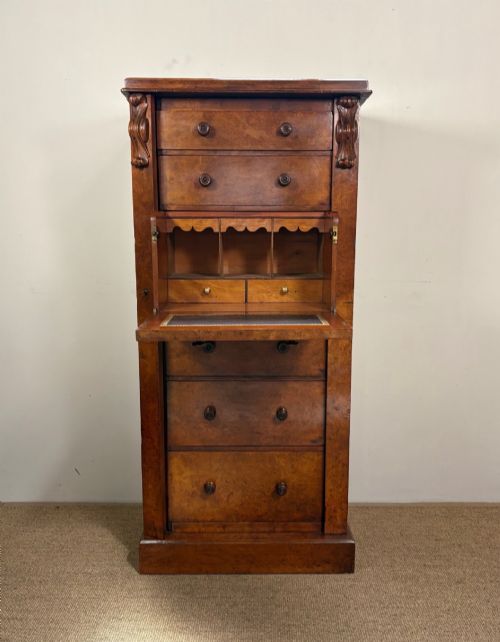
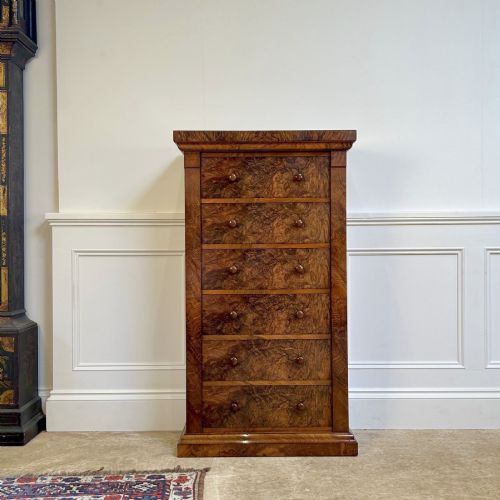
The version most commonly encountered on this page is constructed from mahogany or walnut, housing between six and seven graduated drawers. Buyers also find occasional variations configured as bedside chests, secretaire cabinets with folding writing flaps, or filing furniture.
Originating in the nineteenth century, these chests combine vertical presence with practical security. The locking mechanism requires the user to unlock the side flap before any individual drawer can be opened.
How They Were Made
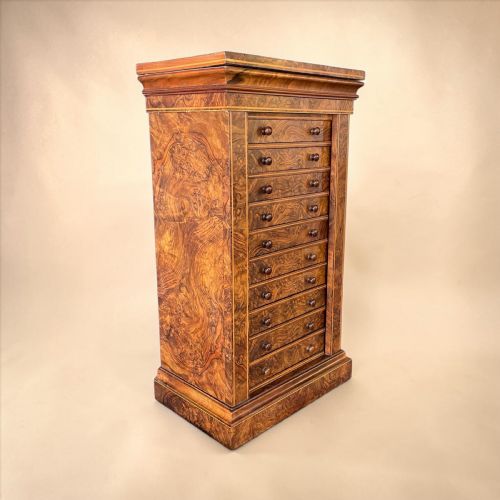
Cabinet makers utilised dense hardwoods such as mahogany, walnut, and rosewood for the exterior carcase, often applying flame mahogany or burr walnut veneers to the drawer fronts. Pine and oak served as secondary woods for the internal drawer construction and carcase linings.
Construction relied on precise joinery to house the signature locking flap, which fastens down the entire stack of drawers via a concealed keyhole. Individual drawers often featured turned wooden knobs or brass pulls, whilst finer examples incorporated marquetry inlay or carved foliate details.
Form variations range from standard tall chests of six or seven drawers down to compact bedside cabinets and secretaire desks.
What Varies in Quality
Quality rests upon the selection of timber veneers and the crispness of the secondary carving or inlay work. Grain matching across the drawer fronts and the integrity of the locking mechanism indicate the standard of original workshop production.
The presence of original turned knobs, working locks with matching keys, and secondary timbers such as oak rather than pine distinguish superior examples. Finer pieces demonstrate precise drawer tolerances and minimal restoration to the structural side stiles.
Warings Liverpool·Gillows·Holland and Sons·Shoolbred
The Victorian Wellington Chest Drawers Glossary
- Wellington Stile
- The hinged vertical locking timber on the right side of the chest that secures all drawers when locked. This member is held in place by a small key-operated lock.
- Secretaire
- A cabinet incorporating a fitted writing drawer or a drop-front flap that pulls down for correspondence. These variations often contain small internal pigeonholes and stationery drawers.
- Burr Walnut
- A highly figured timber veneer sliced from the knot growths of walnut trees. Cabinet makers prized this material for its swirling patterns on primary display surfaces.
- Graduated Drawers
- A series of drawers that decrease in depth progressively from the bottom to the top of the chest. This arrangement provides stability of appearance on tall case furniture.
- Marquetry
- Decorative patterns formed by fitting together contrasting pieces of wood veneer into a surface design. Craftsmen utilised floral motifs and geometric arrangements on select Victorian panels.
Victorian Wellington Chest Drawers: Frequently Asked Questions
How do you lock a wellington chest?
The locking process requires turning the key in the side stile to release or secure the hinged wooden flap. Once the flap swings open or removes entirely, the individual drawers slide outward.
When the flap is closed and locked back against the carcase frame, it blocks the drawer lips and prevents any drawer from opening.
Where were these chests used?
Bedrooms and dressing rooms served as the primary locations for these tall chests, providing deep vertical storage without occupying wide floor space. Their narrow footprint also suited smaller parlours and studies.
Filing variations and secretaire models appeared more frequently in home offices or libraries for managing correspondence and documents.
How do you date a Victorian chest?
Dating relies on examining the secondary timbers, construction methods, and prevailing decorative styles seen across the 19th century. Earlier examples often show solid mahogany linings, whilst late Victorian pieces frequently incorporate pine or oak with machine-cut elements.
Inlay styles, handle designs, and veneer choices provide additional clues to narrow down the decade of manufacture between 1850 and 1900.
Can these chests be used as bedside tables?
Smaller variations and dedicated bedside chests function well beside larger bed frames, offering surface space alongside deep drawer storage. Their vertical orientation matches the height of traditional Victorian bed frames.
Buyers should check the specific height dimensions of each piece to ensure clearance alongside modern mattress levels.