
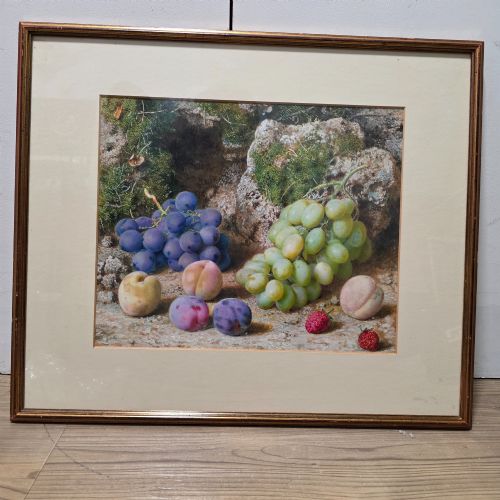


Victorian Watercolour Still Life
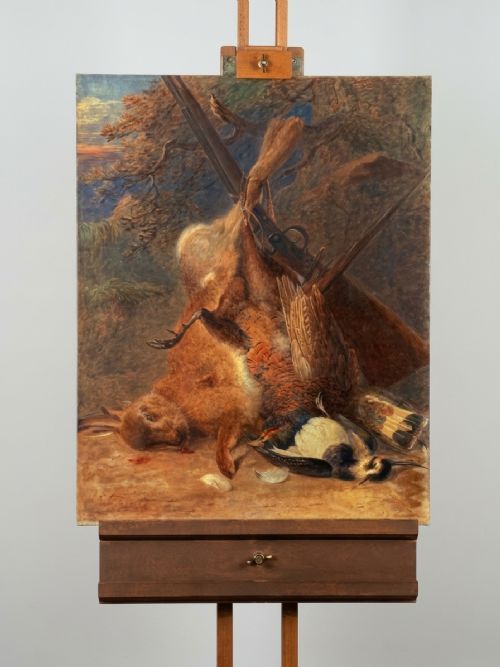
A victorian watercolour still life brings together botanicals, fruit, and domestic objects painted with delicate precision on paper.
Victorian Watercolour Still Life
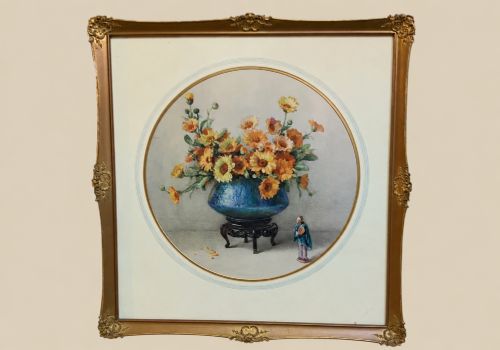
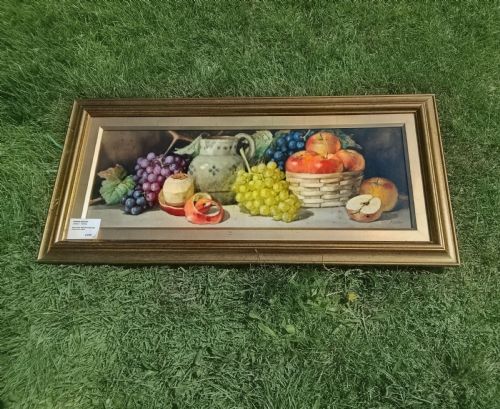
A victorian watercolour still life presents carefully arranged subjects such as garden flowers, wild blossoms, fruit, and Chinese objects on paper. These paintings capture natural forms with a focused attention to detail, ranging from single stems to elaborate arrangements in baskets and vases.
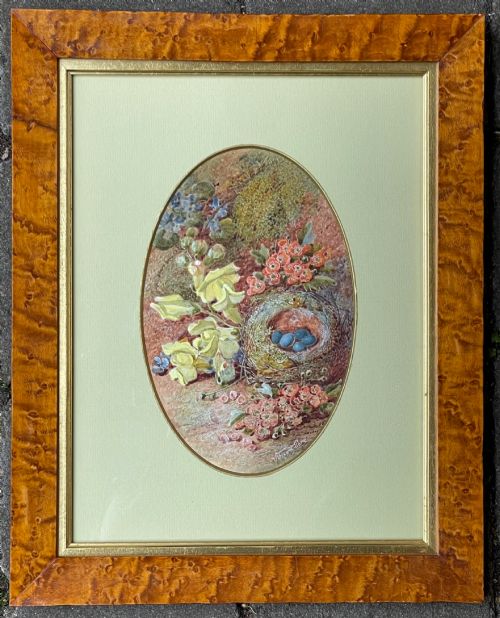
The versions most commonly met on this page date from the nineteenth century, executed within the Victorian period and extending into the early twentieth century. Works frequently depict floral studies of roses, primroses, and pelargoniums alongside compositions featuring birds' nests and fruit.
The scale of these paintings varies from intimate miniatures to exhibition size works. Many retain their original framing of wood and gilded wood, often protected beneath glass to preserve the delicate pigment.
Materials and execution
Artists painted primarily using watercolour pigment on paper, occasionally incorporating bodycolour or pencil to build opacity and definition. The technique relies on translucent washes of colour layered to achieve depth and luminosity.
Finished works were mounted behind glass and housed in wooden frames, frequently enhanced with gold leaf. This framing protected the works from moisture and light exposure while complementing the aesthetic styles of the period.
Several still lifes feature birds' nests nestled among mossy banks, bringing a woodland floor directly onto the drawing room wall.
Assessing quality and execution
Quality in a victorian watercolour still life rests upon the control of pigment, the precision of botanical rendering, and the balance of the composition. Skilled artists handled light and shadow to give tactile realism to fruit surfaces, petals, and mossy banks.
The distinction between standard studies and finer works lies in the handling of detail and structural confidence. Stronger pieces demonstrate meticulous brushwork that defines texture without losing the fluid transparency characteristic of the medium.
George Sydney Shepherd·Vincent Clare·Arthur Dudley·John Sherrin·Henrietta Creswell·Lester Sutcliffe·William Hough·Eloise Harriet Stannard·Edith Barrow·Grace Hastie·Marian Chase·Jabez Bligh·Annie Mary Youngman·Helen Cordelia Angell·Wiliam Stephen Coleman·James T Clapham
The Victorian Watercolour Still Life Glossary
- Watercolour pigment
- Colouring material ground with a water-soluble binder, applied in translucent washes on paper. This medium allows artists to build luminous layers of colour.
- Bodycolour
- An opaque watercolour paint containing white pigment added to create solid highlights and dense areas. It provides contrast against transparent washes.
- Gilded wood
- Timber frames finished with a thin layer of gold leaf or metallic powder. This treatment was standard for framing fine art in the nineteenth century.
- Botanical
- A representation focused on the accurate depiction of plant species, flowers, and foliage. Such studies combine artistic skill with scientific observation.
Victorian Watercolour Still Life: Frequently Asked Questions
How should I hang these watercolours?
Keep watercolours away from direct sunlight to prevent the pigments from fading over time. Hanging them on interior walls with stable light levels protects the paper and the surrounding frame.
Ensure the room maintains moderate humidity levels to avoid warping the paper or damaging the underlying materials within the frame.
Are these paintings original?
The pieces listed are original works painted by hand during the nineteenth and early twentieth centuries. Each watercolour represents a unique composition executed directly by the artist on paper.
Signatures, dates, and stylistic markers help establish authenticity, distinguishing original paintings from later reproductions.
What subjects are most common?
Floral arrangements dominate the subjects, featuring roses, pelargoniums, primroses, and wallflowers painted from life. Fruit studies including grapes, apples, and plums also appear frequently.
Some compositions incorporate decorative items like Chinese objects or baskets, placing natural specimens within domestic settings.
How do I identify the period?
Period identification relies on the paper type, framing materials, and artistic conventions typical of the nineteenth century. Stylistic movements such as Victorian naturalism and the aesthetic movement provide further clues.
Signatures and inscribed dates on the mounts or reverse of the frames often confirm the exact decade of creation.