




Victorian Walnut Vanity Case
These Victorian walnut vanity case examples are fitted travelling boxes designed for personal grooming and jewellery, offering a glimpse into nineteenth-century life.
Victorian Walnut Vanity Case
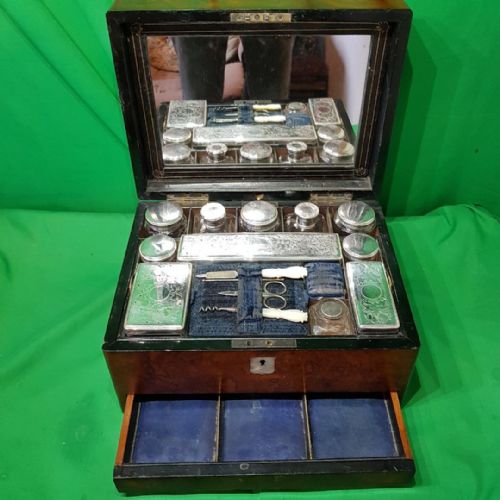
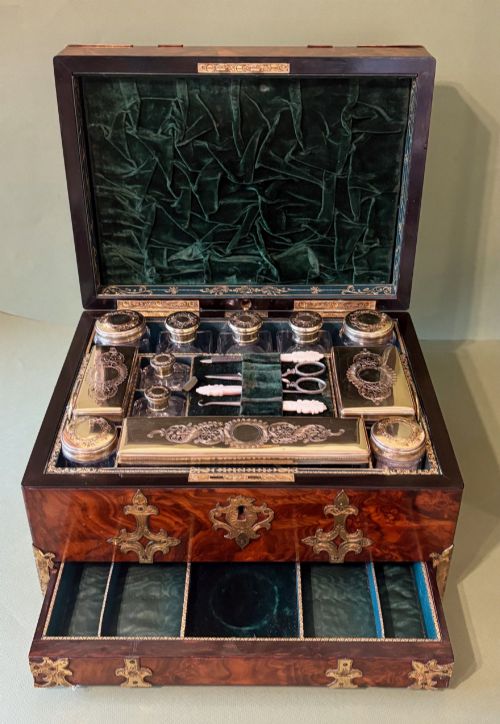
A victorian walnut vanity case is a fitted travelling box designed to hold jewellery, cosmetics and personal grooming items during transit or for use upon a dressing table. These boxes appear in various forms across the listings, including dressing cases, jewellery boxes and workboxes.
The pieces on this page originate predominantly from the Victorian period, with specific dates spanning from the mid to late nineteenth century alongside examples attributed more broadly to the nineteenth century and the Georgian era.
Buyers will encounter distinct variants such as brass-bound travelling cases, Gothic Revival sewing cases and fitted dressing boxes featuring internal mirrors and compartments.
Materials and construction
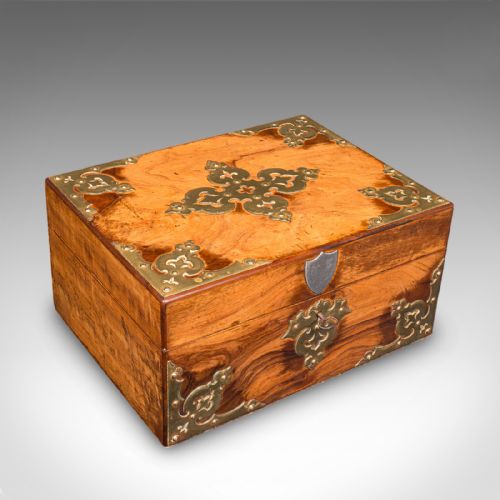
Cabinet makers utilised walnut and burr walnut for the exterior carcasses, often highlighting the natural figure of the wood alongside decorative inlays of mother of pearl and brass banding for structural reinforcement.
Interiors were lined with luxurious textiles such as silk and velvet to protect delicate items, and fitted with compartments, glass containers and silver accessories.
Victorian Walnut Vanity Case Retail Price Guide 2026
Typical asking prices for victorian walnut vanity case among the pieces listed under this phrase on Sellingantiques today, from the lower quarter to the upper quarter. They describe what is for sale here now, not the wider market.
Listings feature walnut alongside decorative materials including brass, silver, glass, mother of pearl, velvet, and silk.
Judging quality
The distinction between standard examples and superior pieces rests upon the complexity of the internal fittings, the choice of burr figure in the walnut veneer, and the presence of original silver or glass components.
Boxes bearing maker signatures, such as those from established London furnishers, demonstrate finer attention to detail in their brass hardware and secret drawers compared to anonymous work.
Parkins and Grotto
The Victorian Walnut Vanity Case Glossary
- Burr walnut
- A prized timber harvested from the burl growth of the walnut tree, showing intricate and swirling grain patterns. It was frequently employed on the exterior lids and panels of high-status nineteenth-century boxes.
- Dressing box
- A portable container fitted with compartments for toiletries, cosmetics, and writing materials. Many versions include a folding mirror set into the lid.
- Gothic Revival
- An architectural and decorative style popular during the Victorian era that drew inspiration from medieval forms. In boxes, this is often expressed through pointed arches, heavy brass mounts, and austere lines.
- Mother of pearl
- An iridescent inner shell layer used by craftsmen to create geometric inlays or escutcheons on box lids. It provides a contrasting shimmer against dark walnut.
Victorian Walnut Vanity Case: Frequently Asked Questions
What is inside a vanity case?
These boxes typically contain a fitted interior with velvet or silk linings designed to hold jewellery, grooming tools, and small bottles.
Many examples also incorporate hidden compartments, writing surfaces, and mirrors set into the underside of the lid.
How do I date a walnut box?
Dating relies on stylistic markers, construction methods, and materials associated with the nineteenth century. The presence of specific brass hardware or maker signatures often helps narrow the timeframe.
Design influences, such as Gothic Revival motifs or plain brass binding, provide further clues to whether a piece belongs to the mid or late Victorian era.
Were these boxes for men or women?
While many surviving examples are described as lady's travelling sets or jewellery cases, gentlemen also used fitted vanity boxes for shaving equipment and grooming accessories.
The internal layout usually reveals the intended user through the specific shapes of the compartments and glass containers.
How should I care for burr walnut?
Burr walnut benefits from being kept away from direct sunlight and sudden changes in temperature to prevent the delicate veneer from lifting.
Applying a suitable wax polish occasionally helps maintain the lustre of the timber without damaging the historic finish.