




Victorian Walnut Tier Server
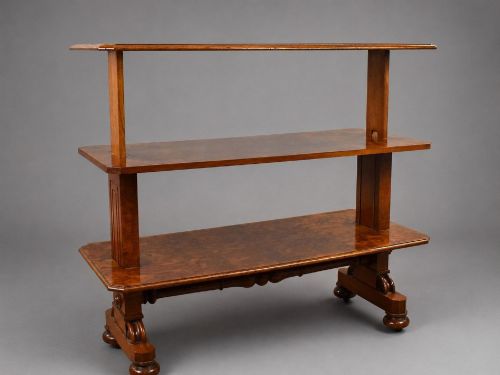
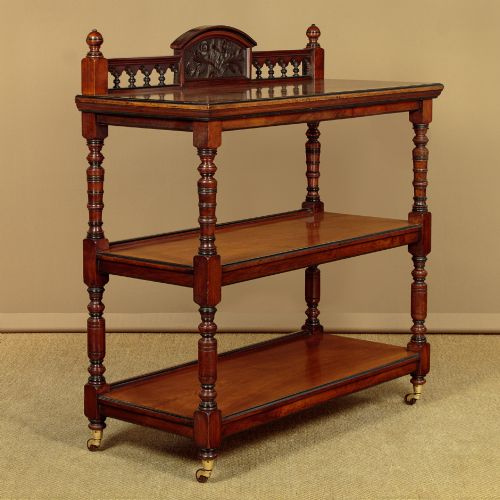
These Victorian walnut tier servers are practical multi-tiered serving pieces in rich timber, designed to hold dishes and music with quiet Victorian elegance.
Victorian Walnut Tier Server
When you search for a victorian walnut tier server, you find tiered serving furniture mostly originating from the Victorian and Edwardian eras. These pieces appear as multi-tiered dumbwaiters, buffets, serving tables, and specialised music cabinets.
How they were made
Joiners built these tier servers primarily using solid walnut and highly figured burr walnut veneers, which show rich natural grain patterns across the tiers. Workshops incorporated brass mechanism components to create telescopic and fully adjustable tier functions.
Makers utilised ebonised wood for contrasting detail on certain frames, alongside carved elements seen in Gothic Revival pieces. Glass surfaces and specialised cabinetry compartments also appear in related music cabinets and serving tables.
Victorian Walnut Tier Server Retail Price Guide 2026
Typical asking prices for victorian walnut tier server among the pieces listed under this phrase on Sellingantiques today, from the lower quarter to the upper quarter. They describe what is for sale here now, not the wider market.
Current listings feature walnut and burr walnut tier servers spanning the Victorian, Edwardian, and nineteenth-century periods, including Aesthetic Movement and Gothic Revival styles.
What varies in quality
The distinction between standard examples and finer pieces rests in the quality of the timber selection and the complexity of the mechanism. Highly figured burr walnut surfaces and smoothly operating telescopic brass adjustments elevate a piece above simpler fixed designs.
Design ambition also separates the range, with Aesthetic Movement and Gothic Revival interpretations showing more sophisticated carving and joinery than plain utility servers. The integrity of the original structure dictates the lasting standing of each tier.
The Victorian Walnut Tier Server Glossary
- Burr walnut
- A veneer sliced from walnut tree growths, producing intricate, swirling grain patterns. It adds distinct visual depth to the surface of table tiers.
- Dumbwaiter
- A multi-tiered serving piece used to hold food or tableware without needing extra servants at the table. Victorian examples often feature adjustable tiers.
- Aesthetic Movement
- A late nineteenth-century design style focusing on visual beauty rather than narrative meaning. Pieces in this style feature refined lines and artistic timber selection.
- Gothic Revival
- An architectural and furniture style drawing on medieval forms, featuring pointed arches and heavy carved detail. Walnut buffets in this style display robust structural carving.
- Telescopic
- A mechanical property allowing upright sections and tiers to extend in height. This mechanism relies on brass fittings concealed within the central column.
Victorian Walnut Tier Server: Frequently Asked Questions
What is a Victorian walnut tier server used for?
These tiered walnut pieces served primarily as dining room helpers to hold extra dishes, glassware, and serving items.
Some variants functioned as specialised music cabinets or serving tables to accommodate household leisure activities.
How do I identify a Victorian piece?
Look for timber choices like solid walnut and burr walnut, alongside stylistic cues from the nineteenth century.
Details such as brass mechanisms, ebonised wood accents, and Gothic Revival carving help confirm the period.
Are these servers adjustable in height?
Many examples feature telescopic columns that allow the tiers to adjust vertically through brass mechanisms.
Fixed multi-tier designs also exist alongside these fully adjustable buffet variants.
How do I care for walnut tiers?
Keep the timber away from direct heat sources and excessive moisture to protect the walnut and burr walnut surfaces.
Dust gently with a dry cloth and polish sparingly with traditional wax suited to antique wood.