

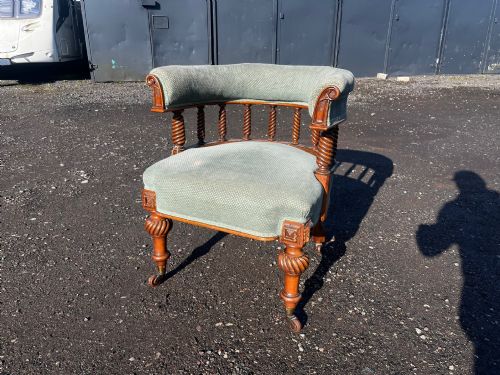
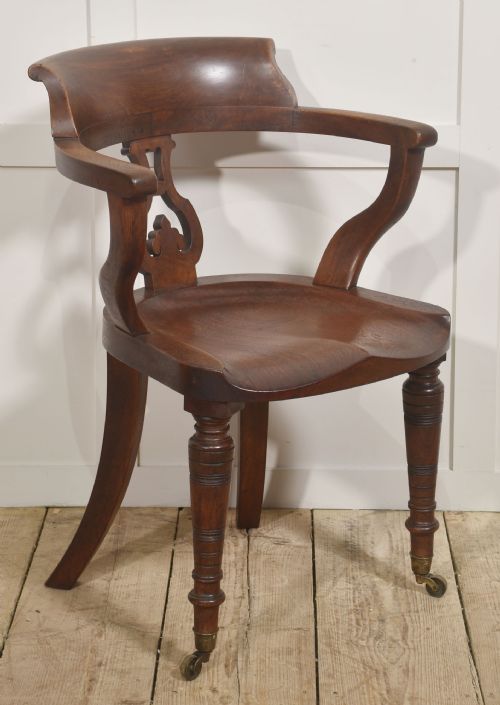


Victorian Walnut Office Chair
These Victorian walnut office chair pieces are sturdy desk seats built for hard work, offering swivel mechanisms and leather upholstery to any traditional study.
Victorian Walnut Office Chair
When you search for a victorian walnut office chair, you look at robust seating designed for nineteenth-century studies and libraries. The selection spans the period from eighteen-sixty to nineteen-hundred, capturing an era of expanding commercial and domestic workspaces.
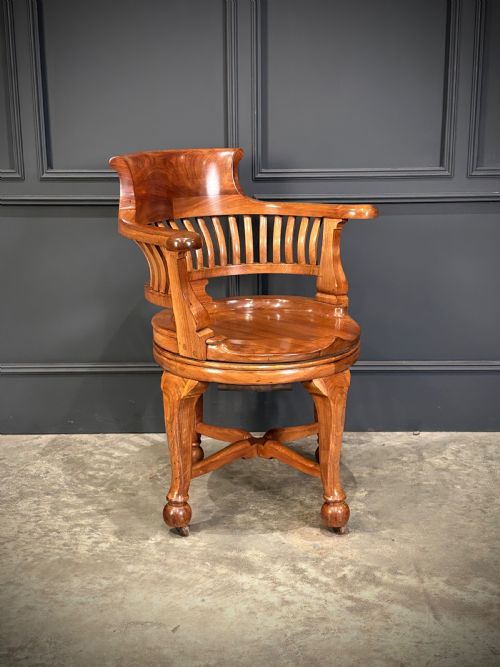
The dominant forms you encounter on this page are revolving desk chairs, armchairs, and captains chairs. Many examples incorporate swivel mechanisms and bow backs, while others appear as pairs or stationary desk armchairs.
Materials and construction
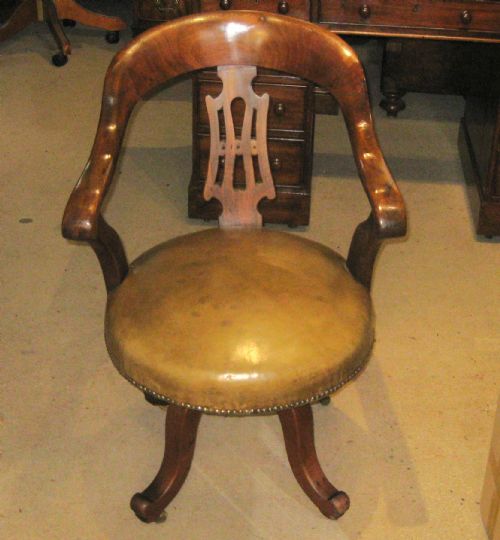
These pieces rely primarily on solid walnut and burr walnut frameworks, paired with leather, red leather, or burgundy leather upholstery. Makers also utilised oil cloth for swab cushions.
Internal and structural support incorporates brass, iron, and cast iron, particularly within the swivel and revolving mechanisms. Textile and metal elements appear alongside the primary wood and leather construction.
Listings feature walnut, brass, iron, and leather across desk chairs, armchairs, and swivel formats spanning the Victorian era.
Distinctions in quality
Quality reveals itself in the depth of the carved walnut framework and the integrity of the swivelling and revolving mechanisms. Finer examples display careful joinery and substantial timber selection.
The finish of the leather upholstery and the inclusion of original cast iron or brass hardware elevate certain pieces above standard utility seating.
Boston Chair Company·Howard & Son's
The Victorian Walnut Office Chair Glossary
- Walnut
- A dense, dark hardwood utilised extensively for nineteenth-century furniture framing and cabinetry. It provides both strength and rich grain patterns.
- Swivel
- A rotating mechanism allowing the seat to turn independently of the base. This engineering element is common in desk chairs from the latter half of the nineteenth century.
- Captain's Chair
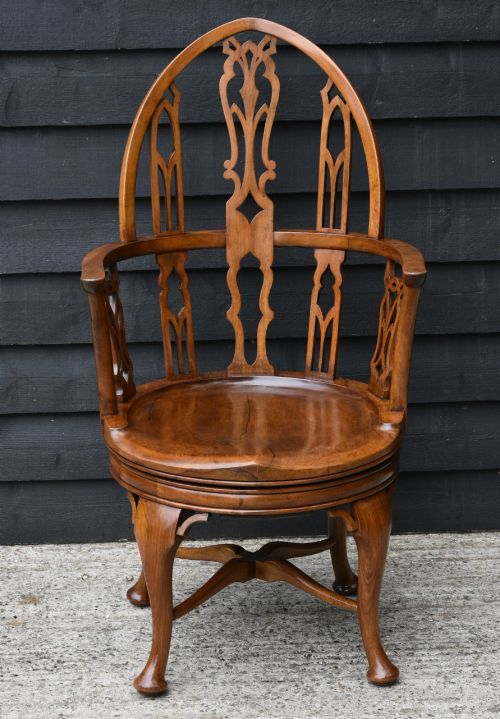
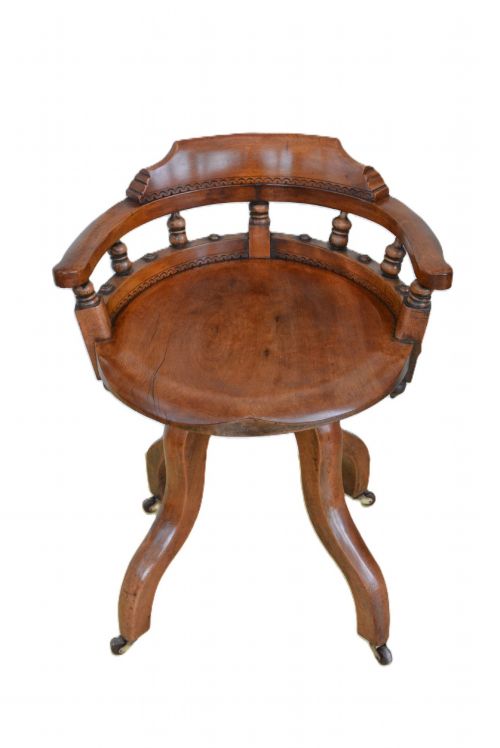
- A low-backed armchair traditionally used in offices and libraries. These seats often feature curved wooden backs supported by spindles.
- Gothic Revival
- An architectural and decorative style drawing inspiration from medieval design. Pieces in this manner display pointed arches and characteristic ecclesiastical motifs.
- Aesthetic Movement
- A late nineteenth-century design current emphasising visual beauty over narrative content. Furniture from this circle values refined lines and artistic craftsmanship.
Victorian Walnut Office Chair: Frequently Asked Questions
What is a revolving desk chair?
A revolving desk chair is a seat equipped with a central pivot mechanism allowing rotation.
These pieces were engineered to give nineteenth-century workers easy access to different parts of a workspace.
How do I identify the period?
Period identification relies on material choices, hardware styles, and construction methods.
Pieces from this range generally date between eighteen-sixty and nineteen-hundred, often marked by walnut frames and cast iron swivel mechanisms.
Where were these chairs used?
These chairs were primarily utilised in professional offices, libraries, and home studies.
Their robust design accommodated long hours of administrative work and reading.
How do I care for leather upholstery?
Leather upholstery requires regular dusting and occasional conditioning to maintain suppleness.
Keeping the material away from direct heat sources prevents cracking over time.