
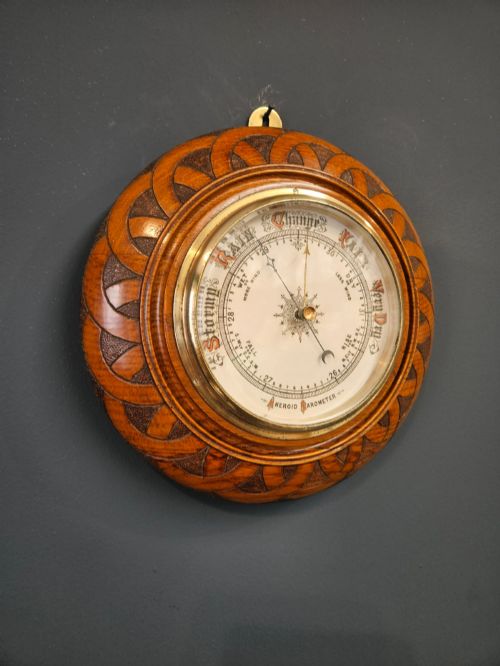
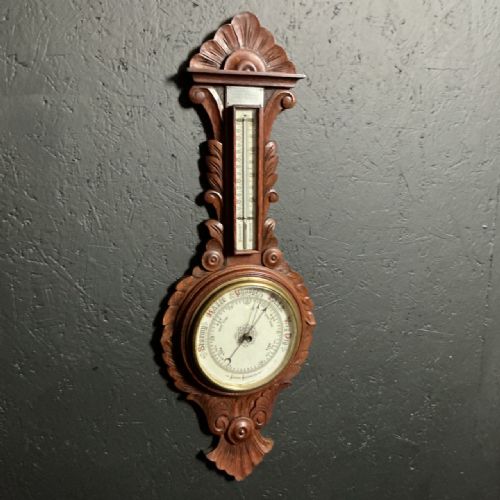

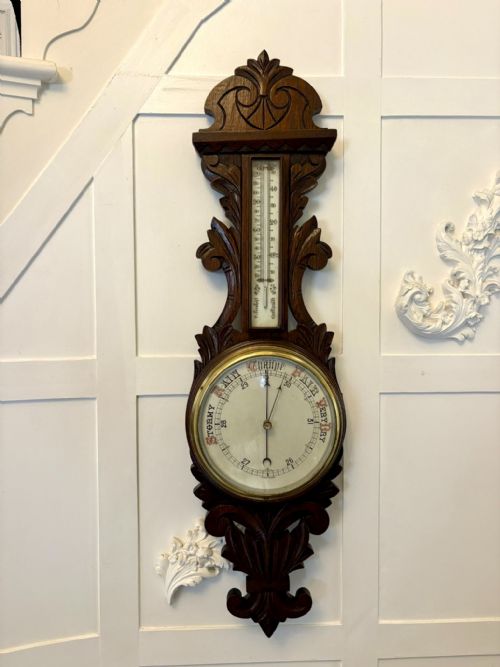


Victorian Wall Hanging Barometer
These victorian wall hanging barometer pieces combine nineteenth-century scientific utility with rich cabinet-making traditions, bringing both practical weather-reading and striking timber into a room.
Victorian Wall Hanging Barometer
A victorian wall hanging barometer serves as both a practical meteorological instrument and a substantial piece of interior woodwork. The selections span from the Victorian and Edwardian eras, reaching from the mid-nineteenth century into the early twentieth century.
Banjo and stick configurations dominate the offerings, frequently incorporating Fahrenheit thermometers alongside the main dial. Timber surrounds range from figured mahogany and rich rosewood to carved oak and walnut.
Regional British makers and continental workshops produced these pieces to monitor atmospheric pressure in domestic halls and libraries. The examples present varied decorative schemes, from austere maritime designs to deeply carved Black Forest foliage.
Materials and Construction
Cabinet makers utilised dense domestic and exotic timbers such as oak, mahogany, walnut, and rosewood to house the delicate brass movements. Selected pieces feature intricate hand-carving, bone inlay, or mother-of-pearl details set flush into the timber surrounds.
The internal mechanics rely upon traditional mercury columns or sealed aneroid capsules linked to visible brass dials behind protective bevelled glass. Heavy turnedbezels and secure wall-mounting brackets ensure the instruments hang plumb for accurate atmospheric readings.
The listings demonstrate a strong prevalence of carved oak and mahogany, spanning Victorian banjo and stick barometer configurations.
Judging the Workmanship
The distinction between standard domestic instruments and exceptional examples lies primarily in the depth and crispness of the timber carving. Elaborate case work, such as the naturalistic foliage found on Black Forest frames, demands superior joinery and finishing.
Signed dials bearing the names of established instrument makers command greater attention than unsigned retail stock. The integrity of the original mercury tube or aneroid mechanism, paired with undamaged glass and legible engraved scales, defines the preservation standard.
Maple & Co·Negretti & Zambra·James Pitkin London·J Groce York·S P Cohen
The Victorian Wall Hanging Barometer Glossary
- Aneroid barometer
- An instrument that measures atmospheric pressure by the expansion and contraction of a flexible metal capsule inside a sealed box, dispensing with liquid mercury. This design allowed for more compact and varied wall-hanging cabinet shapes.
- Stick barometer
- A tall, narrow instrument featuring an exposed vertical glass tube filled with mercury against an engraved scale. These pieces provide a direct, traditional reading of barometric pressure.
- Banjo barometer
- A domestic wall barometer shaped broadly like a banjo, typically housing a dial at the base and a thermometer along the vertical neck. This silhouette proved popular throughout the Victorian period for domestic hallways.
- Wheel barometer
- A dial barometer operated by a float on the mercury surface connected to a pointer by a silk thread and pulley wheel. Such instruments often include supplementary hygrometers or spirit thermometers.
- Bezel
- The brass or wooden ring that holds the protective glass cover in place over the barometer face. Quality examples feature hinged brass bezels with secure latches.
Victorian Wall Hanging Barometer: Frequently Asked Questions
How do I read a stick barometer?
Observe the height of the mercury column inside the vertical glass tube against the engraved scale divisions. Rising levels generally indicate fair weather, while falling mercury points toward approaching rain or wind.
Tap the wooden frame gently before reading to ensure the mercury column has not stuck in the glass tube due to friction. Compare the vernier scale settings to track changes in atmospheric pressure over consecutive hours.
Can I hang a barometer on an outside wall?
Keep these instruments on interior walls away from direct sunlight, radiators, and draughty doorways. Extreme temperature fluctuations can damage the internal mechanics and warp the wooden cases.
Interior placement ensures the sensitive brass mechanisms and timber surrounds remain stable over decades. A secure wall fixing is essential to support the substantial weight of the hardwood case and glass dial.
How do I tell an aneroid from a mercury barometer?
Aneroid models display readings on a circular dial face with a rotating pointer, much like a traditional clock. They contain no visible liquid columns and can be mounted safely in various orientations.
Mercury instruments feature a vertical glass tube where the liquid rises and falls visibly against a numbered scale. These traditional pieces must remain strictly vertical to function correctly and require careful handling if moved.
Did Victorians calibrate these instruments for weather forecasting?
Domestic barometers served as standard household furniture intended to help predict local weather changes for farming and travel. The engraved dials often feature descriptive text such as 'Change', 'Rain', and 'Fair' to guide daily observations.
Owners adjusted the secondary pointer manually to track whether pressure rose or fell since the previous check. This practical function made them essential fixtures in nineteenth-century hallways and libraries.