
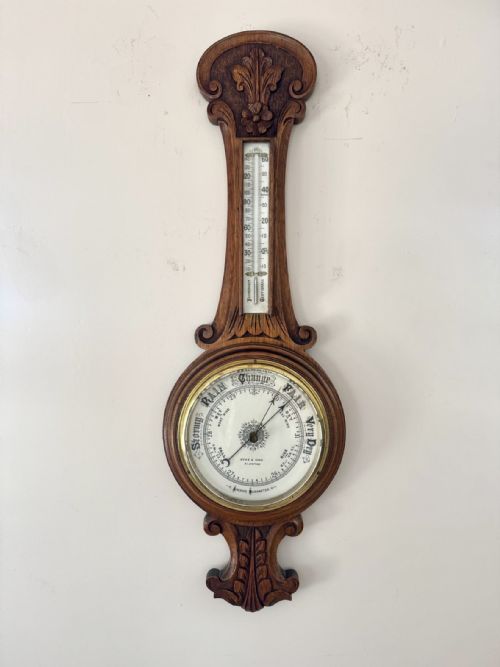
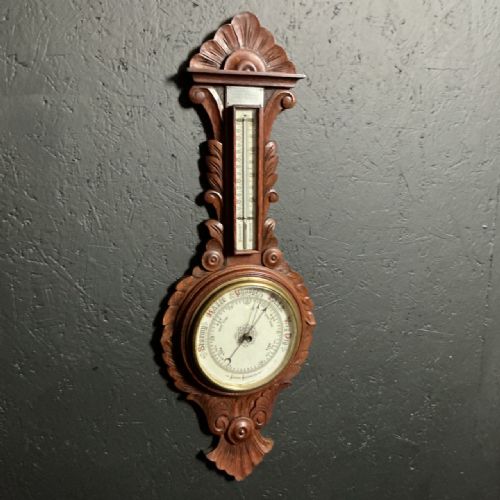
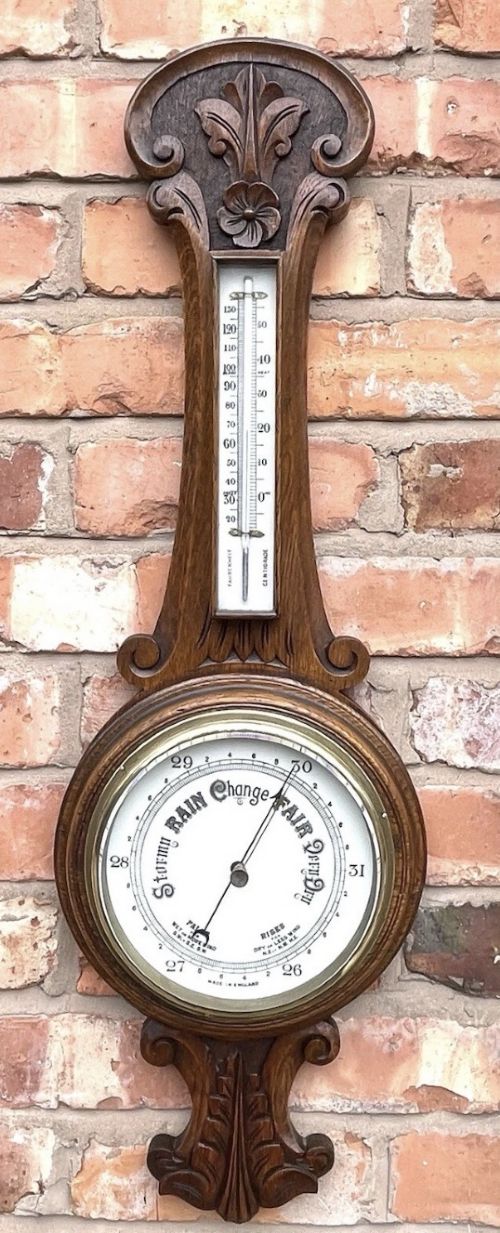


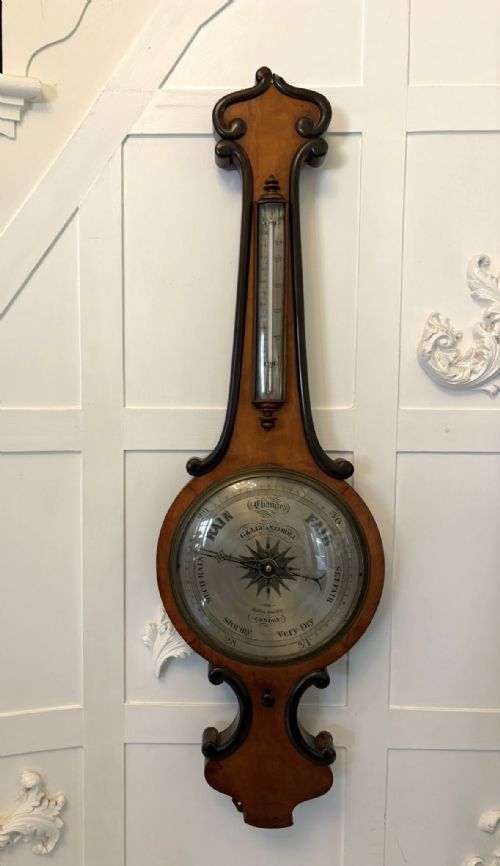
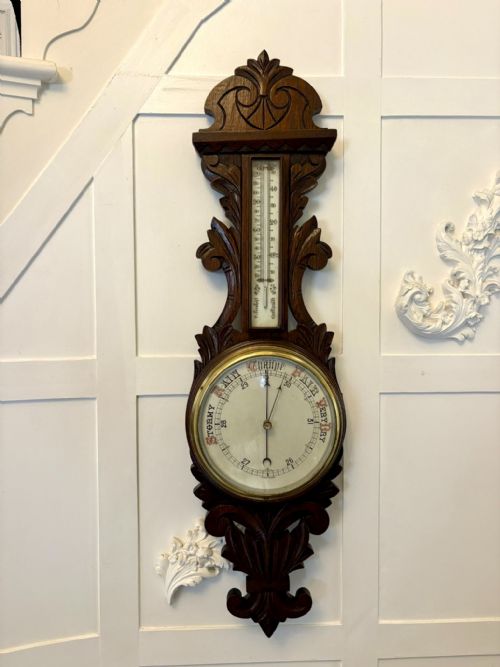


Edwardian Carved Barometer
These edwardian carved barometers measure atmospheric pressure with precision while displaying the rich wood carving characteristic of the period.
Edwardian Carved Barometer
An edwardian carved barometer is a domestic weather glass housed in a decorative wooden wall case, designed to monitor pressure changes while acting as a prominent interior fixture. The pieces seen most frequently on this page take the form of the banjo barometer, combining a dial face with a thermometer mounted on an elongated wooden stem.
Makers from the era utilised seasoned timbers to frame the delicate instruments, often incorporating architectural mouldings or foliate carvings into the surround. These wall-hanging instruments served both a practical domestic function and a decorative role in middle-class and grander homes alike.
How they were made
Cabinetmakers worked primarily with solid oak, walnut, and mahogany, shaping the timber housings through sawing, turning, and hand-carving. The wooden cases accommodated either aneroid movements, which operated via a sealed metal vacuum capsule, or mercurial tube systems that responded directly to liquid pressure.
Dials were protected beneath bevelled or flat glass panels, frequently framed in spun brass bezels. Carved details such as birds, scrolls, or rope-twist borders were executed by hand directly onto the timber frames before French polishing or waxing.
Edwardian Carved Barometer Retail Price Guide 2026
Typical asking prices for edwardian carved barometer among the pieces listed under this phrase on Sellingantiques today, from the lower quarter to the upper quarter. They describe what is for sale here now, not the wider market.
What varies in quality
The distinction between standard domestic pieces and superior examples lies in the depth and crispness of the timber carving. Elaborate cases adorned with sculpted birds or intricate marquetry inlay reflect greater workshop investment than plain circular frames.
The reputation of the instrument maker also determines distinction, with signed dials from established scientific instrument firms indicating higher precision and superior mechanical execution.
Hyde And Sons Sleaford·G And L Guanziroli London·Negretti And Zambra·J Hicks Of London
The Edwardian Carved Barometer Glossary
- Aneroid barometer
- An instrument that measures atmospheric pressure using a flexible metal vacuum capsule rather than liquid mercury. It responds to pressure shifts by moving a mechanical pointer across a graduated dial.
- Banjo barometer
- A wall-mounted weather instrument shaped somewhat like a stringed instrument, featuring a circular dial at the base and a long thermometer shaft extending upward. This form dominated British hallways through the Victorian and Edwardian eras.
- Stick barometer
- A tall, narrow wall instrument that houses a vertical glass tube filled with mercury to display barometric pressure. These offer a direct view of the fluid column without dial linkages.
- Admiral Fitzroy storm barometer
- A large mercurial barometer designed to assist fishermen and sailors by predicting gales through marked scales and an attached thermometer. They were produced in substantial quantities following government endorsement in the nineteenth century.
- Bezel
- The metal ring that holds the protective glass face in position over the barometer dial. It is often hinged to allow access for setting the pointer.
Edwardian Carved Barometer: Frequently Asked Questions
How do aneroid barometers work?
An aneroid barometer contains a corrugated metal box from which air is partially exhausted, allowing the thin metal walls to flex inward or outward as atmospheric pressure rises or falls. A system of delicate levers and springs connects this expanding capsule to the pointer on the dial face.
Changes in weather push or release the metal chamber, translating microscopic movements into visible shifts on the graduated paper or metal scale behind the glass.
Where should I hang a wall barometer?
Wall barometers require stable interior locations away from direct sunlight, central heating radiators, and damp external walls. Sudden temperature shifts can alter the metal components or the mercury column independently of actual barometric pressure.
Solid interior partitions or hallway walls provide the most reliable environment for maintaining calibration and protecting the polished wooden case from environmental stress.
How do I read a weather dial?
Reading the instrument involves tapping the glass lightly to settle any friction in the mechanical linkages before noting the position of the main black pointer. A second, manually adjustable brass pointer is then aligned directly over this primary needle to track whether pressure rises or falls over subsequent hours.
Printed descriptors around the dial edge such as rain, change, or fair indicate general atmospheric tendencies rather than absolute weather certainties.
Are these instruments still accurate?
Most antique aneroid and mercurial barometers retain their functional capability if the internal mechanics remain intact and uncorroborated by damp. They can be calibrated against known local pressure readings using the small adjustment screw typically located on the rear or through the dial face.
While digital alternatives offer instant data, these mechanical pieces continue to track approaching weather fronts with reliable physical sensitivity.