
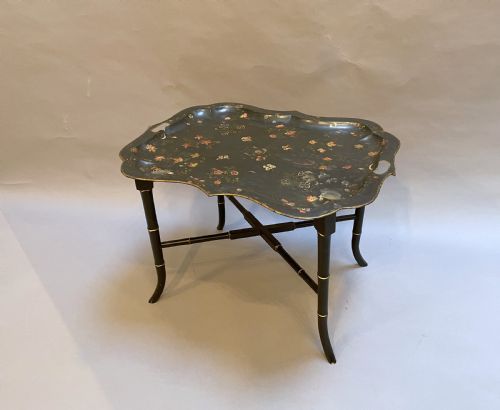


Victorian Tray Ebonised
These victorian tray ebonised pieces combine dark polished surfaces with crisp ornamentation, offering a striking display for drinks or interiors.
Victorian Tray Ebonised
When you search for victorian tray ebonised, you encounter dark, heavily finished serving pieces, drinks trays, and occasional tables from the nineteenth century. These items range from flat desk accessories and mirrored table plateaus to serving surfaces mounted on folding or fixed stands.
The version you are most likely to meet on this page is the papier-mâché or ebonised wood tray, frequently decorated with Victorian Chinoiserie floral motifs. Many examples sit upon custom-made stands, transforming traditional butler trays into practical side tables for modern rooms.
The selection also spans silver-plated gallery trays with scalloped edges, beadwork designs, and comprehensive brass desk sets from the eighteen sixties. Each piece reflects the Victorian appetite for dark, polished surfaces paired with metallic or painted contrast.
Materials and Construction
Makers utilised solid wood, papier-mâché, and lacquer as foundational bases, applying dense ebonised finishes to mimic expensive exotic hardwoods. This dark ground provided the ideal backdrop for applied gold leaf, hand-painted Chinoiserie scenes, and colourful floral details.
Metal mounts, gallery rails, and handles incorporated brass and silver plate, often secured with small pins or screws around scalloped edges. Mirror glass also appears within heavy wooden or metal frames to create reflective table plateaus for dining displays.
Listings feature pieces spanning the mid-nineteenth century through to nineteen ten, incorporating wood, papier-mâché, and mirror glass.
Assessing Quality
The standard of an ebonised piece rests upon the crispness of the hand-painted decoration and the depth of the dark finish. Superior items display intricate Chinoiserie details with minimal rubbing, whereas simpler examples show plain black surfaces with basic metallic edges.
The integrity of the underlying papier-mâché or wood determines durability, as heavy use often causes cracking or flaking around the raised rims. Original stands, matching hardware, and intact silver plating or brass mountings elevate the overall execution.
Gillows
The Victorian Tray Ebonised Glossary
- Ebonised
- Wood treated with stain, dye, or paint to simulate the appearance of dense, expensive ebony. This dark finish became widely popular during the nineteenth century for furniture and decorative accessories.
- Chinoiserie
- European artistic interpretations of Chinese and East Asian decorative motifs. These designs typically feature figures, pagodas, and floral patterns rendered in gold or bright colours.
- Papier-mâché
- A composite material made from paper pulp or layers of paper bound with glue, then pressed and dried. It offers a smooth surface for painting and heavy lacquer finishes.
- Table Plateau
- A mirrored or decorative tray placed in the centre of a dining table to hold candelabras or centrepieces. They protect the furniture surface while reflecting candlelight.
- Gallery Tray
- A serving tray featuring an elevated pierced or solid metal rail around the perimeter. This border prevents glassware and decanters from sliding off during service.
Victorian Tray Ebonised: Frequently Asked Questions
How do I clean an ebonised tray?
Dust the surface gently with a dry, soft microfiber cloth to prevent scratching the dark finish.
Avoid using harsh chemical polishes or excessive water, particularly on papier-mâché or painted Chinoiserie details.
Were these trays originally made on stands?
Many butler trays were produced as portable serving pieces designed to rest on folding wooden X-frames.
Later adaptations and matched stands frequently convert these portable serving trays into permanent side tables.
What is the difference between wood and papier-mâché?
Wooden trays rely on solid timber foundations, while papier-mâché uses compressed paper pulp treated with thick lacquer.
Papier-mâché surfaces tend to feel lighter and smoother, but require careful handling to avoid chipping.
Can I use these trays for serving drinks?
Most antique serving trays function well for holding lighter items and dry glassware during gatherings.
Moisture and heavy weight can damage aged lacquer, silver plate, and delicate painted floral motifs over time.