
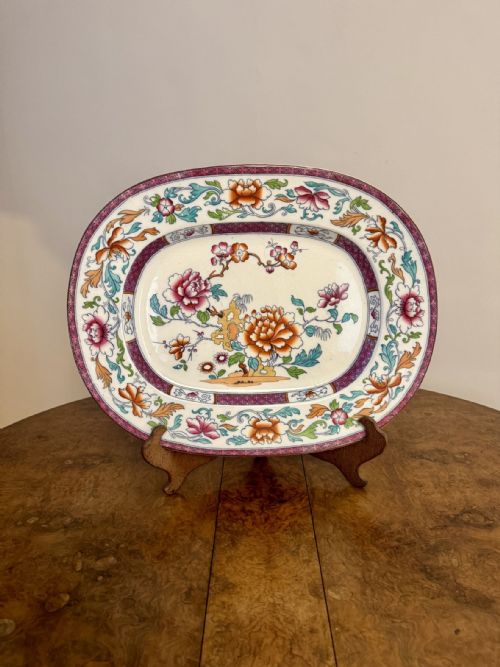


Victorian Transferware Meat Dish
A victorian transferware meat dish is a large earthenware serving platter printed with blue patterns, built to hold joints of meat at table.
Victorian Transferware Meat Dish
A victorian transferware meat dish brings nineteenth century dining history directly to the table, appearing most frequently as large blue and white platters from the eighteen hundreds. These heavy serving plates often measure considerable lengths to accommodate large joints, reflecting the scale of domestic hospitality in the period. Collectors encounter pieces spanning from early regency styles through to late nineteenth century production, with many bearing named topographical, architectural or oriental views.
The dominant aesthetic centres on blue and white transfer printing, displaying subjects such as Windsor Castle, Glasgow cathedral churches, and Chinese garden or villa scenes. Earthenware bodies form the structural basis of these serving platters, finished with rich glazes that protect the printed decoration. Alongside standard flat platters, variants include pearlware platters featuring reservoirs designed to catch juices from carved meat.
Materials and transfer printing techniques
Potters formed these heavy dishes using earthenware and pearlware, shaping the clay bodies before applying intricate monochrome designs via copper plate transfer printing. This method involved engraving a design onto a copper plate, pulling the ink onto tissue paper, and pressing that paper onto the unglazed or bisque ceramic surface.
Following the transfer of the blue pigment, workers coated the plates in lead glaze to seal the surface and impart a glossy finish. Firing in kilns then fused the glaze and colour to the ceramic body, creating durable serving vessels intended for heavy household use.
The documented pieces on this page showcase named views including Windsor Castle, Glasgow cathedral, and Elkington pattern Chinese villas.
Distinctions in quality and execution
Quality in these dishes rests upon the crispness of the transfer print and the clarity of the underlying ceramic glaze. Superior examples exhibit deep, even blue tones without smudging or blurring in the intricate borders and central scenes.
The sophistication of the pattern and the reputation of the pottery dictate the standing of a piece within the range. Well-modelled forms, such as those with integrated reservoirs or crisply moulded rims, demonstrate superior craftsmanship.
Copeland and Garrett·Elkin Knight and Bridgwood
The Victorian Transferware Meat Dish Glossary
- Transferware
- Ceramic ware decorated by printing a design from an engraved copper plate onto paper and then transferring it onto the pottery body. This technique allowed intricate pictorial scenes to be produced rapidly.
- Pearlware
- A refined earthenware developed in the late eighteenth century featuring a subtle bluish glaze that pooled in recesses. It served as an important precursor to later Victorian white earthenware.
- Reservoir
- A well or depression set into the surface of a serving platter to collect juices from carved meat. This functional feature helped keep the dining table clean.
- Glaze
- A glassy coating fused to the ceramic body through firing to render the piece impervious to liquids. Lead glaze provided the smooth finish seen on nineteenth-century earthenware.
Victorian Transferware Meat Dish: Frequently Asked Questions
How were meat dishes used?
These large platters sat at the centre of the dining table to present roasted joints of meat during substantial family meals.
Servants or hosts used them to carry carved portions, while versions with reservoirs managed the excess juices produced during carving.
Are these platters safe for food?
Most buyers treat antique earthenware primarily as decorative display items or for dry serving due to age and historic glaze composition.
Hand washing in warm water preserves the historic glaze and prevents damage to the ceramic body.
How do I date a transferware dish?
Stylistic clues, ceramic bodies like pearlware, and maker marks stamped or printed on the reverse help establish approximate decades.
Early pieces often feature lighter pearlware bodies, whilst later Victorian examples utilise heavier earthenware fabrics.
What subjects appear on the patterns?
Popular designs include romanticized landscapes, historic British buildings such as Windsor Castle, and Chinoiserie garden scenes.
These pictorial themes reflect nineteenth-century tastes for travel, architecture, and exotic foreign cultures.