
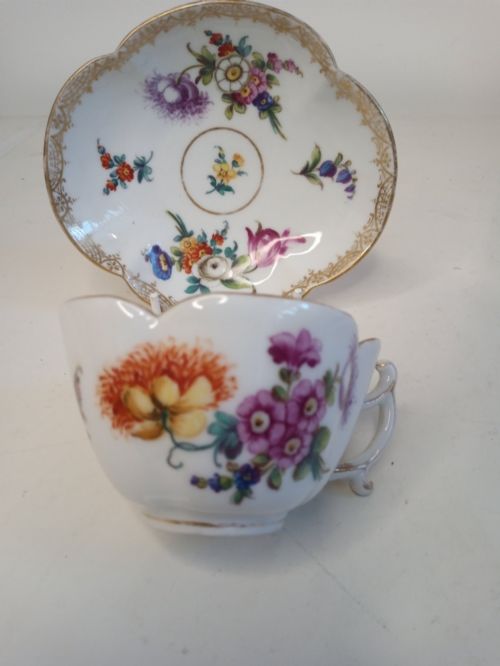


Victorian Teacup Set
A victorian teacup set brings the refined rituals of nineteenth-century hospitality to the table, offering matched cups, saucers, and pots shaped by diverse ceramic traditions.
Victorian Teacup Set
A victorian teacup set comprises matching or coordinated ceramic vessels designed for serving hot tea, frequently encompassing cups, saucers, teapots, and serving bowls. These assemblies range from intimate pairs and breakfast services to extensive afternoon gatherings spanning up to ten persons.
The objects stem from the nineteenth century, including periods labelled Victorian, Georgian, and eras around 1850 to 1900. Forms vary from simple cup and saucer pairs to large twenty-piece services complete with complementary jugs and vases.
Origins stretch across English potteries and continental European workshops, incorporating styles such as Rococo Revival, Bohemian, and Neoclassical. Buyers frequently encounter diverse configurations including single trios, demitasse cups, and miniature solitaire sets.
Factors determining quality
Quality rests in the precision of the hand painting and the crispness of the moulded ceramic forms. Finer sets display delicate brushwork and detailed enamelling that remain sharp and vibrant across every component.
The application of gold leaf and gilding dictates the refinement of a service. Superior pieces feature carefully applied metal leaf that accents handles, rims, and panels without appearing heavy or uneven.
Some nineteenth-century makers decorated their teacups with unexpected motifs, including fences and doves alongside traditional floral sprays.
Royal Worcester·Moser·Meissen·Masons·Davenport·Wileman Foley Shelley·Hirsch Dresden·Royal Crown Derby
The Victorian Teacup Set Glossary
- Bone China
- A type of porcelain incorporating bone ash, known for its high strength, chip resistance, and translucent quality. It formed the body of many nineteenth-century teacups.
- Demitasse
- A small cup used to serve Turkish coffee or strong tea. These items typically accompany larger service components.
- Gilding
- The application of gold leaf or gold powder to ceramic surfaces for decorative effect. This technique highlights rims, handles, and painted scenes.
- Ironstone
- A heavy, durable type of earthenware patented in the nineteenth century. It offered a robust alternative to standard porcelain.
- Trio
- A matched set consisting of a teacup, saucer, and matching tea plate. This configuration became standard for afternoon tea service.
Victorian Teacup Set: Frequently Asked Questions
How many pieces are in a standard tea set?
A standard set varies widely based on its original purpose, ranging from simple cup and saucer pairs to large breakfast sets and twenty-piece afternoon services.
Larger configurations often include teapots, jugs, sugar bowls, and matching plates alongside the core cups and saucers.
What is the difference between porcelain and bone china?
Porcelain is a hard, vitrified ceramic made from kaolin and petuntse, prized for its bright white body and smooth finish.
Bone china incorporates animal bone ash into the ceramic paste, yielding a lighter weight and distinct translucency when held to the light.
Can these antique sets be used daily?
While these ceramics were built for functional use, their age and delicate hand-painted decoration suggest careful handling.
Many collectors prefer to reserve them for special occasions, washing them gently by hand rather than placing them in modern dishwashers.
How do I identify the period of a tea set?
Dating relies on examining the manufacturer marks stamped or painted on the underside of the ceramic base.
Stylistic cues, such as Rococo Revival moulding or specific floral motifs, further help narrow the era of production.