


Victorian Tallboy Desk
These pieces known as a victorian tallboy desk combine upright proportions with a fitted writing surface for practical study.
Victorian Tallboy Desk
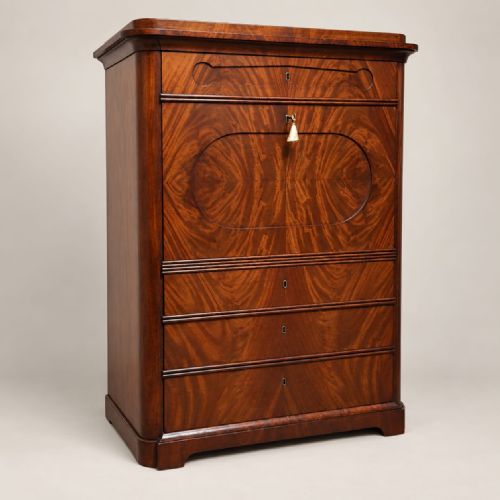
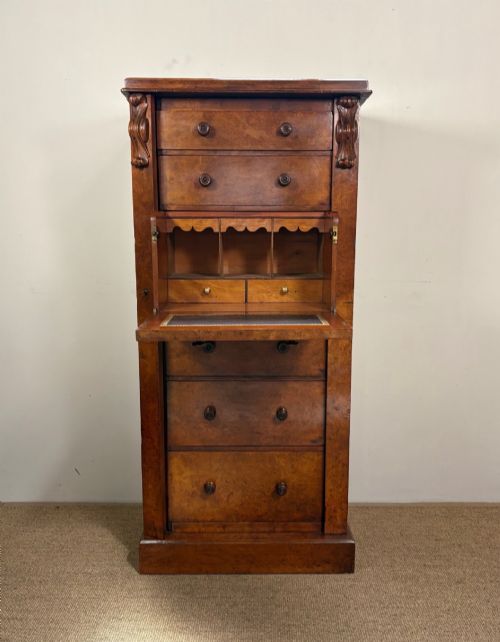
A victorian tallboy desk brings together vertical storage and a fold-down or pull-out writing compartment within a single tall cabinet. You encounter these most frequently as secretaire chests, Wellington chests, and upright bureaus from the nineteenth century.
The form prioritises floor space economy by stacking drawers beneath or above a dedicated writing surface. Mahogany and pine form the backbone of these pieces, often paired with specialised writing compartments.
Most examples date across the nineteenth century, ranging from mid-century military campaign variants to late Victorian writing cabinets. The structural layout consistently balances deep drawer capacity with a functional writing slope or flap.
Materials and construction
Makers utilised solid timbers like mahogany, pine, and rosewood alongside decorative veneers such as flame mahogany, amboyna, and burr walnut. These woods were chosen for structural stability and rich grain presentation.
Brass fittings, including campaign handles, flush mounts, and locking mechanisms, reinforced the corners and drawers of military and Wellington styles. Leather inserts frequently lined the interior writing surfaces to provide a durable workspace.
Secondary timbers such as pine appeared in drawer linings and internal dividers, assembled with traditional joinery. The addition of locking flaps and secret drawers required precise cabinetmaking to maintain smooth operation.
Some secretaire chests hide secret miniature drawers behind dummy pigeonholes, built to outsmart prying eyes.
Assessing quality and execution
The choice of primary timber and veneer selection dictates the visual impact, with figured flame mahogany and burr walnut sitting at the upper end of the scale. Grain matching across drawer fronts and locking flaps demonstrates the maker's intent.
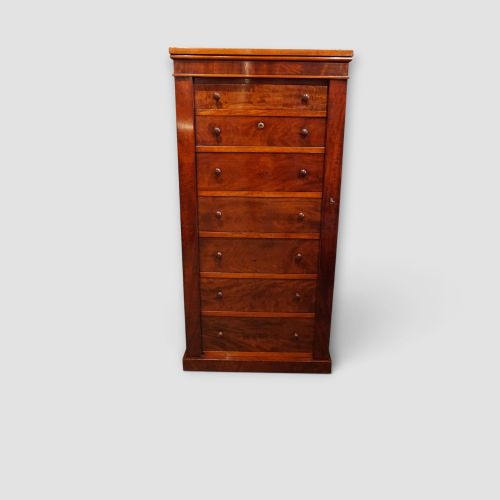
Internal complexity sets finer examples apart, particularly where well-fitted pigeonholes, small drawers, and secret compartments reside behind the writing flap. The integration of robust locking systems, such as the side-locking mechanism on a Wellington chest, reflects superior hardware.
Secondary wood selection and structural neatness in hidden areas indicate the standard of workshop execution. Original brass hardware and intact leather writing surfaces maintain the integrity of the piece.
Druce & Co.
The Victorian Tallboy Desk Glossary
- Secretaire chest
- A chest of drawers featuring a dedicated writing drawer with a drop-front panel and internal compartments.
- Wellington chest
- A tall, narrow chest of seven drawers secured by a single hinged locking flap on the right-hand stile.
- Escritoire
- A small writing cabinet or desk, often tall and narrow in proportion.
- Campaign chest
- Modular furniture built in sections with recessed brass hardware for ease of transport during military deployment.
- Abattant
- A piece of furniture featuring a fall-front writing surface or door.
- Veneer
- A thin layer of figured wood applied over a stable secondary timber base to create decorative surfaces.
Victorian Tallboy Desk: Frequently Asked Questions
What is a victorian tallboy desk?
A victorian tallboy desk is a tall, upright piece of furniture that combines multiple drawers with an integrated writing compartment. These pieces allow users to store correspondence and paperwork while occupying minimal floor space.
The writing surface typically pulls out or folds down to form a slope, revealing small drawers and pigeonholes inside. This hybrid form serves both storage and writing functions.
How do I use a secretaire drawer?
The secretaire drawer opens by unlocking the main panel and lowering the front flap to create a horizontal or sloped writing surface. Supporting arms or brackets often slide out from the frame to bear the weight of the drop-front.
Inside, you will find a series of small stationary compartments and hidden drawers designed for letters and inkwells. Closing the flap conceals the workspace and secures the contents when the external lock is engaged.
Are these desks suitable for modern rooms?
Their vertical proportions make these pieces ideal for rooms with limited floor space, providing substantial drawer storage without dominating a wall. They function well in home studies, bedrooms, or living areas as alternative workspaces.
The enclosed writing compartment allows paperwork to be neatly hidden away at the end of the day, maintaining a tidy room appearance.
How do I distinguish military styles?
Military campaign versions feature brass corner braces, flush-fitting drawer pulls, and sectional construction designed for dismantling during transport. The timber is often teak or mahogany selected for durability in transit.
Standard Victorian pieces rely on traditional bracket feet or plinth bases and lack the recessed hardware associated with campaign furniture.