
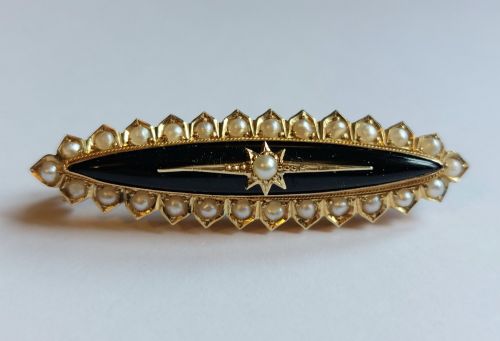
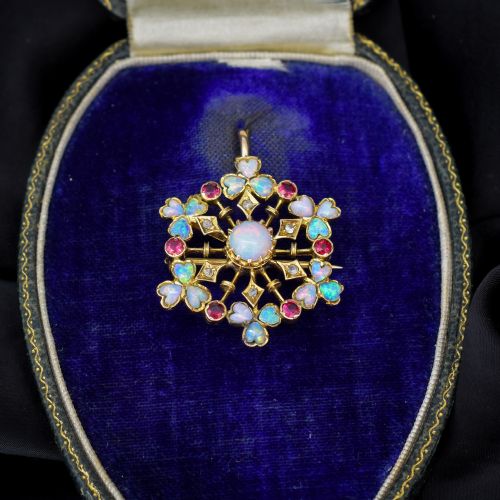
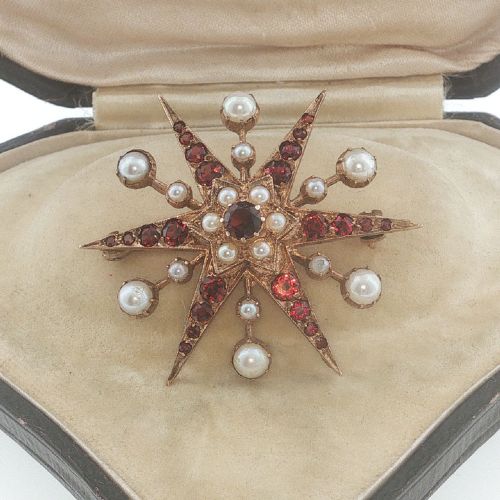
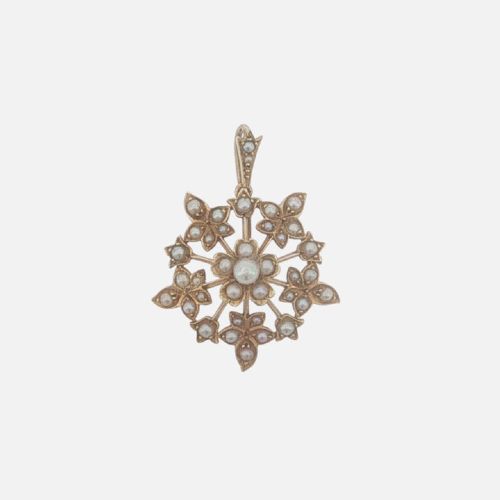
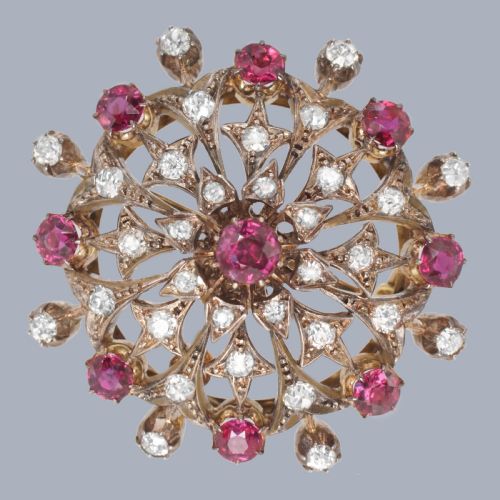


Victorian Starburst Brooch
A victorian starburst brooch is a celestial jewel designed to catch the candlelight, prized for its versatile conversion between a pendant and a fastening.
Victorian Starburst Brooch
A victorian starburst brooch represents the nineteenth-century fascination with the night sky, taking the form of radiating diamond or pearl rays centered on a glowing cluster. These pieces frequently double as pendants, offering a convertible fitting that adapts easily to chains as well as lapels.
The selection here encompasses pieces from the nineteenth century alongside later Edwardian interpretations and twentieth-century revivals. Most examples adhere to classic celestial motifs, executed with multi-tiered pin stems and secure hinged mounts.
Makers of the period arranged gemstones in tiered clusters to create a three-dimensional illusion of twinkling light. Collectors encounter various iterations, from modest seed pearl sunbursts to large diamond-set masterpieces.
Materials and Construction Methods
Goldsmiths set old cut diamonds in silver soldered to gold backings, a technique that preserved the bright white sparkle of the stones while utilising the durability of gold underneath. Lower carats like nine carat and fifteen carat gold appear alongside higher standards such as eighteen carat gold.
Victorian Starburst Brooch Retail Price Guide 2026
Typical asking prices for victorian starburst brooch among the pieces listed under this phrase on Sellingantiques today, from the lower quarter to the upper quarter. They describe what is for sale here now, not the wider market.
Listings demonstrate a frequent pairing of old cut diamonds with pearls, mounted in silver-topped gold or various grades of yellow gold.
Distinctions in Quality and Craftsmanship
The distinction between standard examples and exceptional items rests upon the symmetry of the radiating rays and the uniformity of the old cut diamonds. Finer stones display high clarity and lively facet patterns that amplify the celestial design.
Intricate articulation in the multi-tiered settings and original, intact conversion mechanisms elevate a piece above simpler soldered mounts. The quality of the central gemstone, whether an opal, sapphire, or diamond, dictates the overall presence of the jewel.
The Victorian Starburst Brooch Glossary
- Old Cut Diamond
- A hand-faceted diamond cut before the advent of modern machinery, characterised by a smaller table, higher crown, and distinct open culet that produces a soft, candlelit sparkle.
- Seed Pearl
- A tiny, natural or cultured saltwater pearl, often measuring under two millimetres, used in dense pavé clusters or delicate floral and starburst patterns.
- Millegrain
- A decorative jewellery technique featuring a border of tiny, raised metal beads along the edges of settings, typical of late nineteenth and early twentieth-century work.
- Pendant Brooch
- A dual-purpose ornament equipped with both a pin stem and a hidden loop, allowing the wearer to pin it to fabric or suspend it from a neck chain.
Victorian Starburst Brooch: Frequently Asked Questions
How do I wear a convertible starburst brooch?
These versatile jewels feature a fold-down loop or a detachable fitting on the reverse, allowing you to thread them onto a fine gold chain or a ribbon for the neck.
When worn as a brooch, the sturdy pin stem secures easily through heavy fabrics like wool or velvet without damaging the backing.
Are these pieces suitable for daily wear?
While nineteenth-century construction is remarkably robust, the delicate seed pearls and intricate silver-topped gold settings require thoughtful handling during regular use.
Storing the jewel in a padded box and avoiding contact with water or harsh cosmetics will preserve the integrity of the antique metals and gemstones.
How do I tell Victorian pieces from Edwardian ones?
Victorian examples generally employ heavier yellow gold mounts and bolder, romantic gemstone combinations like garnets and carbuncles alongside old cut diamonds.
Edwardian pieces often embrace lighter silver-on-gold work with intricate lacework patterns and brighter, more delicate diamond or pearl clusters.
What is the significance of the star motif?
Celestial imagery became immensely popular following astronomical discoveries and royal mourning traditions in the nineteenth century, symbolising guidance, eternity, and hope.
Jewellers captured this cultural fascination by transforming naturalistic starbursts into coveted fashion accessories for evening wear.