


Victorian Serpentine Dining Table
These Victorian serpentine dining table pieces combine rich timbers and curving forms, offering both presence and practicality for the dining room.
Victorian Serpentine Dining Table
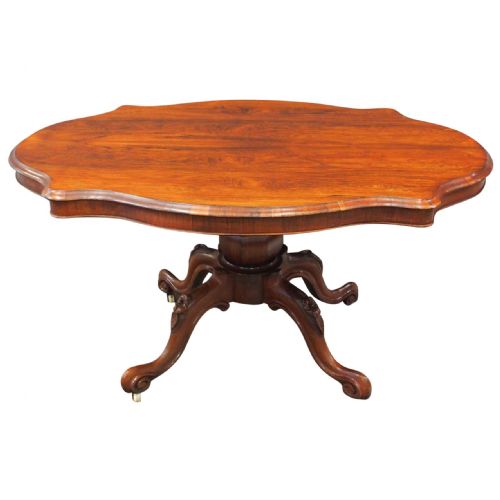
A Victorian serpentine dining table brings together mid-nineteenth-century craftsmanship and distinct curving edges. These pieces emerge from periods spanning the eighteen-fifties to the eighteen-eighties, often categorised broadly under the nineteenth century.
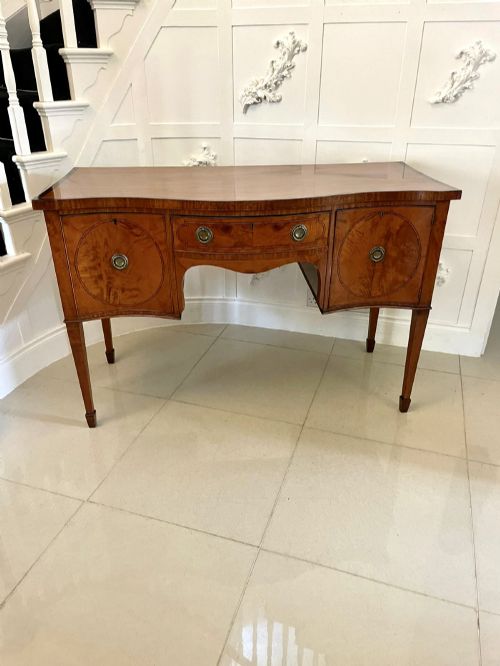
Buyers encountering this selection will frequently find related forms such as loo tables, breakfast tables, centre tables, and sideboards alongside traditional dining formats. The material palette relies heavily on rosewood, burr walnut, mahogany, and satinwood.
Makers of this era employed substantial timbers, combining pedestal supports with shaped tops. Each piece reflects the dominant Victorian taste for heavy, figured woods and expressive outlines.
Materials and construction methods
Workshops relied on dense hardwoods like rosewood, burr walnut, and mahogany to build these large surfaces and sturdy pedestals. Craftsmen selected these timbers for their pronounced grain and depth of colour.
Inlay and contrasting veneers, including satinwood, decorated the surfaces, while brass components often reinforced moving parts such as tilt-top mechanisms. Construction focused on heavy pedestal bases designed to support large, shaped tabletops.
Some tables double as card tables, proving that Victorians took their after-dinner entertainment just as seriously as their dining.
Factors that define quality
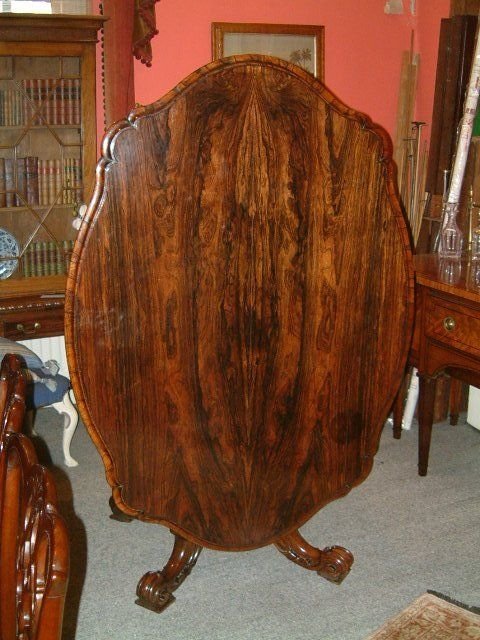
The choice of primary timber significantly dictates the standard of a piece, with figured burr walnut and richly grained rosewood commanding attention. Finer examples display meticulous matching of wood veneers across the sweeping serpentine edges.
The sophistication of the pedestal carving and the stability of the tilt-top or pedestal mechanism separate standard production from superior work. Superior items maintain crispness in the moulded outlines and solidity in their heavy wooden frames.
The Victorian Serpentine Dining Table Glossary
- Serpentine
- A shape defined by a double curve, flowing outward and then inward, frequently seen on table edges and cabinet fronts. This contour requires careful shaping of solid timber or precise veneer work.
- Tilt-top
- A tabletop designed to pivot into a vertical position for storage when not in use. This mechanism relies on a sturdy catch and a robust pedestal base.
- Loo table
- A large round or oval table originating in the Georgian period and remaining popular through the Victorian era for card games and dining. They frequently feature heavy central pillars.
- Credenza
- A sideboard or cabinet form common in Victorian interiors, used for serving food or displaying decorative objects. They often incorporate panelled doors and polished wooden surfaces.
- Satinwood
- A pale, hard timber used extensively for decorative banding, inlay, and occasional furniture during the nineteenth century. Its lustrous finish contrasts sharply with darker woods like rosewood.
Victorian Serpentine Dining Table: Frequently Asked Questions
How do I use a tilt top table?
A tilt top table operates through a release catch beneath the surface, allowing the heavy wooden top to pivot vertically. This feature enables the table to stand flat against a wall when floor space is needed.
In daily use, the mechanism locks securely into the horizontal position to provide a stable surface for dining or display.
What woods are typical for these tables?
Nineteenth century tables rely heavily on dense hardwoods including rosewood, burr walnut, mahogany, and satinwood. These materials were chosen for their durability and striking natural grain patterns.
Craftsmen often highlighted the figuring of the wood by polishing the surfaces to a deep gloss.
Are these pieces strictly for dining?
While many serve as dining surfaces, the historical records show that similar forms functioned as centre tables, loo tables, and breakfast tables. Their versatile proportions suit various reception rooms.
Buyers often place them in large living spaces where their decorative timber and curved forms can be fully appreciated.