

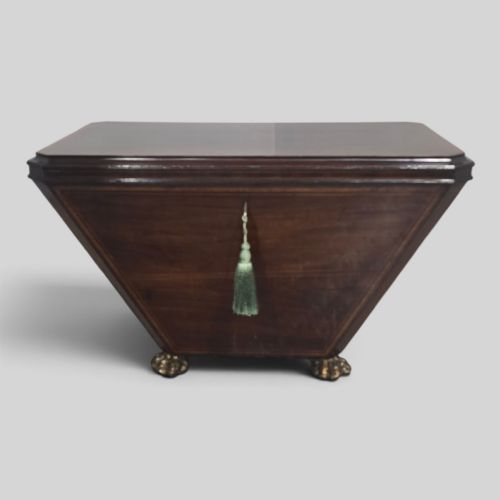


Victorian Sarcophagus Cellarette
These robust victorian sarcophagus cellarette pieces are classic wine coolers designed to chill bottles in formal dining rooms.
Victorian Sarcophagus Cellarette
A victorian sarcophagus cellarette is a substantial container built to store wine during the nineteenth century. These items take the shape of a sarcophagus, featuring heavy tapered bodies and hinged lids that open to reveal fitted interiors.
Most examples found here are constructed from mahogany, though walnut and teak appear alongside them. The forms span from plain timber boxes to intricately carved or inlaid designs influenced by Regency and Anglo-Indian styles.
Wine coolers and cellarettes function as central dining room furniture pieces designed to sit beneath sideboards. Buyers encounter both standard Victorian models and pieces showing specific cabinetmaker attributions.
How They Were Made
Cabinetmakers built these pieces using solid timber and wood veneers over sturdy carcases, frequently selecting rich mahogany and walnut. Many examples incorporate satinwood inlay to create decorative banding and contrasting geometric patterns across the exterior surfaces.
Metalwork played a structural and decorative role, with workshops applying brass bands, handles, and castors to reinforce the heavy wooden bodies. Carved details appear on selected walnut and hardwood variants, showcasing traditional hand-chiselling techniques.
Victorian Sarcophagus Cellarette Retail Price Guide 2026
Typical asking prices for victorian sarcophagus cellarette among the pieces listed under this phrase on Sellingantiques today, from the lower quarter to the upper quarter. They describe what is for sale here now, not the wider market.
Some nineteenth-century models rolled into the dining room on heavy brass castors, ready to rescue warm claret.
What Varies in Quality
The standard of timber selection and veneer matching defines the visual weight of a piece. Finer examples display continuous grain patterns across the sarcophagus lid and sides, whilst simpler versions rely on plain polished timber.
Cabinetmaking skill shows in the execution of decorative elements such as satinwood inlay and carved mouldings. The presence of makers' marks or attributions to established firms elevates the standing of an individual piece.
Edwards and Roberts·Freemans of Norwich·Maples and Co·Robert Strahan and Co
The Victorian Sarcophagus Cellarette Glossary
- Sarcophagus form
- A burial chest shape with a sloping lower profile and a flat or domed lid, adapted by furniture makers for wine coolers. This architectural silhouette defines the classic nineteenth-century cellarette.
- Cellarette
- A lockable container or box built specifically for storing and chilling wine bottles near the dining table. Nineteenth-century versions often include lead-lined interiors.
- Satinwood inlay
- Light-coloured exotic wood inserted into contrasting darker veneers to form decorative borders and motifs. This technique highlights the geometric panels of Victorian case furniture.
- Brass bound
- Fitted with structural metal straps and corner brackets to reinforce heavy wooden chests. This hardware often includes carrying handles and heavy-duty castors for moving the loaded cooler.
- Anglo-Indian
- A style reflecting British colonial design traditions executed by Indian artisans using native hardwoods. These pieces often feature dense carving and regional decorative motifs.
Victorian Sarcophagus Cellarette: Frequently Asked Questions
What is a victorian sarcophagus cellarette used for?
These containers served to hold wine bottles near the dining table during nineteenth-century meals. Interiors were often lined to hold ice and water for chilling.
Today they function as decorative floor-standing chests or drinks cabinets in living spaces and dining rooms.
How do I identify the period?
Examine the timber species, construction methods, and decorative motifs such as satinwood inlay. Nineteenth-century pieces typically feature heavy mahogany construction and hand-cut dovetails.
Stylistic cues range from plain Regency-influenced boxes to carved Victorian walnut and Anglo-Indian designs.
Are all these pieces made of mahogany?
Mahogany is the dominant timber seen across these nineteenth-century listings, used for its rich grain and durability. Walnut and teak also appear in specific regional or heavily carved pieces.
Satinwood is utilised specifically for decorative inlay work rather than the primary carcase.
Where were cellarettes placed in a room?
They traditionally stood directly on the floor beneath or beside the dining room sideboard for easy access by servants. Their substantial weight meant they remained stationary.
Modern homes often use them as standalone feature pieces or low coffee table alternatives.