


Victorian Rosewood Workbox
These Victorian rosewood workboxes are fitted timber caskets for needlework and small treasures that bring tactile warmth and period utility to any room.
Victorian Rosewood Workbox
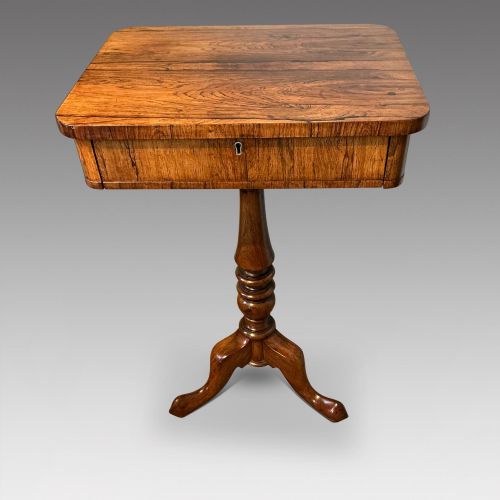
A Victorian rosewood workbox is a portable or table-mounted container designed to house sewing implements, threads, and personal valuables. These pieces emerge across the nineteenth century, encompassing compact tabletop caskets as well as pedestal sewing tables and work tables.
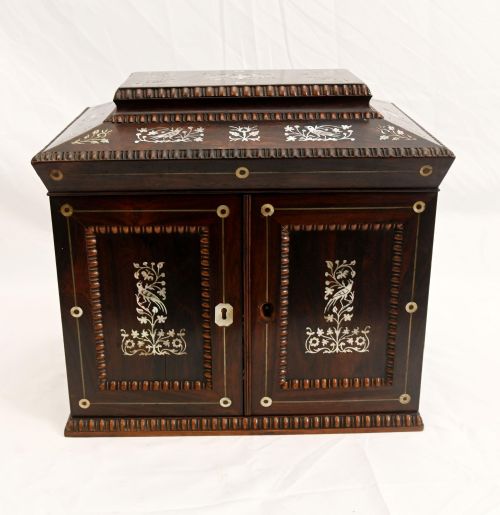
The versions most commonly met on this page span the Victorian period, alongside related examples from the Regency, William IV, and Edwardian eras. They take various forms, including sarcophagus shapes, inlaid caskets, and trumpet workboxes lined with maple.
Makers of the period utilised rich tropical timbers to house elaborate internal fittings, often featuring lift-out trays, velvet or silk linings, and compartments for bone or mother-of-pearl tools. Many integrate decorative techniques such as Tunbridge Ware mosaic work, brass stringing, and mother-of-pearl cartouches.
What varies in quality
Quality in a Victorian rosewood workbox rests on the precision of the timber selection and the execution of its decorative inlays. Superior examples display tightly figured grain matched across the lid and sides, with precisely fitted brass stringing and intact mother-of-pearl cartouches.
Internal architecture marks the distinction between standard production and finer pieces. The finest boxes retain complete compartmentalised trays, original silk and velvet linings, and working locks with matching keys.
Some Victorian workboxes hide secret drawers activated by pressing secret wooden pins hidden beneath the removable sewing trays.
The Victorian Rosewood Workbox Glossary
- Rosewood
- A dense, heavily figured tropical hardwood prized for its dark purple-brown colour and rich grain patterns. It served as the primary exterior material for high-end nineteenth-century caskets and sewing tables.
- Tunbridge Ware
- A specialised form of woodworking originating in Kent, featuring mosaic decoration built from thousands of tiny coloured wood prisms. These create detailed pictorial scenes or geometric borders on box lids.
- Sarcophagus
- A box shape characterised by a domed or stepped lid and a tapering body, often resting on carved feet. This classical architectural form was highly popular for grander nineteenth-century workboxes.
- Trumpet workbox
- A freestanding sewing table featuring an octagonal or flared body resembling a trumpet shape, often mounted on a pillar and tripod base. The interior typically opens to reveal a deep storage bag or compartment.
- Mother-of-pearl
- The iridescent inner layer of certain mollusc shells, cut into thin plates and engraved for use as decorative inlay. It frequently adorns the escutcheons and geometric motifs of Victorian boxes.
Victorian Rosewood Workbox: Frequently Asked Questions
What were workboxes used for originally?
These boxes served as portable stations for needlework, embroidery, and small personal valuables during the nineteenth century. Ladies kept threads, needles, thimbles, and pins organised within the fitted lift-out trays.
Beyond sewing, many housed letters, jewellery, and writing supplies. Their portable nature allowed them to be carried easily between rooms as daily occupations shifted.
How do I tell a Regency box from a Victorian one?
Regency pieces often display restrained classical lines with bold brass inlay and architectural proportions influenced by ancient Roman design. Victorian examples tend to embrace more varied ornamentation, including elaborate mother-of-pearl cartouches and sarcophagus profiles.
Examining the interior layout and secondary timbers also helps establish age. Earlier boxes generally favour simpler, linear mahogany or rosewood carcases before heavier carving and complex compartmentalisation became standard.
Are all these boxes made of solid rosewood?
Most nineteenth-century workboxes are constructed with rosewood veneers applied over secondary foundational timbers such as pine or mahogany. This technique prevented warping while presenting an expensive exterior grain.
Some exceptional pieces feature solid rosewood construction throughout the carcase and lid. Examining the grain continuity across edges helps determine whether solid timber or veneer was employed.
How do I care for rosewood furniture and boxes?
Rosewood benefits from stable indoor humidity and protection from direct sunlight to prevent the timber from fading or drying out. Gentle dusting with a dry, soft cloth maintains the polished surface without building up residue.
Avoid applying modern silicone polishes or commercial sprays directly onto the wood or fabric linings. Traditional wax applied sparingly preserves the natural sheen of the nineteenth-century polish.