

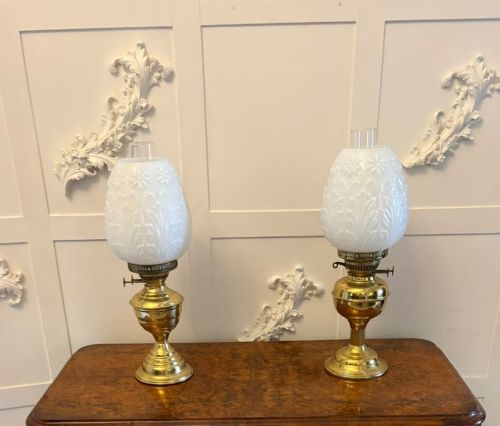


Victorian Oil Lamps Pair
These matching pairs of victorian oil lamps combine practical late nineteenth-century illumination with decorative presence for a room.
Victorian Oil Lamps Pair
A victorian oil lamps pair consists of two matching lighting fixtures designed during the nineteenth century to burn fuel through a wick. Buyers searching for a victorian oil lamps pair will encounter table lamps, desk lamps, and peg lamps intended for specific rooms and settings.
The materials span brass, porcelain, glass, opaline glass, cut glass, gilt brass, and marble, often styled in Victorian, Neoclassical, Edwardian, Chinese Export, Rococo Revival, Chinoiserie, and Napoleon III designs. Many surviving examples have been converted to electricity for modern use while retaining their original burners and reservoirs.
Surviving examples range from simple brass columns to ornate porcelain vessels and vibrant ruby or cranberry glass bowls. Matching pairs are particularly sought after for symmetry on mantelpieces, sideboards, or bedside tables.
Materials and construction
Makers constructed the structural elements of these lamps using cast and turned brass, gilt brass, and silver plating for durability and weight at the base. Columns frequently adopt classical architectural forms such as the Corinthian order.
Reservoirs and shades utilise blown and cut glass, including ruby glass, cranberry glass, milk glass, and opaline glass, alongside hand-painted porcelain bodies from factories like Meissen and Sevres. Metal components like brass and gilt mounts are joined to ceramic or glass bodies using threaded collars and internal fittings.
Victorian Oil Lamps Pair Retail Price Guide 2026
Typical asking prices for victorian oil lamps pair among the pieces listed under this phrase on Sellingantiques today, from the lower quarter to the upper quarter. They describe what is for sale here now, not the wider market.
Several pairs incorporate a hunting theme to chase away the gloom of long winter evenings.
Factors determining quality
The standard of a pair rests upon the crispness of the casting in the brass or gilt mounts and the finesse of hand-painting on porcelain elements. Heavy gauge metalwork and substantial glass reservoirs indicate superior production compared to lighter, plain variants.
The integrity of matching components dictates value, particularly where glass shades, fonts, and bases are original to one another. Finer pairs retain maker-marked burners or specialised mechanical elements like telescopic columns and high-grade silver plating.
Wild And Wessel·Meissen Porcelain·Sevres Vases
The Victorian Oil Lamps Pair Glossary
- Peg lamp
- A small oil lamp designed with a metal or glass peg at the base that fits directly into a candlestick or wall bracket socket.
- Font
- The reservoir container that holds the lamp oil beneath the burner assembly.
- Opaline glass
- An opaque or translucent glass, often pale in colour, popular for nineteenth-century lamp shades and bodies.
- Corinthian column
- A classical architectural column style featuring ornate carved acanthus leaves at the capital, frequently imitated in brass lamp standards.
- Wild & Wessel
- A nineteenth-century German manufacturer known for producing advanced burner mechanisms used on oil lamps.
Victorian Oil Lamps Pair: Frequently Asked Questions
Are these lamps still safe to burn oil?
Most surviving pairs have been converted to electricity for safety and convenience in modern homes. Using them with oil requires professional inspection of the burner and font.
Original burners can sometimes be restored, but many buyers prefer contemporary electrical wiring while keeping the period appearance intact.
Where should I place a pair in my home?
Matching lamp pairs suit symmetrical placement on sideboard surfaces, mantelpieces, or large desks. Their balanced proportions provide an anchor for room decor.
Shorter peg lamps and wall brackets offer alternative options for narrower spaces or specific decorative arrangements.
What styles are most common?
Victorian and Neoclassical designs appear frequently, alongside Edwardian, Rococo Revival, and Chinoiserie aesthetics. Brass columns and coloured glass bowls represent standard Victorian output.
Oriental style enamel and Chinese export porcelain pieces provide decorative variety within the nineteenth-century selection.