

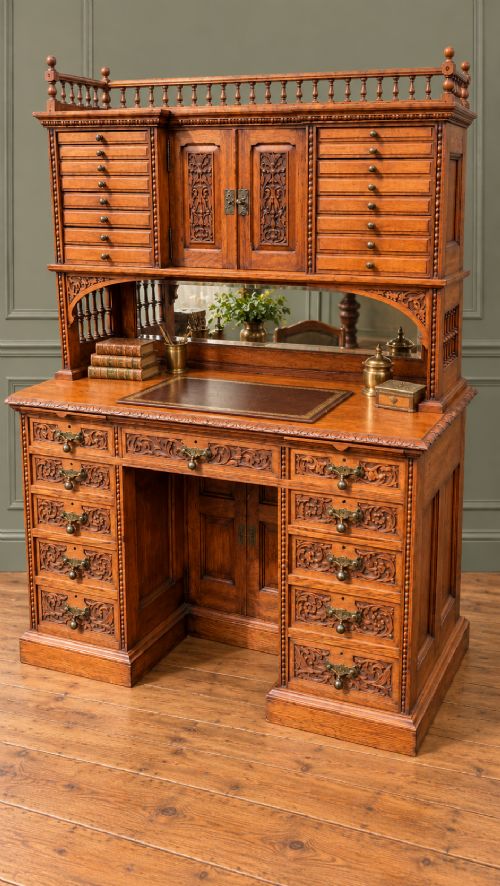


Victorian Oak Hutch
These pieces of victorian oak hutch offer sturdy utility and rich grain, bringing genuine nineteenth-century character straight into a modern kitchen or dining room.
Victorian Oak Hutch
A victorian oak hutch encompasses heavy kitchen dressers, glazed display cabinets, and fitted cupboard bases dating from the nineteenth century. Buyers searching this phrase typically encounter robust country pieces and revival furniture designed for practical storage and display.
The selection ranges from simple rustic farmhouse sideboards to monumental country house dressers with plate racks and breakfront drawers. English country examples sit alongside elaborate revival forms featuring carved cupboards and glazed upper sections.
How they were made
Carpenters built these items primarily using solid oak, sometimes combining secondary woods like pine or mahogany in interior framing. Brass hardware and clear glass panes complete the construction of glazed doors and desk compartments.
Joinery methods rely on heavy framing and pegged joints, paired with hand-carved ornamentation such as Green Man motifs and Renaissance revival details. Selected pieces also incorporate painted finishes or polished surfaces to highlight the natural grain.
Victorian Oak Hutch Retail Price Guide 2026
Typical asking prices for victorian oak hutch among the pieces listed under this phrase on Sellingantiques today, from the lower quarter to the upper quarter. They describe what is for sale here now, not the wider market.
Object forms on this page include desks, bookcases, monks seat benches, and kitchen dressers equipped with plate racks and breakfront drawers.
What varies in quality
The standard of carving and timber selection dictates the distinction between everyday utility furniture and high-status country house pieces. Deeply undercut relief work and dense, figured oak indicate superior workshops compared to plain, straightforward boards.
Proportion and scale also separate standard regional items from monumental examples with integrated plate racks and breakfront drawers. Original brass fittings and intact glazed doors preserve the integrity of the piece.
The Victorian Oak Hutch Glossary
- Breakfront
- A piece of furniture where the central section projects forward from the flanking outer sections. This arrangement creates visual depth and extra internal storage.
- Glazed
- Fitted with glass panels, typically within doors to protect books or china from dust while keeping them visible. It defines display cabinets and upper bookcase sections.
- Kneehole desk
- A writing table with a central recess for the legs, flanked by pedestals of drawers on both sides. These provide compact workspace with integrated storage.
- Monks seat
- A multi-functional convertible piece featuring a hinged back that folds down to form a table top over a box seat base. It serves as both bench and table.
- Plate rack
- An open shelving superstructure mounted atop a dresser base, designed specifically to display ceramic plates upright in grooves. It forms the classic Welsh dresser silhouette.
Victorian Oak Hutch: Frequently Asked Questions
What is a victorian oak hutch used for?
These items serve primarily for storage and display in domestic spaces like kitchens, dining rooms, and studies. Cupboards and drawers house tableware or writing materials, while upper shelves and glazed doors exhibit china and books.
Heavier examples provide generous surface areas for food preparation or serving. Smaller variations function as practical writing desks or seating benches.
How do I care for nineteenth-century oak?
Keep wooden surfaces away from direct heat sources and extreme humidity fluctuations to prevent warping or splitting. Regular dusting with a soft, dry cloth preserves the polished finish.
Apply occasional wax polish formulated for antique timber to nourish the grain. Avoid chemical cleaners that can strip the historic surface.
How can I tell a regional style?
Regional characteristics emerge through specific construction traits, local timber varieties, and regional naming traditions such as Welsh or Cornish origins. Heavy country construction differs distinctly from urban revival pieces.
Carving motifs and proportions often point to particular English districts where local cabinetmakers practiced traditional methods.
What distinguishes revival styles on these pieces?
Renaissance and Jacobean revival pieces incorporate heavy geometric moulding, strapwork, and elaborate figural carvings inspired by earlier centuries. These decorative elements contrast with simpler utilitarian country furniture.
Makers utilised historic motifs to appeal to Victorian buyers who favoured historical association and substantial craftsmanship.