
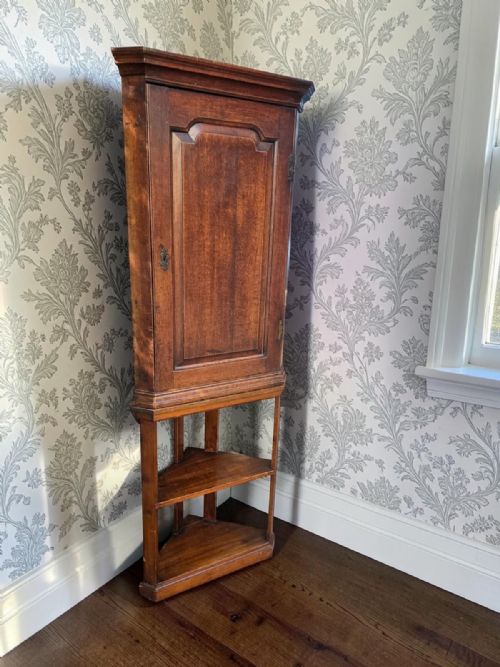


Victorian Oak Corner Cabinet
A victorian oak corner cabinet saves valuable floor space while bringing warm timber grain and period character directly into your room.
Victorian Oak Corner Cabinet
The pieces on this page span styles from Gothic Revival and Aesthetic Movement to Arts & Crafts and Chippendale Revival. You will find both plain country pieces in Welsh oak and heavily carved urban examples.
Most pieces date from the middle decades of the Victorian era up to around eighteen ninety. They utilise the natural figure of oak, often enhanced with brass hardware, glass panels, or ebonised wood details.
Craftsmanship and Proportion
Quality in these cabinets rests upon the crispness of the timber carving and the selection of the oak grain. Superior examples display thoughtful proportions that fit snugly into ninety-degree corners without appearing heavy or clumsy.
Finer pieces feature original brass hardware, well-fitted panelled doors, and intact cornices. The integrity of the internal shelving and the neatness of the secondary timbers reveal the maker's underlying standard of work.
Listings feature solid oak, ebonised wood, mahogany, and pine, spanning Victorian, Gothic Revival, Arts & Crafts, and Aesthetic Movement styles.
Garnett & Sons
The Victorian Oak Corner Cabinet Glossary
- Corner Cupboard
- A storage unit built with a triangular footprint designed to tuck neatly into the intersection of two walls. These pieces can be wall-mounted or rest on the floor.
- Gothic Revival
- A nineteenth-century design movement drawing inspiration from medieval architecture. Pieces in this style often feature pointed arches, tracery, and heavy carved details.
- Astragal
- A small wooden or metal moulding used to hold panes of glass within a cabinet door. They frequently form geometric or Gothic patterns across the glazed front.
- Ebonised Wood
- Timber treated with a chemical stain or dark finish to imitate ebony. This technique gained popularity during the late nineteenth century, particularly within Aesthetic Movement pieces.
Victorian Oak Corner Cabinet: Frequently Asked Questions
How do I hang a wall corner cabinet safely?
Hanging a corner cabinet requires locating the solid studs behind your plaster walls to support the weight of the solid oak frame. You should use heavy-duty steel brackets screwed securely into both intersecting walls for maximum stability.
Because these nineteenth-century pieces are heavy, professional installation is often advisable. Ensure the cabinet rests level so the doors swing shut properly without sagging on their brass hinges.
Are these cabinets freestanding or wall mounted?
The inventory includes both wall-hanging designs and freestanding floor units, including two-part cupboards and pieces on stands. Wall-hanging versions usually feature small brass fixing loops integrated into the backboards.
Freestanding variants sit directly on the floor and often provide deeper storage capacity. Some tall floor models are constructed in two stacked sections for easier transport.
What is the difference between golden oak and dark oak?
Golden oak pieces exhibit a warmer, lighter honey tone that reflects more light into a room. These variations often align with Arts and Crafts or later Victorian production.
Dark carved oak pieces display a heavily patinated, deep brown or ebonised surface often associated with Gothic Revival designs. Both tones occur naturally through ageing and finishing techniques chosen by nineteenth-century cabinetmakers.