



Victorian Neoclassical Standard Lamp
These Victorian neoclassical standard lamp examples bring classical Grecian and Pompeian dignity into a room, offering commanding height and warm downward illumination.
Victorian Neoclassical Standard Lamp
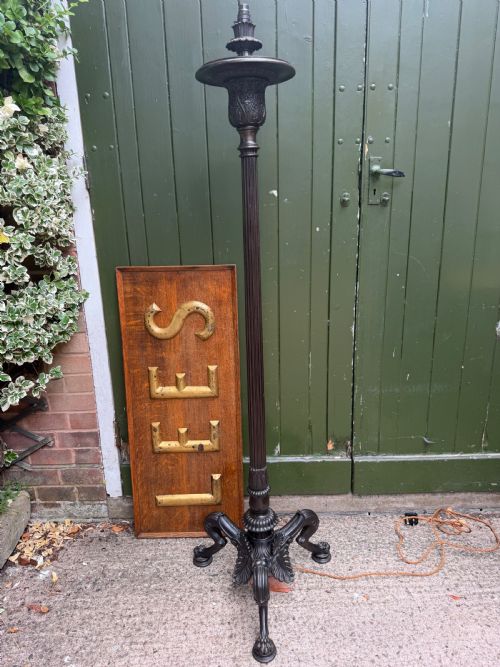
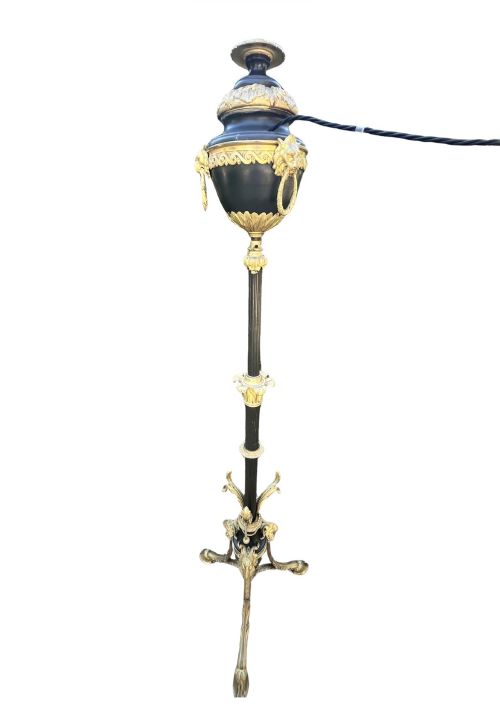
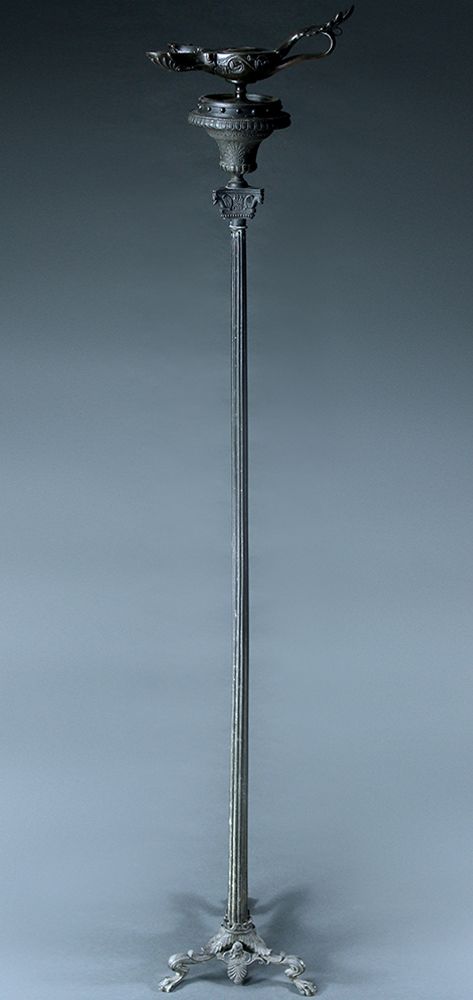
A Victorian neoclassical standard lamp stands as a tall floor-standing lighting column, drawing heavily on ancient Greek and Roman architecture for its vocabulary of ornament. These pieces often take the form of fluted columns in brass or marble, supported by heavy cast-iron or bronze bases.
You are most likely to encounter tall brass shafts, telescopic forms that adjust in height, and bronze patinated examples with classical detailing. The selection ranges from severe architectural columns to ornate Grand Tour interpretations.
Makers and designers of the period looked directly to antiquity, incorporating Corinthian capitals, marble plinths, and gilt bronze mounts into domestic lighting. These heavy floor lamps were engineered to hold substantial fabric shades safely above seating areas.
How they were made
Construction relies heavily on cast brass, patinated bronze, and heavy cast iron to ensure stability at such a tall height. Metal components are frequently turned on lathes, chased by hand, and assembled with internal threaded rods.
Marble columns provide solid weight and striking natural veining, often paired with gilt bronze capitals and bases. Telescopic mechanisms use sliding brass inner tubes secured by thumbscrews to allow height adjustment.
Surface treatments include applied bronze patination, gilding, and clear lacquering over polished brass. Fabric shades complete the construction, though original textiles rarely survive in usable condition.
Victorian Neoclassical Standard Lamp Retail Price Guide 2026
Typical asking prices for victorian neoclassical standard lamp among the pieces listed under this phrase on Sellingantiques today, from the lower quarter to the upper quarter. They describe what is for sale here now, not the wider market.
Victorian readers adjusted standard lamp heights with brass thumbscrews, ensuring the light fell precisely upon their novel.
What varies in quality
Quality reveals itself in the crispness of the casting work and the depth of the classical chasing on capitals and bases. Sharp, well-defined acanthus leaves and fluting indicate superior workshop standards.
Weight and stability separate robust architectural examples from lighter domestic reproductions. Heavier gauge brass and solid marble shafts provide both physical substance and visual gravity.
The sophistication of the engineering, particularly in telescopic height-adjusting mechanisms and heavy weighted iron sub-bases, dictates the tier of the piece.
Hinks
The Victorian Neoclassical Standard Lamp Glossary
- Telescopic
- An adjustable shaft mechanism allowing the overall height of the standard lamp to be raised or lowered. This engineering feature enabled Victorian users to direct light at various levels.
- Corinthian
- A classical architectural order identified by ornate capitals decorated with stylized acanthus leaves. Lamps utilising this style mimic ancient temple columns.
- Grand Tour
- A term describing items acquired by wealthy travellers visiting cultural sites in Italy and Greece during the nineteenth century. These objects often reflect classical archaeological discoveries.
- Patinated Bronze
- A metal surface treated with chemical solutions to produce an aged, darkened, or greenish finish. This treatment mimics the appearance of excavated antiquities.
Victorian Neoclassical Standard Lamp: Frequently Asked Questions
How tall are these standard lamps?
These floor-standing pieces generally reach significant heights to cast light across a large reception room. Telescopic versions allow the owner to adjust the elevation within a specific range.
Exact measurements vary depending on whether the lamp is designed for intimate seating or general ambient room illumination.
Where were they placed in Victorian homes?
Victorian households positioned these heavy metal columns beside reading chairs, grand pianos, or in the corners of drawing rooms. Their substantial weighted bases ensured they remained stable on thick carpets.
They served as both functional reading lights and grand decorative statements signalling classical taste.
How do I operate a telescopic lamp?
Telescopic standard lamps feature an inner brass tube that slides smoothly inside an outer column. A tightening key or thumbscrew locks the upper section at the desired height.
Care should be taken to support the weight of the fitting while adjusting the mechanism.