


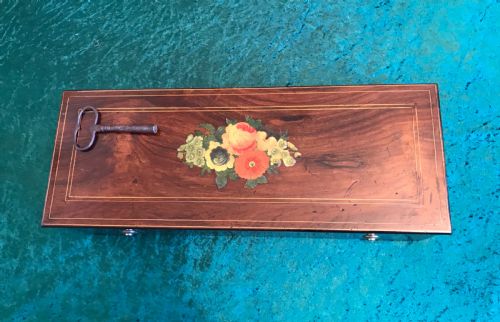
Victorian Marquetry Music Box
A victorian marquetry music box brings mechanical melody and intricate wood inlay together, offering both sound and decorative craft for the home.
Victorian Marquetry Music Box
When you search for a victorian marquetry music box, you encounter nineteenth-century cylinder boxes housed in timber cases decorated with detailed wood inlay. These items typically date from the Victorian period, around the eighteen-seventies and eighteen-eighties, alongside related forms such as music cabinets and musical chairs.
Swiss makers produced many of these mechanisms, and surviving examples frequently feature multiple airs and occasional additions like bells in view. The cases rely on contrasting timbers to form floral or geometric decorative patterns on the lid and front.
While standard tabletop music boxes dominate the selection, the category also embraces larger floor-standing cabinets and seating designed to house musical movements. Each piece combines carpentry with pinned metal cylinders that rotate against a tuned comb.
Materials and construction
Makers constructed the exterior cases using dense hardwoods such as rosewood, walnut, and ebonised wood, providing a stable foundation for decorative treatments. Marquetry inlay and boxwood details were then pieced together to create contrasting pictorial or ornamental motifs across the surfaces.
Internal mechanisms combined brass components with steel pins and combs, driven by spring-wound cylinders to produce the programmed tunes. Glass panels occasionally protected the delicate internal workings while allowing the movement to be observed during play.
Listed objects span tabletop music boxes, music cabinets, and musical chairs from the nineteenth century.
Assessing quality in construction and tone
Quality rests primarily on the complexity of the musical arrangement, measured by the number of airs the cylinder can play and whether decorative elements like visible bells are included. Finer boxes demonstrate superior mechanical precision in the pinning of the cylinder and the tuning of the comb.
The standard of the marquetry inlay also distinguishes finer pieces, with intricate, multi-wood pictorial designs marking out superior cabinet work. The choice of primary case wood, from standard walnut to figured rosewood or gonçalo alves, further indicates the original tier of production.
Langdorff & Fils·Nicole Freres
The Victorian Marquetry Music Box Glossary
- Marquetry inlay
- The art of applying small pieces of veneer to a structure to form decorative patterns. This technique defines the ornate lids characteristic of these musical cases.
- Cylinder
- The rotating brass barrel set with tiny pins that pluck the teeth of the comb. It dictates the specific tunes and number of airs the box plays.
- Comb
- The tuned metal plate with individual steel teeth that vibrate when struck by the cylinder pins. Its precision determines the purity of the musical output.
- Air
- A distinct musical tune played during one full rotation sequence of the cylinder. Boxes are often categorized by how many of these melodies they hold.
- Gonçalo Alves
- A dense, highly figured exotic hardwood utilised for specialist cabinet work. It provides a striking striped grain pattern on select nineteenth-century pieces.
Victorian Marquetry Music Box: Frequently Asked Questions
What woods were used for the cases?
Cabinet makers predominantly utilised rosewood, walnut, and ebonised wood for the main body of the box.
Inlay work frequently employed lighter boxwood and various tinted veneers to construct contrasting pictorial motifs.
How do you wind the mechanism?
Most nineteenth-century examples operate via a built-in handle or a separate key used to tension the internal spring.
Once wound, a lever starts or stops the cylinder rotation as it engages with the tuned metal comb.
Are all the boxes Swiss made?
A significant proportion of the movements originate from Swiss workshops and manufacturers operating during the nineteenth century.
These imported musical movements were then housed in decorative wooden cases assembled by regional cabinet makers.