
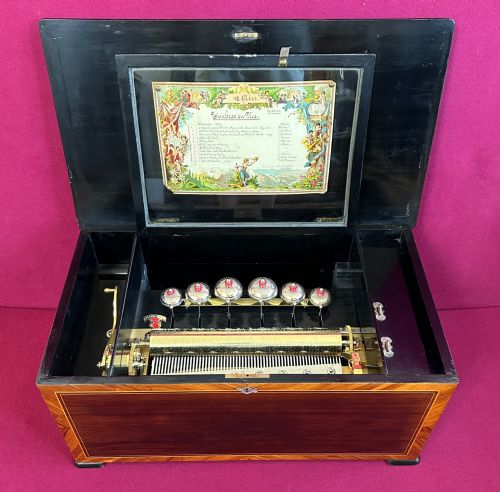


Rosewood Musical Box
These rosewood musical boxes bring mechanical precision and rich timber cases together, offering both visual warmth and period melody.
Rosewood Musical Box
A rosewood musical box combines a tuned metal comb with a pin-studded brass cylinder inside a substantial timber housing. Most examples encountered here belong to the Victorian era, spanning the middle and late nineteenth century.
Makers housed these mechanisms in cases shaped from dense rosewood, frequently enhanced with marquetry inlay or contrasting boxwood lines. Alongside standard table boxes, variations range from vanity interiors to unusual forms like conductor batons.
Materials and construction
Case construction relies heavily on figured rosewood timber, chosen for its deep grain and resilience, often detailed with intricate marquetry inlay. Brass forms the rotating cylinders and internal levers, while hardened steel provides the tuned teeth of the comb.
Internal movements required precise pinning of the brass cylinders to pluck the steel teeth at exact intervals. Secondary timbers like walnut and ebonised wood occasionally support the structural framework beneath the exterior veneers.
Some nineteenth-century makers extended their mechanical repertoire beyond table boxes into the handle of a single wooden conductor baton.
Assessing quality
Superior quality in these boxes rests on the complexity of the movement and the crispness of the arrangement. Mechanisms playing twelve airs, or incorporating visible bells, represent a higher order of mechanical achievement than simpler eight-air configurations.
Case execution also separates standard production from finer output, distinguished by the precision of the marquetry inlay and the depth of the rosewood grain. The integration of maker signatures, such as Nicole Freres, elevates the standing of a piece.
Nicole Freres·LeCoultre
The Rosewood Musical Box Glossary
- Air
- A distinct musical tune played by the pinned cylinder. Boxes often list eight or twelve airs on their pinned brass barrels.
- Cylinder
- The rotating brass barrel set with tiny pins that pluck the steel comb. Each pin must align precisely to produce the correct note.
- Comb
- The tuned plate of steel teeth that vibrates when struck by the cylinder pins. The quality of the steel dictates the tonal resonance.
- Marquetry Inlay
- Decorative patterns formed from fitted pieces of contrasting wood veneer embedded into the rosewood surface. This technique highlights the lid of the case.
- Bells
- Small tuned metallic domes struck by hammers during playback. Their inclusion adds a secondary auditory layer to the mechanical performance.
Rosewood Musical Box: Frequently Asked Questions
How do I operate a rosewood musical box?
Winding the spring mechanism engages the internal gear train to rotate the pinned cylinder. Releasing the stop lever allows the steel comb to interact with the pins.
Ensure the mechanism runs through its complete cycle without forcing the stop lever. Keep the internal glass cover closed during playback to protect the delicate comb.
What does air mean in these descriptions?
An air refers to a distinct musical tune or melody encoded onto the brass cylinder. Boxes typically feature a set number of distinct tunes that play in sequence.
Larger cylinders accommodate more airs or incorporate multiple turns per tune. The pin configuration on the barrel dictates the specific sequence of notes.
How are periods identified on these boxes?
Most pieces date from the Victorian period, largely centred between eighteen-sixty and eighteen-ninety. Stylistic markers include floral marquetry inlay and substantial rosewood cases.
Mechanisms from this era often bear stamped movement details or maker attribution marks on the brass bedplate. Case construction styles shift from simple veneering to more elaborate inlaid geometric patterns as the nineteenth century progresses.
Where were these mechanical boxes made?
Swiss workshops produced the vast majority of these musical movements during the nineteenth century. Skilled artisans assembled the brass cylinders and steel combs in specialised alpine hubs.
Exporters then cased these Swiss movements in dense rosewood, sometimes adding marquetry or boxwood details. British retailers frequently imported the finished pieces for domestic buyers.
Can I display items on top of the box?
Placing heavy objects on the rosewood lid risks scratching the polished veneer and delicate marquetry inlay. The timber surface requires clearance to prevent damp or pressure marks.
Position the box away from direct sunlight and heat sources to protect the natural wood. Maintaining a stable environment preserves both the exterior finish and internal wooden joints.