
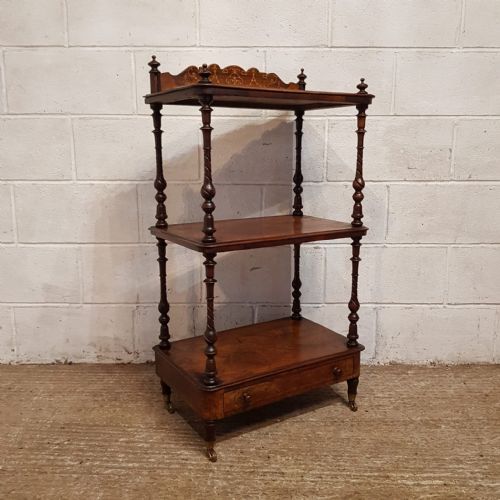
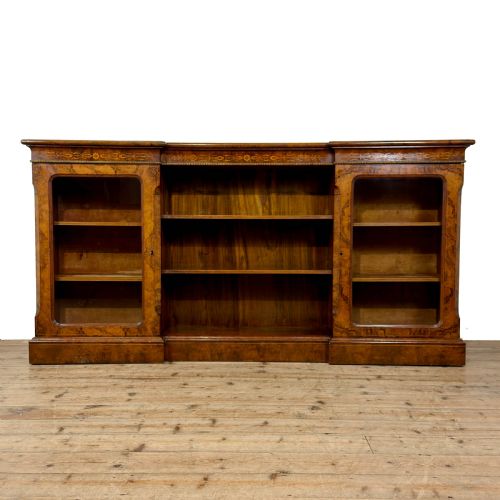
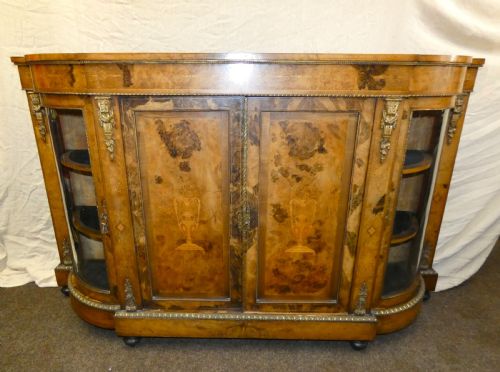


Victorian Marquetry Display Shelf
A victorian marquetry display shelf brings patterned timber and open tiers to a room, holding books and small ornaments with distinct nineteenth-century character.
Victorian Marquetry Display Shelf
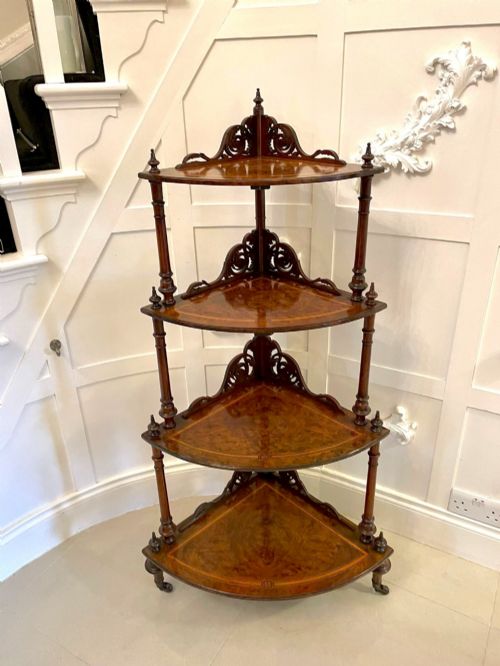
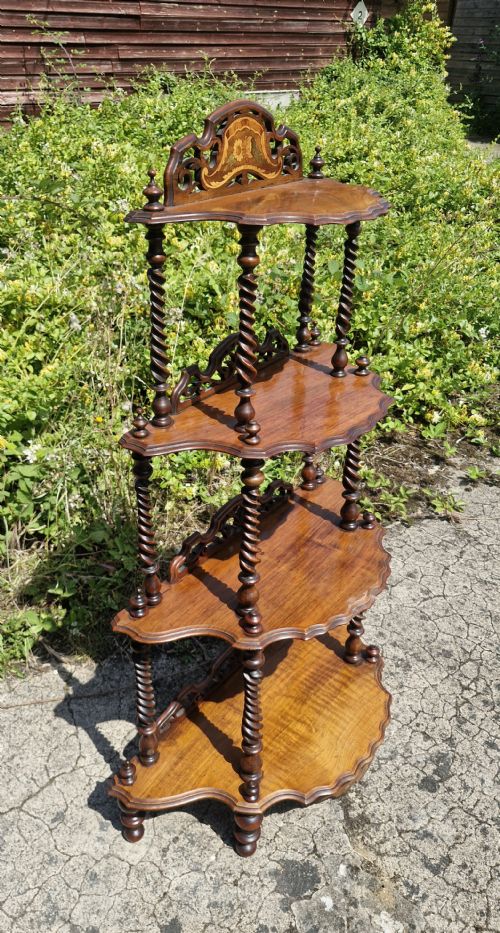
A victorian marquetry display shelf usually takes the form of a tiered whatnot, etagere, or corner stand designed to hold ornaments and small books. These pieces provide vertical storage through multiple open wooden shelves supported by turned columns or uprights.
The selections span standard floor-standing étagères alongside wall-mounted shelves and corner units. Walnut forms the dominant primary wood, frequently enhanced with contrasting boxwood and marquetry inlay.
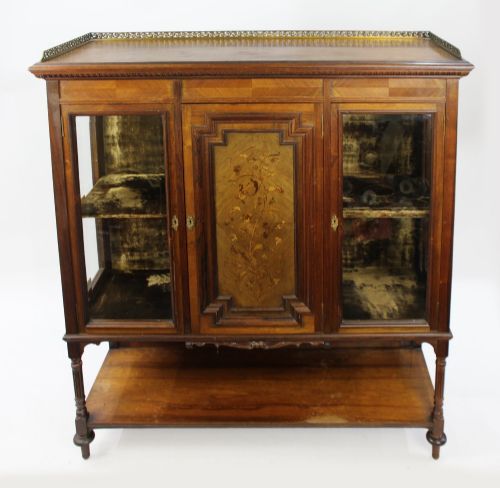
Most examples date across the nineteenth century, including pieces influenced by French revival styles and Sorrento workshop traditions. Buyers encounter everything from compact three-tier stands to large side cabinets featuring glazed doors and mirror backs.
Distinctions in quality
The refinement of the marquetry inlay separates standard production pieces from superior works. Finer examples display meticulous cutting of contrasting veneers with sharp detail in the floral and foliate motifs.
The choice of primary timber heavily influences the overall calibre of the item. Highly figured burr walnut and rich rosewood foundations indicate elevated workshop standards, paired with cast ormolu mounts rather than plain brass.
Materials appearing across the selection include solid walnut, burr walnut veneers, rosewood, olive wood, satinwood, and mahogany, accented with ormolu and brass.
Gillows
The Victorian Marquetry Display Shelf Glossary
- Marquetry
- Decorative veneer work arranged in pictorial or geometric patterns using various coloured woods. This technique requires precise hand-cutting to fit each wood piece tightly into the design.
- Etagere
- A piece of furniture consisting of a set of open shelves for displaying small objects. These multi-tiered stands emerged in France before becoming popular across nineteenth-century British interiors.
- Whatnot
- An open shelving unit designed for the display of bric-a-brac and small books. They commonly feature three or four tiers supported by slender uprights.
- Ormolu
- Gilded bronze used for mounts and decorative trimmings on nineteenth-century furniture. The technique involves applying a gold amalgam to bronze before heating.
- Credenza
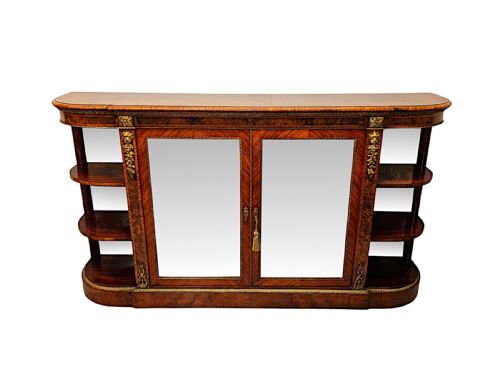
- A sideboard or cabinet, frequently featuring glazed central doors and curved glass side compartments. Victorian iterations often incorporated marquetry panels and brass mounts.
Victorian Marquetry Display Shelf: Frequently Asked Questions
What is a whatnot?
A whatnot is an open-shelved tiered stand designed for displaying ornaments, ceramics, and small books. These pieces became prominent in nineteenth-century homes to maximise display space in parlours and drawing rooms.
They appear in various formats, including square, oval, and corner configurations. The multiple tiers allow for structured arrangement of collections while keeping floor footprints relatively compact.
How do I clean marquetry?
Marquetry surfaces require gentle dusting with a soft, dry cloth to prevent dirt accumulation within the fine veneer joints. Avoid moisture and commercial liquid polishes that can seep into the grain and loosen the inlaid wood pieces.
Periodic application of a quality microcrystalline wax helps protect the timber and preserves the sheen of the polish. Maintaining a stable room temperature prevents the underlying wood from expanding and causing the veneer to lift.
Where should I place a corner shelf?
Corner shelves utilise unused angles in a room to display small decorative items without obstructing pathways. They suit hallways, alcoves, and compact reception rooms where wall space is limited.
These pieces anchor visually into room corners, balancing larger furniture arrangements. Ensure the supporting wall or floor surface is level to keep multi-tiered stands stable.
What is the difference between an etagere and a cabinet?
An etagere consists entirely of open shelves designed specifically for display rather than enclosed storage. Cabinets incorporate doors, often glazed, to protect contents from dust.
Many nineteenth-century forms blend both concepts by combining open tiers with enclosed lower cupboards. This provides versatile storage alongside traditional display capacity.