


Walnut Marquetry Whatnot
A walnut marquetry whatnot brings layered display and exquisite craftsmanship to a room, offering multiple tiers of inlaid timber to hold cherished ornaments.
Walnut Marquetry Whatnot
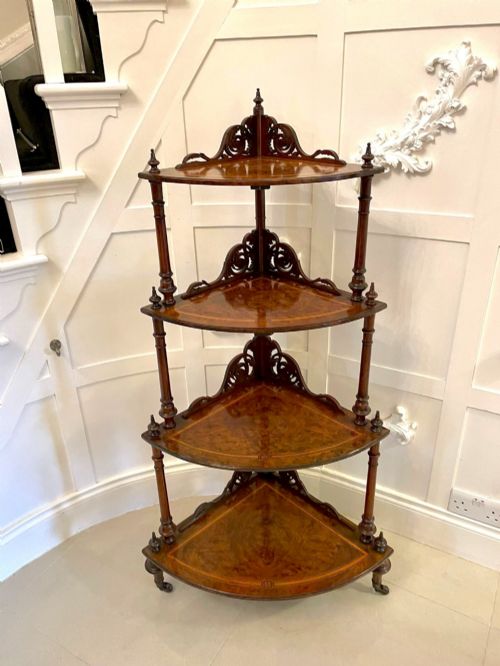
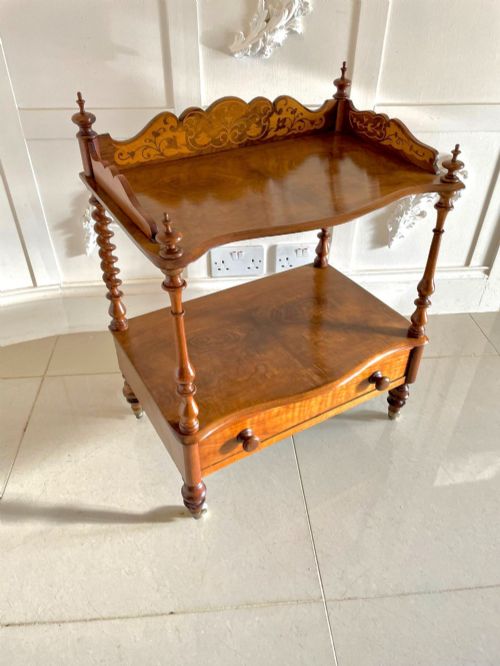
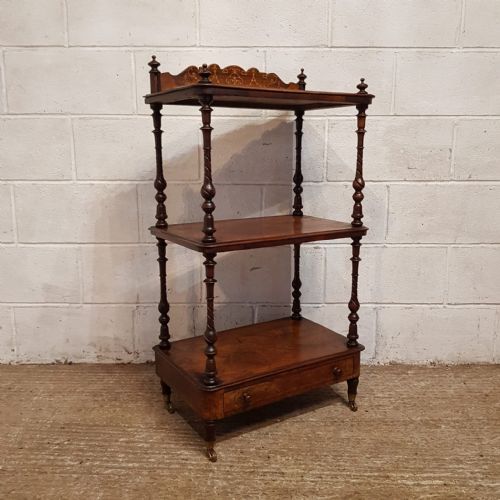
A walnut marquetry whatnot is a multi-tiered shelving unit designed for displaying decorative objects, ornaments, and books within reception rooms. These pieces emerged strongly during the Victorian period, appearing in forms ranging from freestanding three-tier stands to clever corner units and combination pieces like chiffoniers and davenports.
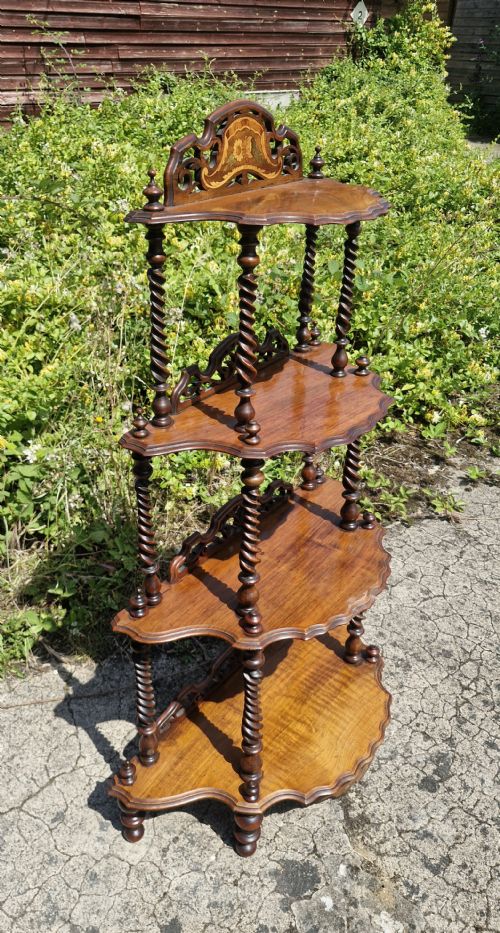
The selections available span from the mid-nineteenth century through the Edwardian era, incorporating French Napoleon III, Belle Epoque, and Louis XV styles alongside classic British Victorian designs. Buyers will encounter both standard oval or rectangular three-tier étagères and space-saving corner stands designed to fit snugly into room angles.
Makers of the period utilised the decorative grain of walnut and burr walnut, enhancing the timber with intricate boxwood and floral marquetry inlay. Many examples feature brass mounts or ormolu accents that elevate their presence, turning simple shelving into striking focal points.
What varies in quality
The refinement of the marquetry inlay sets the standard for these pieces, separating simple geometric borders from elaborately detailed floral and figural compositions. Finer examples display meticulous hand-cutting where individual veneer pieces fit together without gaps.
The choice of primary timber significantly impacts the overall character, with highly figured burr walnut commanding greater visual depth than plain walnut boards. Additionally, the presence of fire-gilded ormolu mounts rather than basic brass plating indicates a higher grade of manufacture.
Victorian corner whatnots were cleverly engineered to conquer dead space, finally giving awkward room angles a purposeful job to do.
The Walnut Marquetry Whatnot Glossary
- Marquetry inlay
- Decorative woodwork where pieces of contrasting veneer are fitted into a ground material to form intricate patterns. This technique transforms plain flat surfaces into detailed pictorial or floral displays.
- Burr walnut
- Timber sliced from the abnormal growth nodes of a walnut tree, producing highly prized swirling grain patterns. Cabinet makers reserved this expensive veneer for the most prominent display surfaces.
- Étagère
- A piece of furniture consisting of a set of open shelves for displaying small objects or ornaments. The term originates from France and often describes lighter, decorative multi-tiered stands.
- Ormolu
- Gilded bronze or brass used as a decorative mount on furniture and decorative objects. The technique involves applying a mercury-gold amalgam to cast bronze.
- Ebonised wood
- Timber treated with chemical stains or black finishes to imitate costly ebony. This dark treatment provided stark contrast against lighter walnut veneers in Victorian design.
Walnut Marquetry Whatnot: Frequently Asked Questions
Where should I place a whatnot in my home?
A whatnot suits corners or empty wall spaces in a drawing room or hallway where its open tiers can hold small collections, books, or decorative porcelain. Because these pieces are finished on multiple sides, they catch the light and draw the eye from various angles in a room.
Avoid placing antique walnut furniture in direct sunlight or near active heat sources, as fluctuating temperatures can dry out the timber and cause the delicate marquetry veneers to lift over time.
How do I distinguish a Victorian whatnot from an Edwardian one?
Victorian walnut whatnots generally date from the mid to late nineteenth century and often feature heavier, richer burr walnut veneers paired with dense floral marquetry. They tend to emphasise formal symmetry and deep, dark wood tones.
Edwardian examples, manufactured around the turn of the twentieth century, frequently adopt lighter French influences like Louis XV styles with slender proportions, delicate ormolu mounts, and brighter boxwood inlay work.
What is the difference between a whatnot and an étagère?
While both terms describe multi-tiered shelving units used for display, a whatnot is traditionally associated with British furniture design of the Victorian era. These often include enclosed cabinet spaces at the base or multi-functional designs like desk combinations.
An étagère specifically refers to open-shelved stands influenced by French fashion, focusing primarily on lightness and decorative display rather than storage.
Can corner whatnots hold heavy objects?
Corner whatnots are engineered to utilise awkward angles and provide sturdy display space, but their slender turned columns and tiered shelves are primarily intended for decorative ornaments rather than heavy books. The structural integrity relies on tight joints and wall support in corner configurations.
Distributed weight across the lower tiers remains stable, but delicate top shelves should be reserved for lighter ceramics, glass, or small framed photographs.