
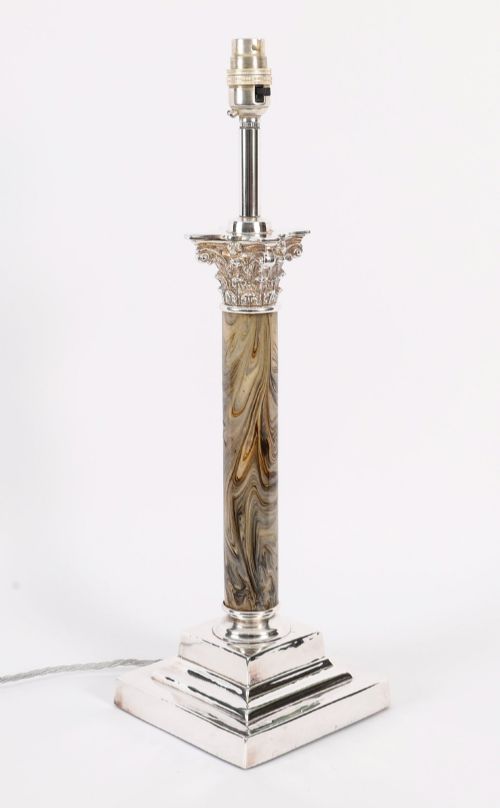
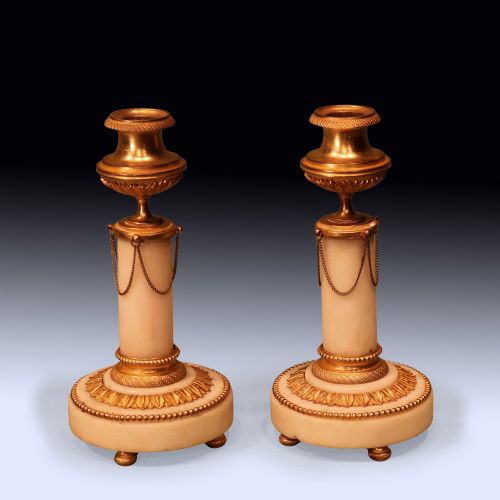


Victorian Marble Candlesticks
Victorian marble candlesticks bring heavy stone and warm metal together on a dining table or mantelpiece with a presence that demands attention.
Victorian Marble Candlesticks
Victorian marble candlesticks combine solid stone bases with metal mounts, columns, and candle nozzles. The pieces found here range from modest pairs of domestic candlesticks to grander multi-branched candelabra designed for formal rooms.
Most examples lean towards revival styles, incorporating classical motifs or French decorative schemes into domestic lighting. Buyers encounter everything from white and green marble to Ashford marble and red marble variants.
Makers frequently paired the stone with bronze, ormolu, brass, and silver plate to create contrast and structural support. Figures such as putti, cherubs, and sphinxes often appear alongside architectural columns and urn forms.
How they were made
The construction relies on turning and cutting stone for the bases and columns, paired with cast metal components secured by central threaded rods. Natural marble and variegated stones provide heavy foundations that keep tall lighting stable.
Foundries shaped bronze, brass, and ormolu mounts through casting and chasing, often applying mercury gilding or modern electroplating for the metallic finish. Artisans then joined the stone and metal sections tightly together with hidden internal fixings.
Listings feature periods spanning the Regency era, Victorian decades, and early twentieth century alongside materials such as onyx, brass, and gilt bronze.
What varies in quality
Quality rests in the crispness of the metal chasing and the depth of the marble selection. Finer pairs show sharply detailed cast figures like cherubs or sphinxes, while simpler items rely on plain turned columns and basic brass nozzles.
The weight and figuring of the stone dictate the upper tier of production. Richly coloured mineral patterns and integrated multi-branch configurations separate standard domestic lighting from ambitious exhibition-grade pieces.
The Victorian Marble Candlesticks Glossary
- Ormolu
- A technique of applying finely ground high-carat gold to a bronze base using a mercury amalgam. This gives the metal a warm, durable surface that resists tarnishing.
- Ashford marble
- A Derbyshire limestone inlaid with various minerals to create colourful geometric or floral patterns. It was heavily utilised during the nineteenth century for decorative table wares.
- Candelabra
- A branched lighting fixture holding multiple candles simultaneously. These pieces often feature a central light flanked by symmetrical arms.
- Regency
- An architectural and decorative style spanning the early nineteenth century. It heavily references classical Greek and Roman forms.
- Neoclassical
- A revival movement drawing direct inspiration from classical antiquity. It prioritises symmetry, architectural columns, and restrained ornamentation.
Victorian Marble Candlesticks: Frequently Asked Questions
How do I clean marble candlesticks safely?
Use a soft, dry microfibre cloth to remove dust from both the stone and metal surfaces. Avoid harsh chemical cleaners or abrasive pads that can strip thin gilt layers or etch the polished marble.
Keep moisture away from any exposed plaster cores or internal fixings within the base. Professional conservation wax can help protect older metal mounts from further oxidation.
Were these converted into electric lamps?
Some nineteenth-century examples underwent conversion during the twentieth century to take modern wiring and bulbs. Other surviving pairs retain their original untouched socket setups for standard candles.
Buyers should inspect the base and candle nozzles closely for drilled holes or added fittings. Original form remains a matter of personal preference for collectors and interior stylists alike.
What is the difference between candlesticks and candelabra?
Candlesticks support a single candle nozzle atop a central shaft and base. Candelabra feature multiple branches diverging from a main stem to hold several candles at once.
Multi-branched items usually command more visual weight and served as centrepieces on dining tables or sideboards. Both formats utilise the same combination of heavy marble and cast metal.
Where were these pieces displayed historically?
These decorative objects sat atop mantelpieces, pier tables, and sideboards in nineteenth-century drawing rooms. Their reflective metal mounts and polished stone surfaces helped amplify candlelight during evening gatherings.
Grand tour souvenirs and revival styles also found places in private studies and parlours. They served as functional lighting and markers of cultivated taste.