



Two Branch Candelabras
These two branch candelabras bring paired illumination and classical symmetry to a table, offering adaptable branch configurations shaped by late nineteenth and mid twentieth century hands.
Two Branch Candelabras
Two branch candelabras provide twin arms for holding candles, appearing frequently as matched pairs set upon dining tables or mantelpieces. The selections gathered here span from Victorian ormolu and marble compositions to twentieth century silver plate and sterling silver productions.
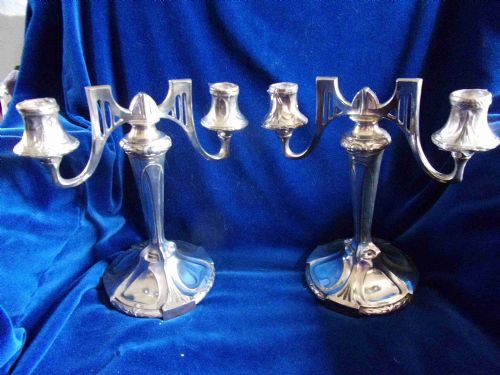
The physical forms range from low table models and wall sconces to converted table lamps and candelabras that accommodate three candles through a central socket. Styles draw heavily upon French Chateau, Neoclassical revival, Jugendstil, and George I design vocabularies.
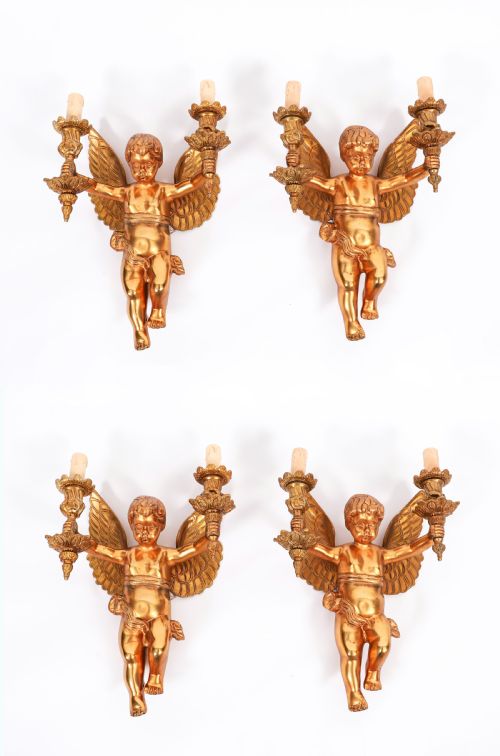
Origins stretch across English, French, and Italian workshops, reflecting diverse regional tastes in domestic lighting from the eighteen eighties onward. Buyers encounter both robust plated utilitarian wares and delicate decorative bronze castings featuring figural motifs like cherubs.
Distinctions in quality
Quality rests upon the crispness of the metal casting and the depth of the chased details, particularly visible in figural elements like cherubs and acanthus foliage. Superior examples maintain structural integrity across the joint where branches meet the central stem.
The weight of the base and the purity of the metal alloys - whether heavy sterling silver, solid bronze, or thick silver plate over base metal - distinguish fine maker productions from standard commercial wares. Integration of secondary materials such as matched marble plinths elevates the overall execution.
Claude Clodion·Barker Ellis·Robert Edgar Stone·Elkington and Company
The Two Branch Candelabras Glossary
- Ormolu
- Gilded bronze, where a mercury amalgam is applied to a bronze base and heated to leave a golden coating. This finish appears frequently on nineteenth-century French lighting.
- Jugendstil
- The German variant of Art Nouveau, characterised by flowing organic lines and stylized natural motifs. Pieces in this style emerge around the turn of the twentieth century.
- Sterling silver
- An alloy containing ninety-two point five percent silver by mass, with the remainder composed of copper or other metals. Items made from this material usually display official assay hallmarks.
- Silver plate
- A thin layer of silver fused to a base metal such as copper, nickel silver, or brass. This method offered the visual appeal of solid silver at a more accessible cost.
- Wall sconce
- A light fixture fixed to a wall rather than resting upon a surface. Certain examples feature twin branches extending outward from a decorative backplate.
Two Branch Candelabras: Frequently Asked Questions
How do I clean tarnished silver plate?
Use a soft cloth and a specialised silver cleaner formulated for plated items, applying gentle pressure to avoid wearing away the thin silver layer.
Avoid abrasive pastes or harsh scrubbing brushes that can permanently scratch the underlying base metal.
Can these candelabras be wired for electricity?
Many examples adapt successfully into table lamps or wiring systems, provided the conversion respects the original structure and metalwork.
Consult a professional electrician to ensure any internal wiring preserves the stability and integrity of the vintage frame.
How are paired candelabras arranged safely?
Place them on stable, level surfaces away from heavy foot traffic and draughty doorways to prevent accidental tipping while candles burn.
Ensure adequate clearance above the flames if placed beneath low shelves or decorative wall treatments.