
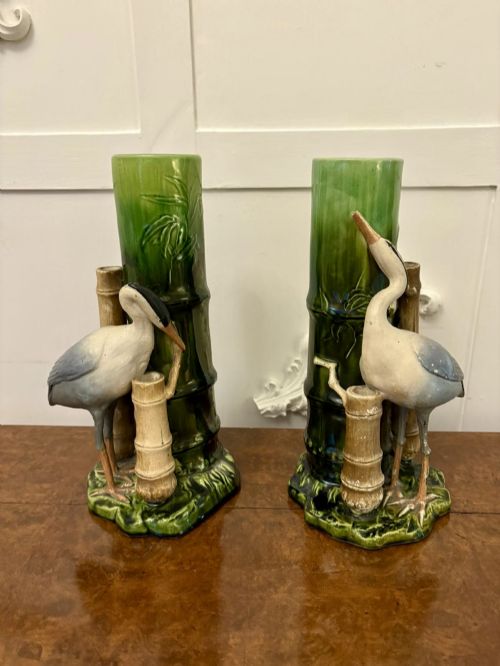
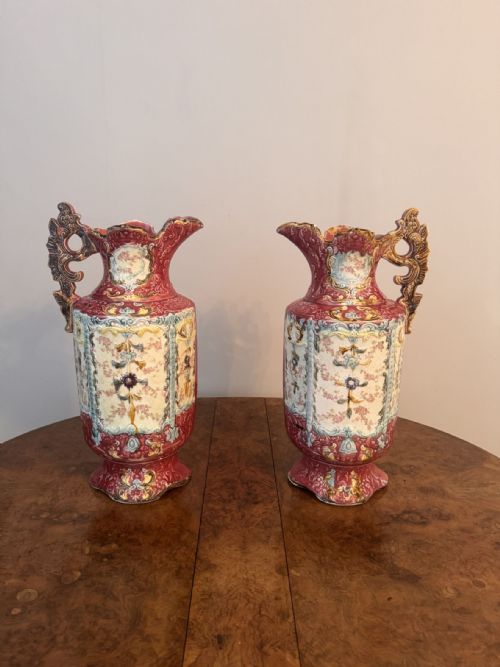
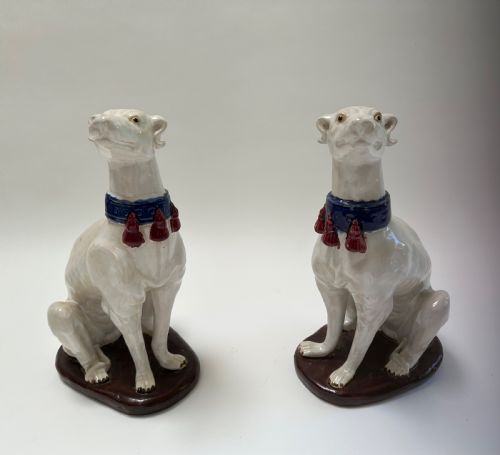
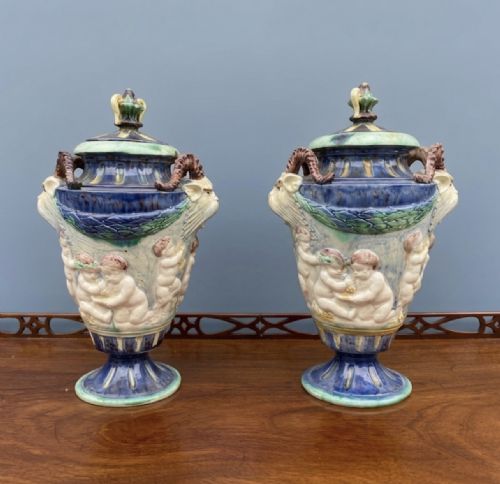


Victorian Majolica Pair
These Victorian majolica pairs bring striking colour and sculptural presence to a room, offering the bold glazes and figural forms collectors prize.
Victorian Majolica Pair
A victorian majolica pair comprises matching matched items sharing the characteristic lead-glazed earthenware construction and rich palette found across the nineteenth century. These symmetrical groupings include vases, ewers, urns, and figural ornaments designed to sit in balanced arrangement upon a mantelpiece or sideboard.
The selections available here range from Italian Renaissance Revival and Aesthetic Movement designs to Victorian Naturalism and Arts & Crafts interpretations. Such matching pieces frequently showcase elaborate moulded motifs such as cherubs, dogs, and botanical subjects rendered in high relief.
Buyers will encounter vessels from the eighteen-seventies through to nineteen-twenty, encompassing both British potteries like Minton and Copeland and continental examples. These pairs demonstrate the Victorian appetite for decorative ceramics that combined utility with dense, colourful ornamentation.
Materials and construction
These items rely upon earthenware and ceramic bodies shaped through moulding or hand-forming before receiving opaque tin-glazes or coloured lead glazes. The vibrant surface effects depend upon metallic oxides applied directly to the porous clay body or over an initial white tin-enamel ground.
Kiln firing fixed the complex colour palette, fusing the lead glazes into a glossy, reflective skin that accentuates the relief modelling beneath. Enamel highlights and hand-painted details were occasionally added over the glaze before a final low-temperature firing.
Listings feature earthenware, porcelain, and tin-glazed ceramic forms spanning the nineteenth and early twentieth centuries.
Distinctions in quality
Quality rests upon the crispness of the moulded relief and the control evident in the application of colourful glazes. Finer examples maintain sharp botanical or figural detail without pooling or running in the vitreous coating.
The reputation of the pottery and the sophistication of the revival style shape the standing of a pair. Strong modelling paired with balanced, rich coloration distinguishes the work of established manufacturers from simpler production.
Bretby Vases·Royal Worcester·Minton·Wedgwood·Copeland
The Victorian Majolica Pair Glossary
- Majolica
- Earthenware decorated with colourful metallic oxide glazes fired over a tin-enamel or directly onto the clay body. This technique creates a glossy, vibrant finish typical of nineteenth-century revival wares.
- Ewer
- A large pitcher or jug with a wide spout and looped handle, frequently produced in matched pairs for decorative display. These vessels often incorporate classical or naturalistic relief ornament.
- Compote
- A raised bowl on a stem used for serving fruit or sweets, sometimes modelled with figural supports like cherubs. In ceramic pairs, these pieces serve a primarily ornamental function.
- Jardinière
- A large decorative pot or stand intended to hold growing plants or flowers. These items appear in nineteenth-century earthenware with moulded botanical and aesthetic motifs.
- Faience
- Tin-glazed earthenware produced in imitation of Italian majolica and Dutch delftware. The term embraces various regional art pottery traditions from the Victorian period.
Victorian Majolica Pair: Frequently Asked Questions
What is a majolica pair?
A majolica pair consists of two matching ceramic or earthenware decorative objects finished with vibrant, coloured lead glazes. These symmetrical items were created to provide balanced ornamentation on mantels, tables, and pedestals.
They reflect the diverse aesthetic movements of the nineteenth and early twentieth centuries, incorporating styles from the Italian Renaissance Revival to Arts and Crafts naturalism.
How were these pairs used?
Victorian households utilised these matched vessels primarily for interior display rather than practical service. Ewers, urns, and vases sat on prominent surfaces to showcase the owners' taste for colour and relief modelling.
Larger items such as jardinières and plant stands combined this decorative function with the housing of indoor ferns and potted palms.
How do I date a pair?
Dating relies upon stylistic markers, body materials, and manufacturer registry marks or stamps found on the unglazed bases. The presence of Aesthetic Movement motifs or Victorian Naturalism points to specific decades within the nineteenth century.
Comparative study of glaze palettes and moulding techniques helps narrow the production era between eighteen-seventy and nineteen-twenty.
Where should I display them?
These colourful glazed pieces demand stable surfaces where their reflective surfaces and relief details catch natural light. Placing them on sideboards, mantelpieces, or dedicated plant pedestals allows the matching pair to be viewed in balance.
Care should be taken to position heavier earthenware items away from high-traffic edges where accidental bumps might occur.