
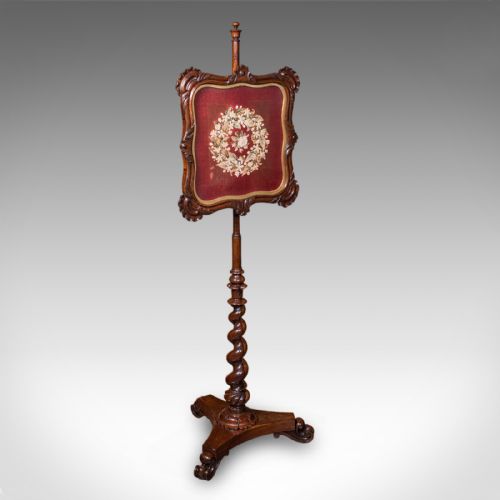
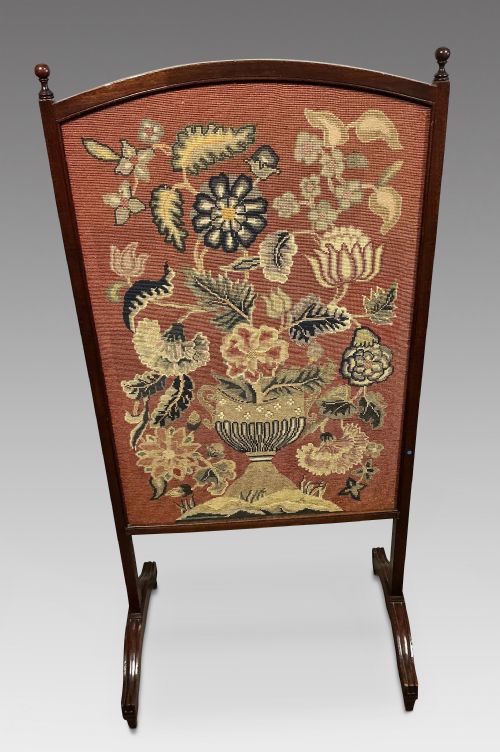


Victorian Mahogany Tapestry Screen
These Victorian mahogany tapestry screen pieces bring practical fireside warmth and hand-stitched needlework into a room.
Victorian Mahogany Tapestry Screen
A victorian mahogany tapestry screen acts as a functional fireside heat shield or a decorative room divider within the home. Buyers encounter a mix of pole screens featuring adjustable needlepoint panels alongside larger folding privacy screens spanning multiple panels.
The pieces on offer span the Georgian, Regency, William IV, and Victorian periods, often framed in solid mahogany with carved bases. Single-panel pole screens and larger multi-panel room dividers dominate the selection, showcasing needlework samplers, pastoral scenes, and coats of arms.
Originating primarily from English workshops, these items date from the nineteenth century, with specific examples recorded from eighteen thirty through to eighteen eighty. They serve both a practical domestic purpose and a decorative role as textiles mounted in timber frames.
Quality variations in timber and textiles
Superior examples display crisp carving on the mahogany bases and sophisticated turning, whereas simpler versions rely on plain uprights and minimal decoration. The complexity and tightness of the needlepoint or tapestry panel mark the distinction between standard production and finer work.
Condition of the wooden frame and the tension of the textile panel determine the integrity of each piece. Intricate wool work depicting detailed armorial bearings or pastoral scenes indicates higher workshop skill.
One recorded screen depicts the Clan Maclellan coat of arms, letting your living room double as a Scottish heraldic outpost.
The Victorian Mahogany Tapestry Screen Glossary
- Pole screen
- A vertical stand holding an adjustable sliding panel designed to block radiant heat from a fireplace. The screen moves up and down on a central wooden shaft.
- Needlepoint
- Embroidery stitched onto a stiff open-weave canvas ground to form dense pictorial designs. This technique creates the durable pictorial panels seen on firescreens.
- William IV
- A design period bridging Regency and early Victorian styles, characterised by robust mahogany proportions and classical motifs. Pieces from this era often feature heavy carved pedestal bases.
- Bobbin turned
- Timber turned on a lathe to resemble a series of rounded bobbins or beads. This decorative turning method appears on Victorian frames and supports.
Victorian Mahogany Tapestry Screen: Frequently Asked Questions
What is a pole screen?
A pole screen is a vertical nineteenth-century stand featuring a sliding textile panel. It was placed near a fireplace to protect a person's face from the direct heat of the flames.
The adjustable panel moves up and down a central wooden pole to suit the seated user. Many examples utilise heavy mahogany bases for stability.
How do I use a tapestry screen today?
These screens function effectively as decorative room dividers, privacy panels, or standalone focal points in a sitting room. Their textile panels add texture and colour to traditional or contemporary interiors.
Larger multi-panel versions divide open spaces, while single pole screens sit comfortably beside armchairs or fireplaces.
How do I date a mahogany screen?
Dating relies on observing the timber characteristics, turning styles, and the nature of the needlework. Regency and William IV pieces often display classical pedestals and bold mahogany grains.
Victorian examples frequently incorporate bobbin turning, richer carved details, or pastoral tapestry motifs. Archival records and stylistic markers help narrow the period of origin.
Are the tapestry panels original?
Most surviving screens retain their period needlework or wool tapestry panels stitched during the nineteenth century. Hand-woven pastoral scenes and needlework samplers form an integral part of the piece's history.
Examining the back of the panel reveals the mounting technique and the age of the canvas backing. Collectors look for consistent wear between the wooden frame and the textile.