
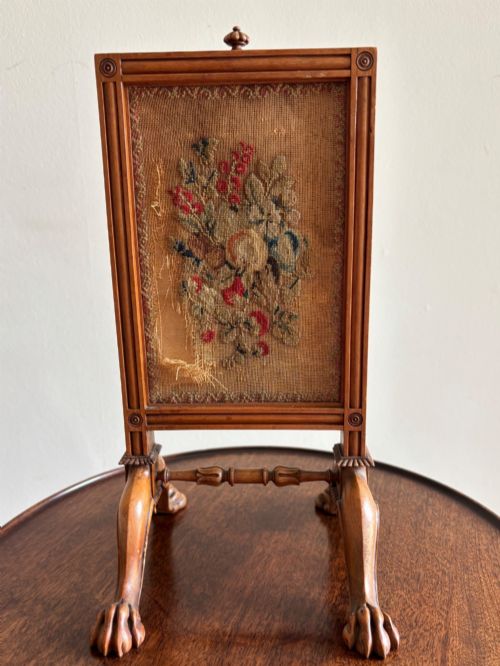


Tapestry Fireguard
These tapestry fireguard examples shield a room from hearth heat while bringing needlework and turned timber into the salon.
Tapestry Fireguard
A tapestry fireguard combines a protective wooden frame with a decorative textile panel designed to stand before an unlit hearth. The form ranges from small miniature firescreens to tall pole screens and large cheval arrangements that adjust on upright supports.
Most pieces seen here date from the Georgian, Regency, and Victorian periods, reflecting shifts in interior taste from classical restraint to ornate revivalism. Makers utilised forms that echoed prevailing furniture styles, incorporating carved wood and textile panels into domestic interiors.
Materials and construction
The structural framework relies on traditional timbers including mahogany, rosewood, walnut, and oak, often shaped with turning or carving. Metal elements such as brass appear in pole screen mountings and decorative feet.
Panels utilise textile techniques ranging from needlework and needlepoint to embroidery and woven tapestry, often worked in wool and silk on canvas. These panels are secured within frames designed to withstand the dry heat of a room fireplace.
Periods represented range from the Georgian era through Regency and Victorian designs up to the early twentieth century.
Assessing quality and execution
Quality rests in the crispness of the timber carving and the complexity of the wood turning, particularly on pole screens and cheval frames. Dense woods like rosewood and mahogany hold fine detail better than softer timbers.
The needlework panel dictates much of the visual merit, with fine stitching density and well-composed pictorial or geometric designs separating standard work from exceptional examples. The integration of the textile into the frame must be secure and balanced.
The Tapestry Fireguard Glossary
- Pole screen
- A firescreen featuring an adjustable vertical shaft where the textile panel slides up and down to block radiant heat. This form became popular in Georgian and Regency drawing rooms.
- Cheval screen
- A self-standing screen supported by two upright legs or feet, allowing the large panel to tilt or remain fixed. It provides greater hearth coverage than a standard pole screen.
- Needlework
- A general term for decorative stitching executed by hand on a canvas or textile ground using wool, silk, or metallic thread. It forms the central decorative element of these pieces.
- Rococo Revival
- A nineteenth-century style drawing on mid-eighteenth-century French motifs, characterised by asymmetrical scrolls, C-scrolls, and naturalistic floral carvings found on many Victorian frames.
Tapestry Fireguard: Frequently Asked Questions
What is a tapestry fireguard used for?
These pieces were originally placed in front of fireplaces during warmer months when fires were unlit, protecting the room from soot smells and shielding inhabitants from residual drafts.
Today, they function primarily as decorative room dividers or focal points in sitting rooms, bringing historic textiles and woodwork into modern interiors.
How do I date a firescreen?
Dating relies on timber choice, turning style, and the character of the needlework panel, moving from restrained Georgian lines to ornate Victorian revival carving.
Earlier pieces often use mahogany or rosewood with classical proportions, while later nineteenth-century examples introduce heavier frames and distinct artistic influences like Art Nouveau.
Are these screens still functional?
While they can still block draughts from an unlit fireplace, modern central heating means they are mainly appreciated for their craftsmanship and textile art.
Placement should avoid direct, intense heat sources to protect the historic wood and delicate wool or silk embroidery.