


Victorian Mahogany Buffet Stand
A victorian mahogany buffet stand brings rich timber grain and tiered display space to a room, offering the practical utility that nineteenth-century hosts relied upon for serving.
Victorian Mahogany Buffet Stand
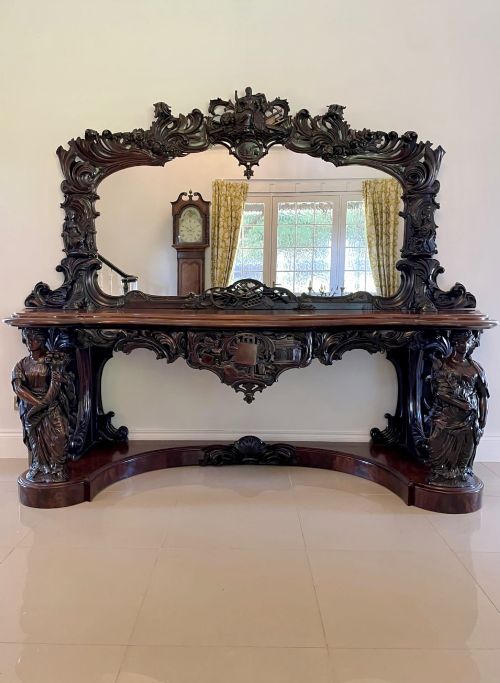
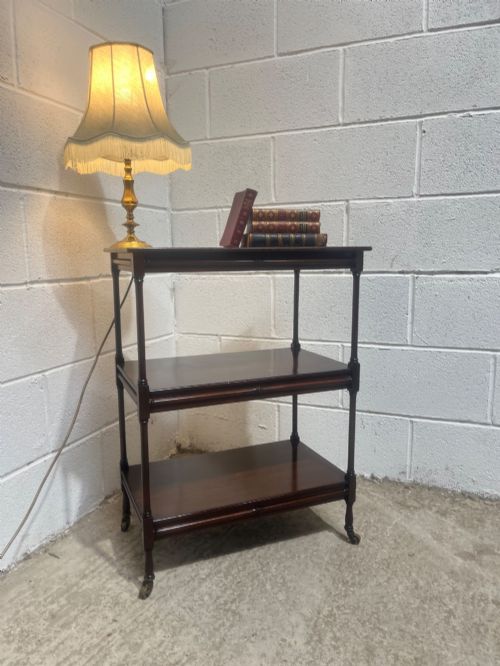
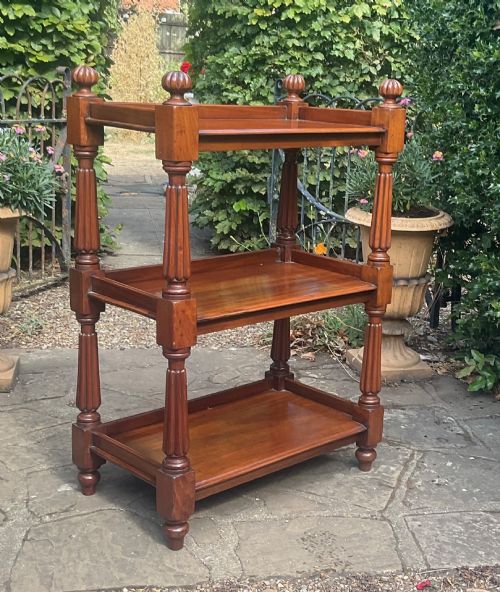
A victorian mahogany buffet stand is a multi-tiered piece designed for serving, displaying, or storing items within domestic interiors. These pieces take forms such as dumb waiters, etageres, trolleys, and tiered tables, aligning with the nineteenth-century taste for organised presentation.
The versions most commonly met on this page span the nineteenth century, including specific dates around eighteen-fifty and eighteen-eighty alongside pieces from the Georgian, Regency, and Edwardian periods. They appear predominantly in mahogany, occasionally incorporating brass and glass elements across styles that range from plain Victorian utility to Victorian Rococo Revival and William IV.
How they were made
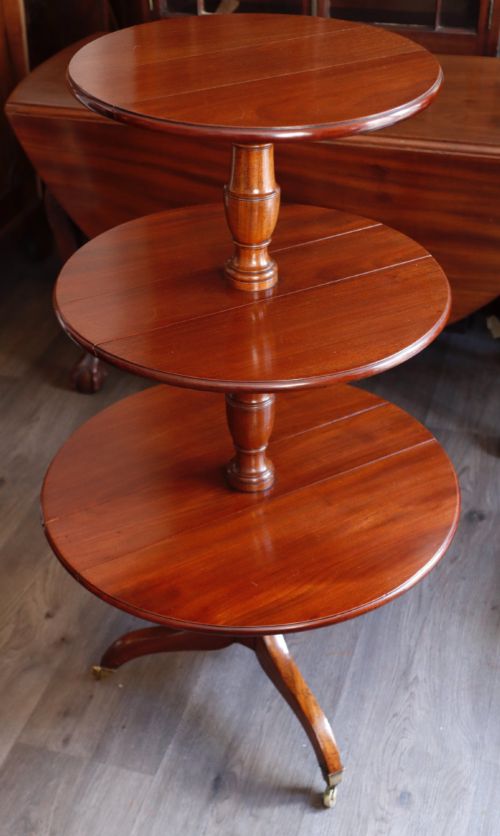
Makers utilised solid mahogany and mahogany veneers selected for deep colour and prominent grain patterns, shaping the timber into multi-tiered circular or rectangular shelves supported by turned columns or tripod bases. Structural joints relied on traditional cabinet-making methods to sustain the weight of heavy service items across multiple tiers.
Metal fittings such as brass castors or cast collars frequently appear on mobile trolley and dumb waiter designs to facilitate movement across floor surfaces. Glass inserts are occasionally integrated into the shelving structure, adding textural contrast to the timber framework.
Some revolving dumb waiters feature tiers that turn independently, allowing Victorian diners to spin the cheese board without disturbing the port.
What varies in quality
The standard of a victorian mahogany buffet stand rests on the depth of timber selection, the crispness of turned supports, and the structural integrity of the tiered shelves. Pieces intended for major exhibitions or produced by prominent firms demonstrate superior carving work and heavier gauge timber compared to simpler domestic items.
Refinement in proportion and the integration of functional elements, such as smoothly revolving tiers or robust brass castors, separate standard production items from more ambitious architectural forms like large mirror-back console tables and exhibition-quality etageres.
Maple and Co
The Victorian Mahogany Buffet Stand Glossary
- Mahogany
- A durable tropical hardwood prized for its rich reddish-brown colour and fine grain. Cabinet-makers relied on it extensively throughout the eighteenth and nineteenth centuries for high-status furniture.
- Dumb waiter
- A tiered piece of furniture designed to hold dishes, glassware, or books without the need for immediate servant attendance. These units often feature revolving circular shelves mounted on a central column.
- Etagere
- A set of open shelves arranged in tiers for displaying ornaments and small objects. The form gained popularity in the nineteenth century as domestic spaces embraced decorative grouping.
- Tripod base
- A three-legged support structure commonly found beneath circular tables and dumb waiters. This configuration provides stable contact on uneven historical flooring.
Victorian Mahogany Buffet Stand: Frequently Asked Questions
What is a victorian mahogany buffet stand used for?
These pieces served originally as auxiliary tables for holding dishes, drinks, or serving utensils during meals in nineteenth-century dining rooms. Today, they function effectively as display surfaces for books, plants, and decorative objects in living spaces.
The tiered configuration allows users to utilise vertical room efficiently, placing bulkier items on lower levels while keeping smaller objects accessible on top.
How do I date a mahogany buffet stand?
Dating relies on observing stylistic markers, construction techniques, and the specific turnings of the central columns. Pieces from the Regency era often display cleaner classical lines, while Victorian examples introduce heavier proportions and carved ornamentation.
Secondary woods used in drawer linings or interior framing also provide clues, as workshop practices shifted across the decades of the nineteenth century.
Are these stands difficult to move around?
Many examples feature original brass castors beneath tripod bases or heavy legs specifically designed to let the stand glide across carpets and floorboards. Models built as stationary console tables or large etageres lack wheels and require fixed placement.
Checking the undercarriage reveals whether mobility was an intended feature of the original design.
How do I care for nineteenth-century mahogany?
Mahogany responds best to regular dusting with a soft, dry cloth and occasional treatment with appropriate natural waxes to nourish the timber grain. Direct sunlight should be avoided to prevent the rich reddish-brown tone from fading unevenly over time.
Keeping the furniture away from extreme heat sources protects the joints and prevents the timber from drying out.