



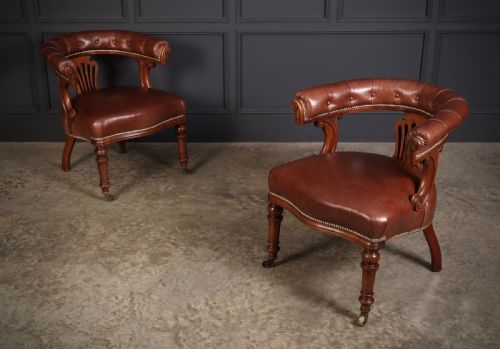


Victorian Leather Tub Chair
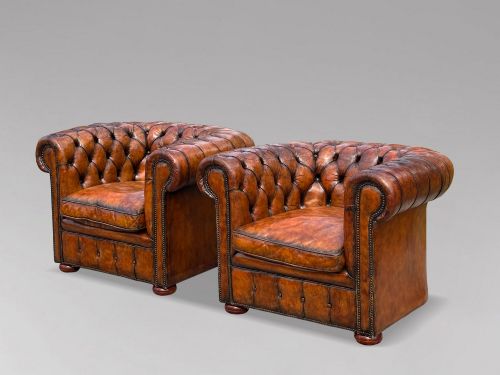
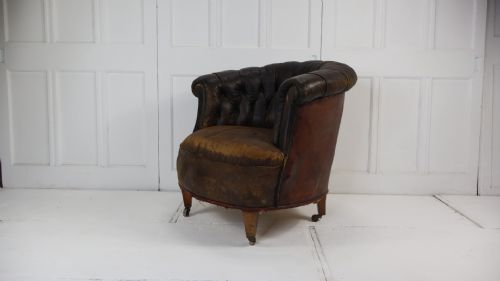
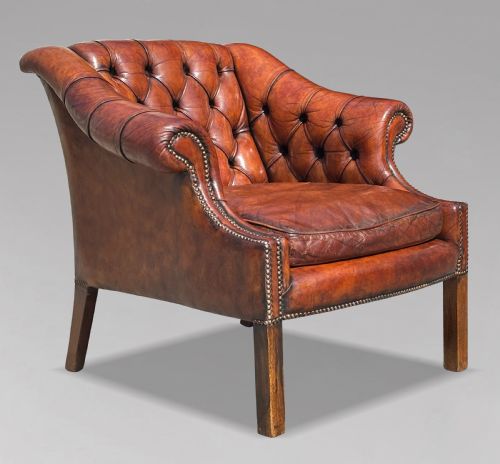
A victorian leather tub chair combines deep-buttoned comfort with sturdy timber frames, offering a practical seat for studies and libraries.
Victorian Leather Tub Chair
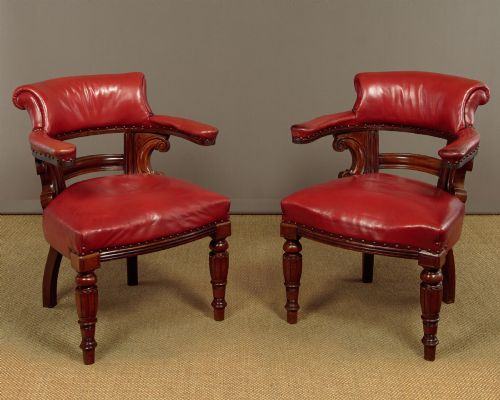
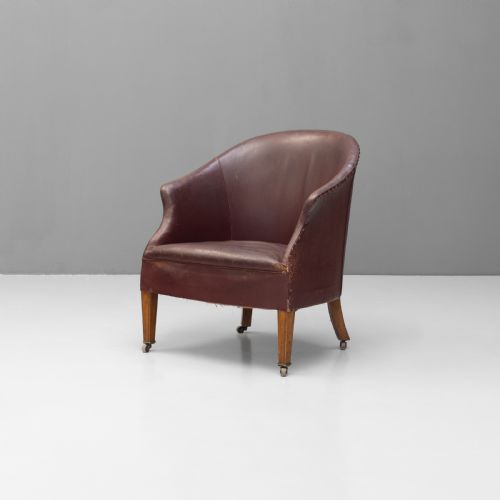
A victorian leather tub chair provides a rounded, enclosing backrest designed to support the sitter during long hours at a desk or in a library.
The pieces appearing here span the nineteenth century, including specific decades such as the eighteen-seventies, eighteen-eighties, and eighteen-nineties, alongside related examples from the Regency period and the early twentieth century.
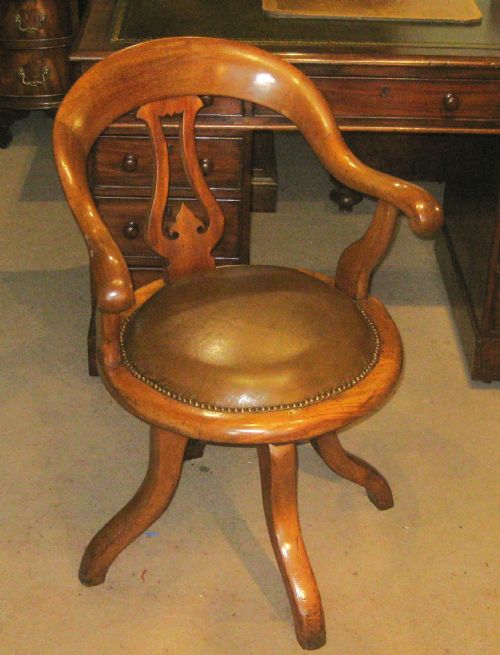
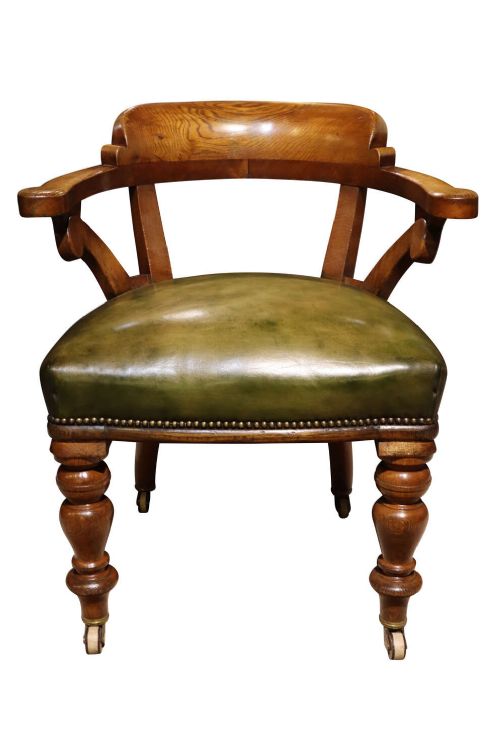
Most entries take the form of desk chairs, armchairs, and revolving office seating, often constructed in mahogany, oak, or walnut with upholstered leather seats and backs.
Materials and Construction
Makers utilised dense timbers such as mahogany, oak, walnut, and burr elm for the structural frames, shaping solid wood into curved rails and legs.
Upholstery relied on durable leather combined with padding, secured frequently with brass studding along the borders of the seat and back.
Revolving and desk variants incorporated internal metal mechanisms and brass castors to allow mobility and smooth turning within the study.
Victorian Leather Tub Chair Retail Price Guide 2026
Typical asking prices for victorian leather tub chair among the pieces listed under this phrase on Sellingantiques today, from the lower quarter to the upper quarter. They describe what is for sale here now, not the wider market.
Listings feature nineteen-century desk chairs and armchairs constructed from mahogany, oak, and walnut with brass castors.
Quality and Craftsmanship
Quality rests in the selection of the timber and the depth of the carving, where solid mahogany or figured walnut frames display crisper mouldings than simpler utility seating.
The treatment of the leather upholstery dictates the finish, ranging from plain fitted coverings to deep-buttoned hides with hand-dyed colouring.
Mechanisms on swivel and revolving desk chairs determine the operational standard, separating basic stationary armchairs from complex adjustable library seats.
Cope and Collinson
The Victorian Leather Tub Chair Glossary
- Tub chair
- An armchair with a continuous curved back and arms forming a low, enclosing cylinder. This shape provides secure side support for reading or writing.
- Captain's chair
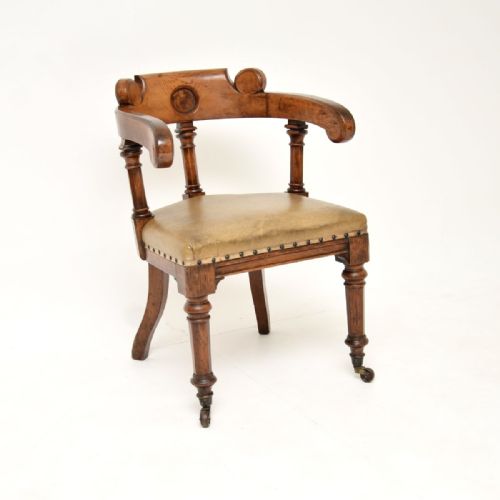
- A sturdy wooden armchair with a low, rounded back rail supported by vertical spindles. These seats frequently served nineteenth-century offices and ships.
- Smoker's bow
- A low wooden armchair with a arched, turned spindle back derived from Windsor chair designs. They commonly feature solid timber seats rather than full upholstery.
- Revolving chair
- An office seat mounted on a central pivot allowing rotation. Nineteenth-century versions often utilised a threaded spindle or metal mechanism hidden beneath the seat.
- Bergere
- An enclosed armchair with upholstered back and sides set within a wooden frame. The term denotes a French seating style adopted by British cabinet makers.
Victorian Leather Tub Chair: Frequently Asked Questions
How do I identify a Victorian tub chair?
Look for a continuous curved backrest that wraps around the sitter, combined with nineteenth-century timber frames in mahogany, oak, or walnut. Many examples include leather upholstery secured with brass tacks.
Examine the turning on the legs and the construction methods underneath to confirm nineteenth-century origin rather than later reproduction work.
Were these chairs used at desks?
Yes, many nineteenth-century examples functioned as library or office seating. Swivel mechanisms and castors allowed users to move easily around a partner desk.
Stationary armchairs also served sitting rooms and studies as comfortable reading seats.
What woods were used for the frames?
Cabinet makers predominantly selected mahogany, oak, and walnut. Some pieces also feature burr elm, golden oak, or mixed timber construction.
Dark finishes were standard, though golden mahogany and lighter polished oaks appear frequently across the period.
How do I care for the leather?
Maintain the leather by keeping it away from direct heat sources and strong sunlight. Regular dusting prevents particle buildup in the creases.
Apply appropriate leather balms periodically to keep the hide supple and preserve the historic finish.