
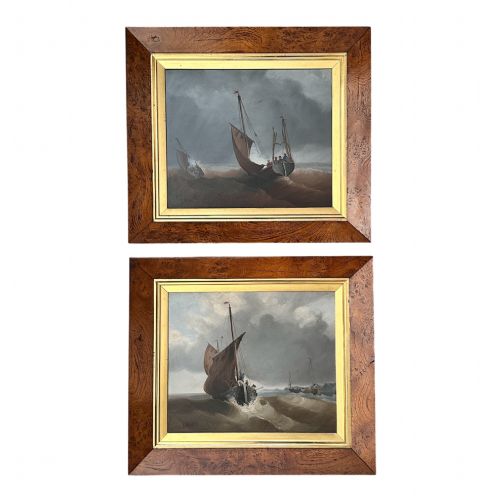
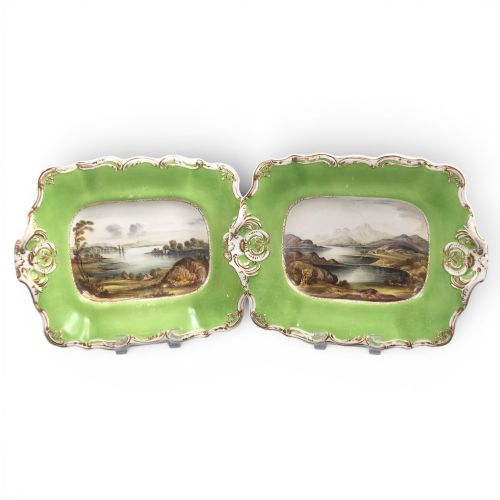


Victorian Landscape Painting Pair
These double works bring matching views and balanced wall decoration straight from the nineteenth century into your home.

Victorian Landscape Painting Pair
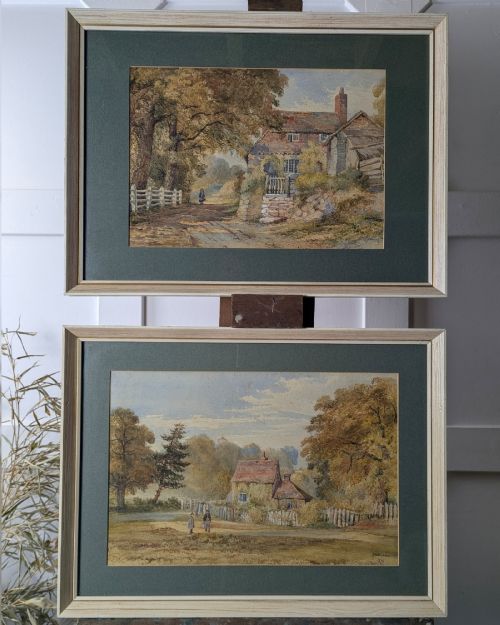
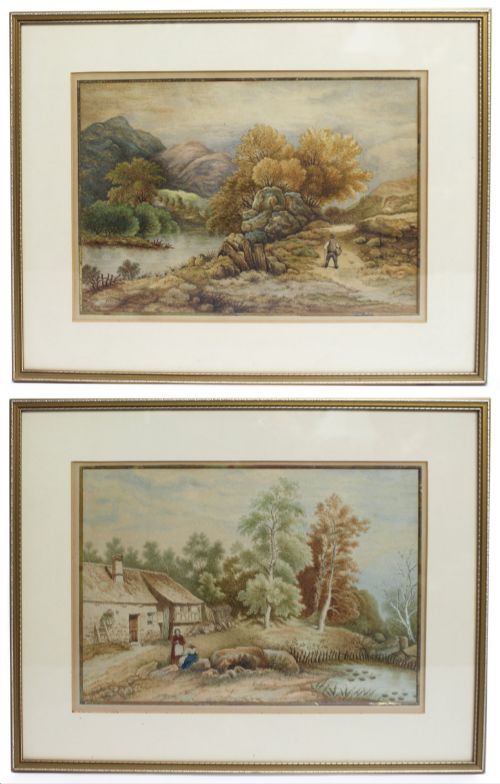
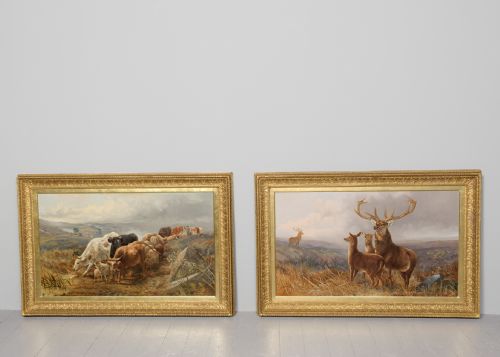
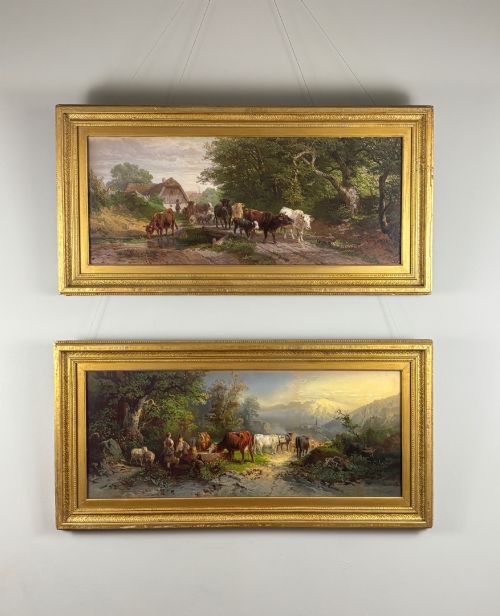
A victorian landscape painting pair presents matching twin compositions created during the nineteenth century, often depicting rural valleys, coastal waters, or highland cattle. These dual works were designed to hang together in domestic interiors, offering balanced symmetry across a mantelpiece or a principal drawing room wall.
Most examples found here utilise oil on canvas or delicate watercolour on paper, framed in period gilt wood to hold their companion status. The subjects range from quiet riverbanks and pastoral scenes to dramatic mountain views, executed by named artists and anonymous hands alike.
Materials and methods
Painters of this era applied oil paint onto stretched canvas or wooden boards, building rich texture and deep colour through successive layers. Watercolours on paper required precise, swift brushwork, often finished with protective glass and heavy moulded frames of giltwood.
Makers shaped the supporting frames from timber and finished them with carved ornament or plaster gilt, ensuring the two halves of a pair matched in decorative weight as well as artistic subject.
Listings feature works in oil and watercolour across periods from the mid-nineteenth century up to the early twentieth century.
Evaluating quality
The standard of execution rests on the confidence of the brushwork, the accuracy of perspective, and the handling of natural light across the terrain. Finer pieces capture atmospheric depth and distinct animal or human anatomy, whereas simpler decorative works rely on formulaic foliage and repetitive skies.
Preservation of the original surface and matching period frames significantly alters the desirability of a pair. Works that retain their untouched nineteenth-century varnish and synchronous framing hold a stronger visual harmony than matched assemblies put together in later decades.
Robert A Nottingham·Th Thibault·Robert Cleminson·Johann Friedrich Voltz·John Moore of Ipswich·John Grenville Fennell·Alfred George Morgan·Gustave De Bréanski·Franz van Severdonck·John Bell·John Frederick Herring Jnr·Clarence Henry Roe·Frederick James Knowles·Lewis J Wood·George Dodgson Callow·Robert Buchan Nisbet·William Mellor·Jan van Couver·Karl Herrle·Sidney Pike·Benedetto Salviati·James H Hulse·Thomas Bush Hardy·Ebeneezer Colls·Robert Watson
The Victorian Landscape Painting Pair Glossary
- Oil on Canvas
- A traditional painting medium where pigments bound in drying oil are applied to woven fabric stretched over a wooden frame. This technique allowed artists to work slowly, blending tones and building heavy texture across the surface.
- Watercolour
- A painting method where fine pigment is suspended in a water-based solution and applied to paper. It relies on the white of the paper showing through thin washes to create luminous, transparent effects.
- Giltwood
- Timber carved and coated with a thin layer of gold leaf or metallic powder. It provided reflective, ornate borders that brightened darker Victorian parlours.
- Tondo
- A circular work of art, whether a painting or a relief sculpture. The curved format presents unique compositional challenges for spatial balance.
- Provenance
- The documented history of ownership surrounding a work of art. Clear records help verify the authenticity and dating of nineteenth-century pieces.
Victorian Landscape Painting Pair: Frequently Asked Questions
Why were these painted as pairs?
Artists and patrons favoured dual compositions to create symmetrical balance when hanging works on either side of a fireplace or architectural feature.
The matching scale, palette, and subject matter provided a unified decorative scheme for Victorian rooms.
How do I hang a pair correctly?
Hang the two works at eye level with a consistent gap between them, ensuring their centre points align on the wall.
If the compositions feature directional lighting or flowing rivers, arrange them so the focal points draw the eye inward toward the furniture below.
Can I separate the two frames?
Separating a matched pair breaks the artistic intent and historical pairing created by the original artist or Victorian framer.
Keeping them together preserves their visual dialogue and value as a complete interior furnishing.
How do I care for nineteenth-century canvases?
Keep painted works away from direct sunlight and sudden temperature shifts to prevent the canvas or wooden panel from warping.
Dust the frames gently with a soft dry brush and avoid using liquid cleaners on the aged oil paint surface.