




Victorian Ladies Davenport
These compact Victorian ladies davenport desks offer ingenious writing surfaces and concealed storage, making them a practical choice for small studies.
Victorian Ladies Davenport
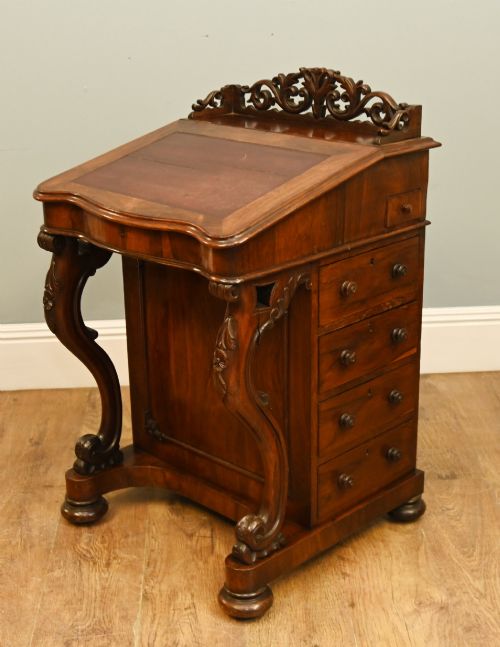
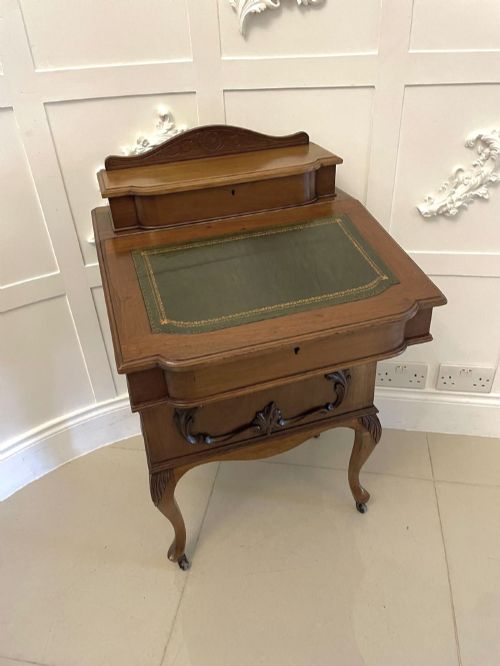
A victorian ladies davenport is a compact writing desk designed during the nineteenth century, combining a sloping writing surface with a set of drawers accessed from the side. The pieces seen here typically date from the 1850s through to 1870, capturing the height of Victorian cabinet-making.
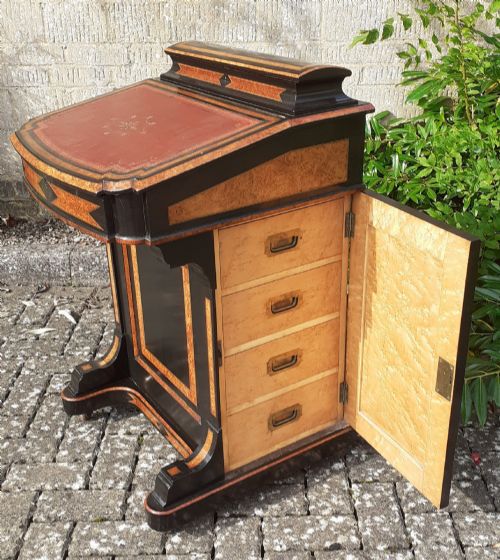
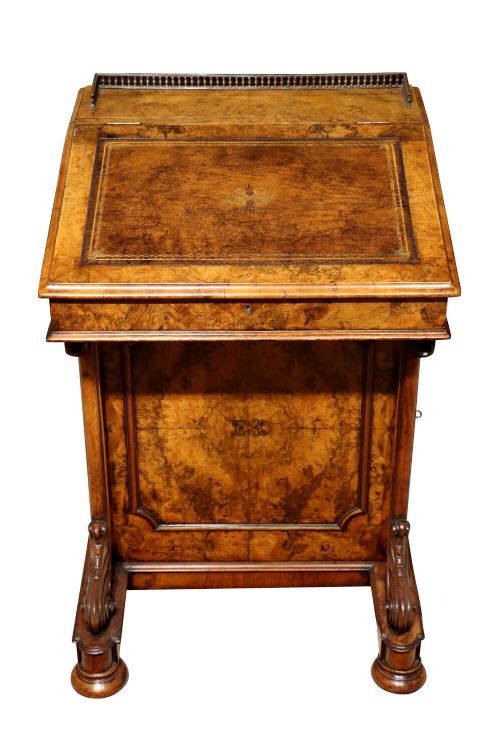
Most examples found on this page are constructed from walnut, frequently featuring burr walnut veneers or marquetry inlay. Alongside standard rectangular forms, variations include freestanding models, kidney-shaped desks, and specialised pop-up variants.
These desks serve primarily as intimate writing tables, often incorporating satinwood interiors with small compartments for stationery and ink. Their dual function as storage cabinets and writing slopes made them popular for boudoirs and drawing rooms.
How They Were Made
Cabinet-makers utilised dense timbers such as walnut, rosewood, ebony, and ambboyna as the foundation for these desks. They frequently applied burr walnut veneers to create highly figured, decorative surfaces on the sloping lids and drawer fronts.
Brass hardware, including hinges, castors, and handles, was incorporated to accent the dark timbers and facilitate movement. Leather inserts were commonly fitted into the writing slopes to provide a smooth, durable surface for correspondence.
Interior compartments utilised lighter woods like satinwood, demonstrating meticulous joinery for hidden drawers and stationery slots. Marquetry inlay was often added to the exterior surfaces, employing contrasting woods to form intricate geometric or floral patterns.
Victorian Ladies Davenport Retail Price Guide 2026
Typical asking prices for victorian ladies davenport among the pieces listed under this phrase on Sellingantiques today, from the lower quarter to the upper quarter. They describe what is for sale here now, not the wider market.
Materials documented across the desks include walnut, burr walnut, rosewood, ebony, ambboyna, leather, and brass.
What Varies in Quality
The refinement of the timber selection largely determines the standing of a davenport, with richly figured burr walnut and exotic woods like ambboyna occupying the upper tier. Plain walnut or less distinct grain patterns indicate a more utilitarian construction.
The complexity of the interior fittings and the precision of the marquetry inlay also distinguish finer examples. Desks featuring bespoke satinwood stationery compartments and detailed brasswork reflect a higher grade of Victorian craftsmanship.
The Victorian Ladies Davenport Glossary
- Burr walnut
- A figured wood obtained from the wart-like growths on walnut trees, prized for its swirling grain patterns. Cabinet-makers used veneers of this timber to create highly decorative surfaces on Victorian furniture.
- Marquetry
- The art of applying pieces of veneer to a structure to form decorative patterns and pictures. This technique was frequently utilised on nineteenth-century writing desks using contrasting timbers.
- Satinwood
- A durable, yellowish wood with a lustrous sheen, often used for secondary timbers and interior fittings. It provides a bright contrast when opening the drawers of darker walnut desks.
- Aesthetic movement
- A late nineteenth-century design style that emphasised visual beauty over narrative or moral function. Pieces from this period often display refined lines and Japanese-inspired decorative motifs.
- Pop-up davenport
- A specialised variant incorporating a mechanical rising superstructure for additional storage or stationery compartments. This mechanism demonstrates the ingenuity applied to compact nineteenth-century furniture.
Victorian Ladies Davenport: Frequently Asked Questions
What is a davenport desk?
A davenport is a small, compact nineteenth-century writing desk featuring a sloping top and side drawers.
They were originally designed for ladies to use in boudoirs or drawing rooms for personal correspondence.
How were davenports used?
The sloping top opens to reveal a fitted interior with small drawers and pigeonholes for stationery.
Side drawers store writing materials and papers while keeping the footprint of the desk remarkably small.
Are all davenports Victorian?
The examples seen here predominantly date from the Victorian era, spanning the mid to late nineteenth century.
Periods represented on this page include the 1850s, 1860s, and 1870s.
What materials are used?
Walnut is the predominant timber, frequently enhanced with burr walnut veneers and marquetry inlay.
Other materials recorded include rosewood, ebony, ambboyna, leather writing surfaces, and brass hardware.