


Victorian Inlaid Armchair
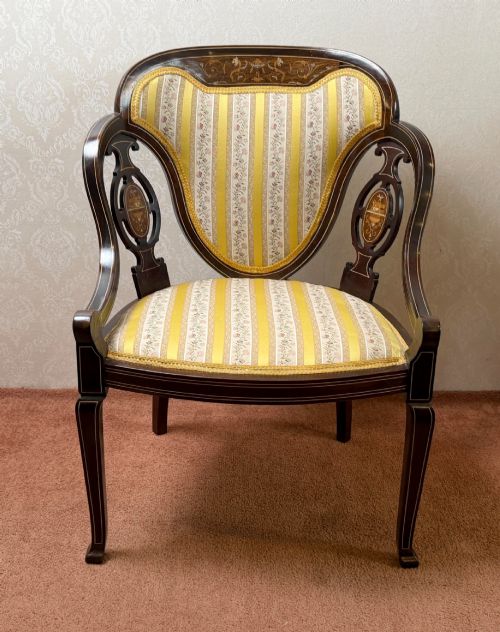
When you seek a victorian inlaid armchair, you are looking at nineteenth-century seating that combines rich timber frames with delicate contrasting wood and brass details.
Victorian Inlaid Armchair
A victorian inlaid armchair spans standard open armchairs, library chairs, corner chairs, and tub chairs produced across the nineteenth century and into the early twentieth century. Mahogany and walnut form the primary timber framework for the vast majority of pieces encountered here.
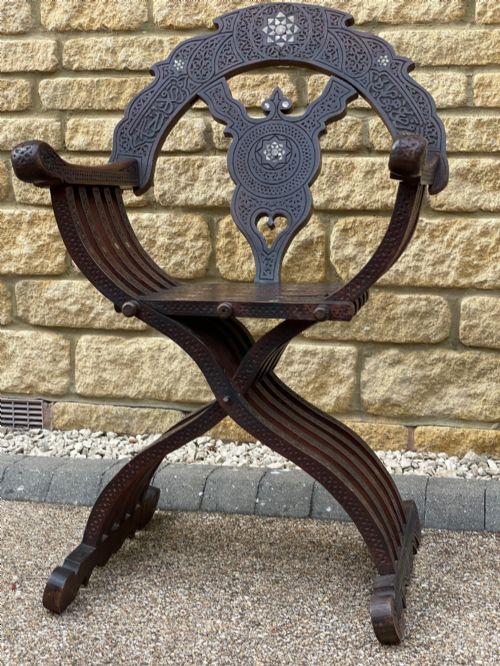
The aesthetic reaches beyond standard Victorian cabinet work into Sheraton Revival, Moorish, Arts and Crafts, and Art Nouveau interpretations. Pieces range from straightforward domestic library seating to more ornate rosewood and satinwood salon chairs.
Materials and construction methods
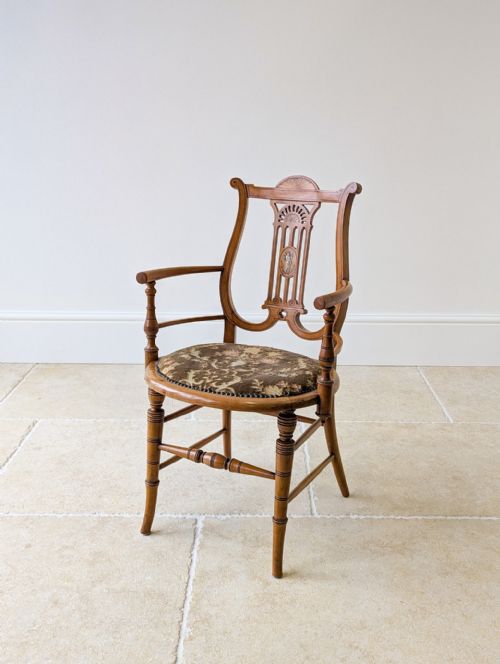
Makers utilised solid timbers such as mahogany, walnut, rosewood, and satinwood, applying contrasting wood veneers and occasional brass or mother of pearl for the decorative motifs. Carved wooden elements, pierced crest rails, and turned supports frequently accompany the inlaid surface patterns.
Upholstery methods vary from traditional horsehair stuffing beneath velvet, leather, or patterned fabric to simpler cane or wooden panel inserts. Frames are assembled with traditional joinery, sometimes supplemented by turned or fluted structural members.
The selection encompasses diverse nineteenth-century styles, including Moorish Revival, Arts and Crafts, and Egyptian Revival.
Distinctions in construction and design
The precision of the wood inlay separates standard commercial seating from finer cabinet work, where floral or geometric motifs align seamlessly into the primary timber. The choice of backing timber, such as dense mahogany or figured walnut, dictates the baseline solidity of the frame.
Detailing in the carved crest rails, the crispness of turned members, and the retention of original upholstery textiles influence the overall integrity of the piece. Finer examples display meticulous attention to secondary woods and integrated decorative panels.
Liberty and Co·Jenks and Wood·Edwards and Roberts·Maple and Co·Sanderson
The Victorian Inlaid Armchair Glossary
- Inlay
- A technique where pieces of contrasting wood, metal, or shell are fitted into depressions within a solid timber surface to form decorative patterns. This method defines the primary ornamentation on these frames.
- Sheraton Revival
- A late nineteenth-century design movement drawing on eighteenth-century neoclassical furniture forms, frequently featuring satinwood and delicate marquetry. Pieces in this style display lighter proportions.
- Corner chair
- A seating form designed to fit into the corner of a room, typically featuring a curved top rail supported by multiple spindles and a square seat. These often incorporate detailed wood inlay on the central splats.
- Marquetry
- Form of inlay utilising fitted veneer patterns to create pictorial or decorative designs across the surface of the wood. It appears frequently on rosewood and walnut panels.
- Tub chair
- An upholstered seating form characterised by a continuous curved back and arms that form a single enclosed bucket shape. They provide deep, supportive seating.
Victorian Inlaid Armchair: Frequently Asked Questions
How do I date an inlaid armchair?
Dating relies on identifying the underlying timber, the prevailing style clues like Sheraton Revival or Art Nouveau, and construction methods. Secondary woods and framing techniques offer further confirmation of the manufacturing era.
Cabinet-making trends shifted from solid mahogany frames in the mid nineteenth century to lighter satinwood and rosewood designs by the late Victorian period.
Were these chairs used at desks?
Many smaller open armchairs, swivel versions, and tub forms served dual purposes in libraries and studies. Their lower arm heights allowed them to be pulled close to writing tables.
Library chairs and desk variants often feature more robust timber frames and upholstered leather panels to withstand daily study use.
What is the difference between marquetry and inlay?
Inlay involves sinking pieces of contrasting material into a solid wood base, whereas marquetry assembles an entire veneer puzzle on a paper backing before applying it to the surface. Both techniques decorate nineteenth-century seating.
Marquetry allows for complex pictorial floral arrangements, while simpler line inlay uses strips of contrasting timber to frame panels.
Can I use these chairs every day?
Solid nineteenth-century timber frames tolerate regular domestic use provided the underlying joinery remains sound. Checking the stability of the legs and arm attachments ensures daily reliability.
Upholstered components may require updating over time, though original horsehair and webbing can often be preserved depending on the condition.