



Victorian Horseshoe Back Chair
A victorian horseshoe back chair offers distinctive curved support, bringing nineteenth-century comfort and traditional craftsmanship straight to a modern desk or study.
Victorian Horseshoe Back Chair
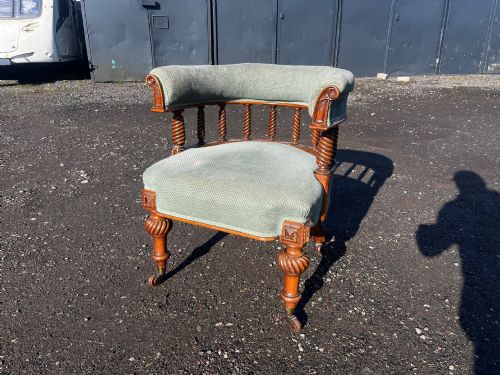
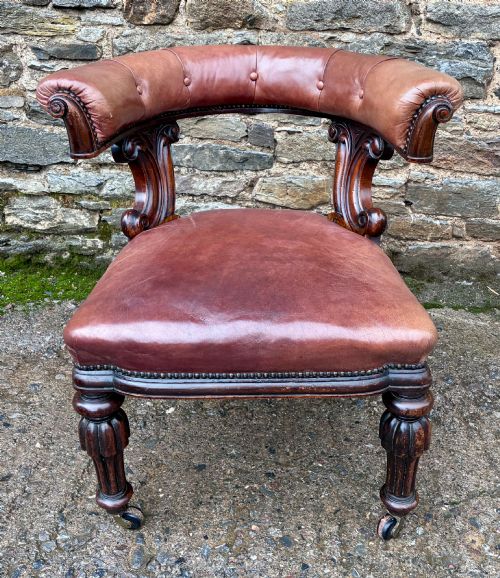
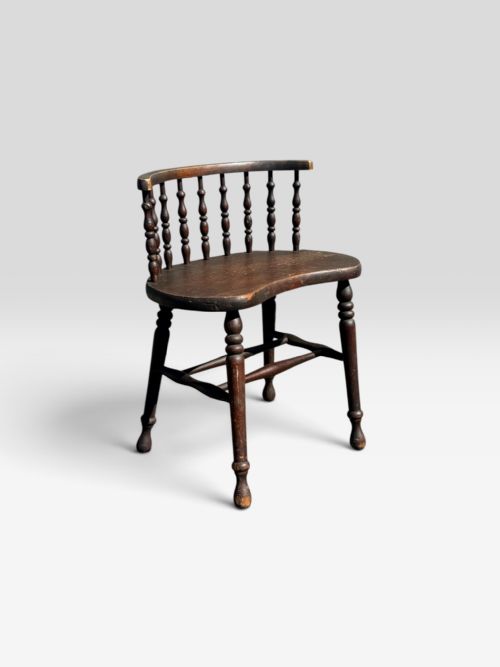
A victorian horseshoe back chair is defined by its sweeping, continuous upper rail that curves around the sitter to form both the backrest and armrests in a single arc. These seating forms serve primarily as functional library chairs, desk chairs, and occasional accent chairs within period interiors.
The versions most commonly met on this page span the nineteenth century, including specific dates from the eighteen-fifties and eighteen-sixties alongside Edwardian examples. They take various forms such as corner chairs, cockfighting chairs, and gaming chairs designed for specific domestic tasks.
Makers of the period built these seats to accommodate long hours of reading, writing, or leisure. The distinctive curved geometry ensures that the occupant receives continuous support around the upper body.
Materials and Construction
Cabinet makers utilised dense hardwoods such as mahogany, walnut, oak, elm, and beech to construct the sturdy frames required for these curved designs. Mahogany and walnut provide a refined appearance for library and desk settings, whilst oak, elm, and beech frequently appear in more robust vernacular or country pieces.
Upholstery represents a major component of construction, with leather and various fabrics fitted to the seats and backrests. Brass details and studs often secure the leather upholstery to the wooden framework, adding both structural reinforcement and decorative contrast.
Victorian Horseshoe Back Chair Retail Price Guide 2026
Typical asking prices for victorian horseshoe back chair among the pieces listed under this phrase on Sellingantiques today, from the lower quarter to the upper quarter. They describe what is for sale here now, not the wider market.
Listings feature pieces spanning the Victorian and Edwardian periods, utilising materials such as mahogany, walnut, oak, elm, leather, and brass.
Variations in Quality
Quality in a victorian horseshoe back chair rests upon the execution of the curved wooden elements and the integrity of the timber selection. Finer examples display seamless joinery along the continuous rail, whilst simpler items utilise more utilitarian timbers like elm or beech.
The grade of the secondary materials also dictates the standing of the piece. Premium examples feature high-quality leather upholstery and precise brass detailing, whereas standard versions rely on simpler fabric coverings and plain wooden frames.
The Victorian Horseshoe Back Chair Glossary
- Horseshoe back
- A seating design featuring a continuous curved rail forming the backrest and arms. This shape distributes support evenly around the sitter.
- Library chair
- A heavy, comfortable armchair intended for reading rooms and studies. These often feature upholstered leather pads and sturdy wooden frames.
- Cockfighting chair
- A low-backed seating form traditionally designed with a padded rest on the upper rail. Sitters would straddle the seat facing backward for specific leisure activities.
- Corner chair
- A chair constructed to fit into the corner of a room, featuring a diagonal orientation and a curved back rail supported by multiple uprights.
Victorian Horseshoe Back Chair: Frequently Asked Questions
What is a horseshoe back chair used for?
A victorian horseshoe back chair functions primarily as seating for desks, libraries, and studies where comfort and support are necessary during extended periods of sitting.
The curved backrest provides ergonomic support around the sides of the body, making these chairs practical for writing and reading tasks.
How do I identify a Victorian horseshoe back chair?
Identification relies on observing the continuous curved wooden rail that sweeps around the back to form the arms. Nineteenth-century examples typically utilise dense timbers like mahogany, walnut, or oak.
Details such as leather upholstery, brass studs, and specific turning on the legs further help date the piece to the Victorian or Edwardian eras.
Are these chairs comfortable for daily use?
These nineteenth-century chairs were originally built for practical tasks in libraries and studies, offering supportive upright seating. The padded leather or fabric seats provide adequate cushioning for modern daily use at a desk.
The wraparound backrest also encourages a stable and supported posture while working.
What woods were used for these chairs?
Cabinet makers selected hardwoods depending on the intended style and function of the chair. Mahogany and walnut were chosen for formal library and desk settings.
Elm, beech, and oak appear more frequently in country or vernacular pieces, providing durability and a different aesthetic character.