




Victorian Gilt Bronze Timepiece
A Victorian gilt bronze timepiece brings French and English decorative metalwork together in mantel, carriage and boudoir forms.
Victorian Gilt Bronze Timepiece
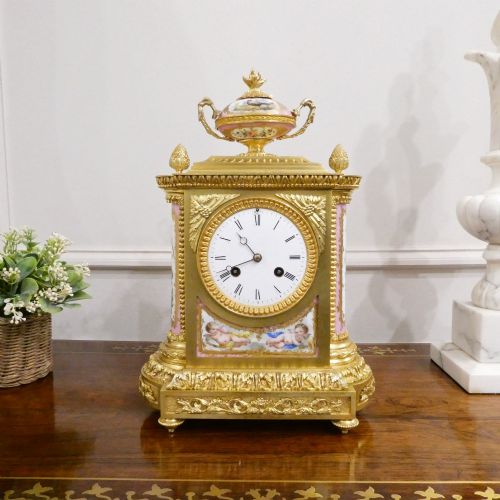
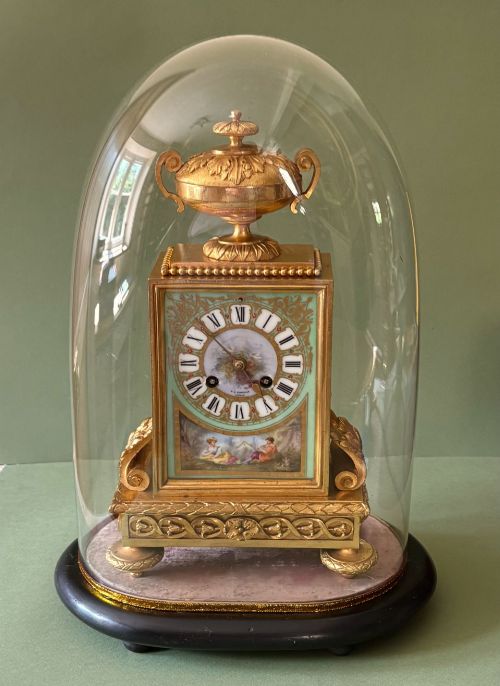
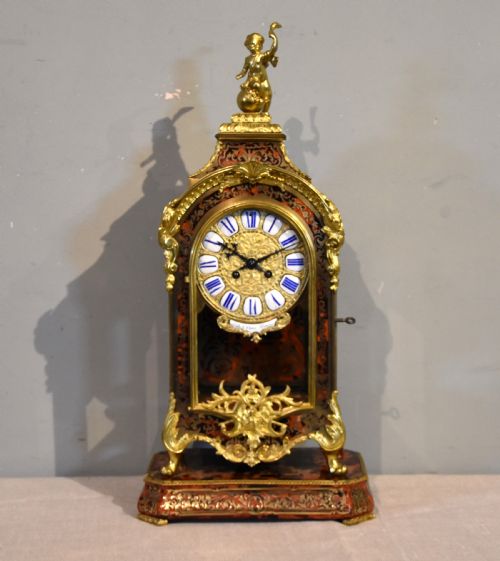
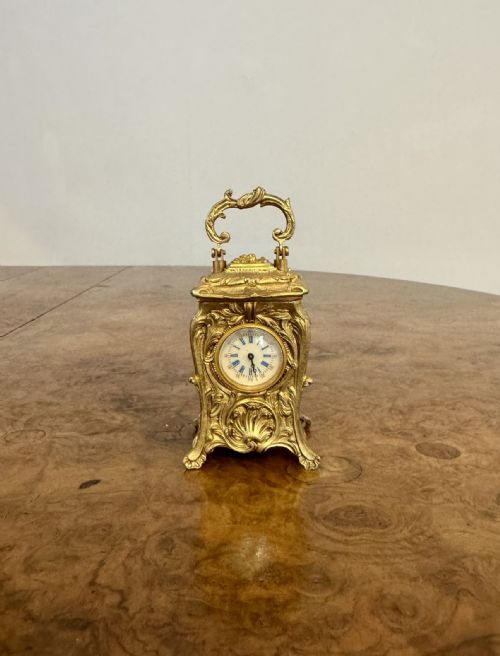
A victorian gilt bronze timepiece represents a diverse group of nineteenth-century clocks spanning mantel, carriage, table and desk formats. You will find grand architectural cases alongside diminutive boudoir clocks, miniature bedside pieces and clock garnitures.
The majority of these objects originate from French workshops and Parisian makers, though English makers also contribute fusee movements and architectural cases. Dating spans predominantly from eighteen-sixty to nineteen-hundred, incorporating Victorian eras and French Second Empire aesthetics.
Forms range widely from Rococo revival swirls with cherubs to classical porticoes, crystal regulators and novelty desk clocks. Dial configurations vary from hand-painted enamel to visible escapements and champleve enamel panels.
Materials and construction
Makers utilised gilt bronze and ormolu extensively for the primary housings, pairing the golden metallic surfaces with contrasting white marble, slate, alabaster and glass. Enamel appears frequently on dials and inset panels, complemented by champleve technique and porcelain mounts.
Foundries cast bronze and brass components before applying mercury gilding or electroplating to achieve the characteristic rich surface sheen. Movements rely on mechanical brass gear trains, often featuring eight-day springs, platform escapements or single chain fusee systems.
Victorian Gilt Bronze Timepiece Retail Price Guide 2026
Typical asking prices for victorian gilt bronze timepiece among the pieces listed under this phrase on Sellingantiques today, from the lower quarter to the upper quarter. They describe what is for sale here now, not the wider market.
Several clocks feature playful cherubs clinging to dragonfly wings, swinging from pendulums or operating industrial steam engines.
Judging the range
Quality separates through the crispness of the bronze casting and the depth of the hand-chasing on floral or figural motifs. Superior examples display intricate piercing and deeply carved details rather than soft, flat surfaces.
The sophistication of the movement and signature of a known maker elevate a piece substantially. Fully engraved carriage cases, hand-painted enamel dials and multi-piece marble or porcelain garnitures indicate higher tier workshop production.
Jean-Baptiste Delettrez·Philippes Paris·Samuel Marti·Le Roy and Fils·Achille Brocot·Victor Paillard·John Bennett Cheapside London·James Ritchie and Son·John Walker·Barwise London·Payne of London
The Victorian Gilt Bronze Timepiece Glossary
- Gilt bronze
- Metal cast in bronze and treated with gold leaf or mercury gilding to produce a permanent golden finish. It forms the primary housing for many nineteenth-century French clocks.
- Ormolu
- Finely ground high-purity gold applied to a bronze base using a mercury amalgamation method. This historic technique creates a warm, dense lustre distinct from modern electroplating.
- Carriage clock
- A portable spring-driven timepiece fitted with a handle and glass panels designed for travel. Nineteenth-century examples often sit in dedicated leather carrying cases.
- Champleve
- An enamelling technique where troughs or cells are hollowed out of the metal surface and filled with vitreous enamel prior to firing. It decorates bezels and architectural columns.
- Fusee
- A conical pulley used in mechanical clocks to maintain even power delivery as the mainspring unwinds. This mechanism improves timekeeping accuracy across the duration of the spring power.
Victorian Gilt Bronze Timepiece: Frequently Asked Questions
How do I wind my timepiece?
Most mechanical clocks utilise a matching key inserted into the dial arbors to tension the mainspring barrels. Turn the key gently until you feel firm resistance, avoiding overwinding.
Ensure you identify whether the clock has a time-only movement or a striking train before tensioning both arbors.
Where should I place a bronze clock?
Position your clock on a stable, level surface away from direct sunlight, central heating vents and damp areas. Mantelpieces and sturdy console tables provide ideal support.
Keep the environment temperature stable to protect delicate enamel dials and mercury-gilded bronze finishes from environmental stress.
How do I set the correct time?
Move the minute hand forward slowly until the hands indicate the correct hour. Avoid turning the minute hand backwards on striking clocks, as this can jam the internal rack and snail mechanism.
Allow the pendulum or platform escapement to settle into a steady beat after adjusting the hands.
What periods do these clocks cover?
The inventory spans the nineteenth century, concentrating heavily on the Victorian era between eighteen-sixty and nineteen-hundred. You will encounter transitional periods including French Second Empire and Rococo Revival styles.
Dates are deduced from stylistic markers, dial signatures and associated maker records.