
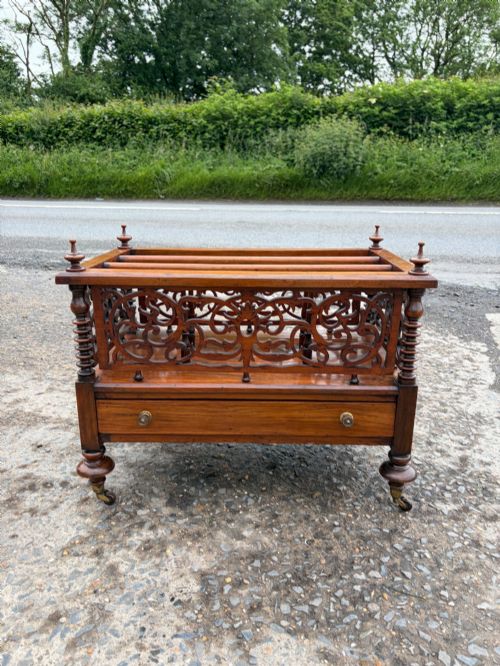


Victorian Fretwork Canterbury
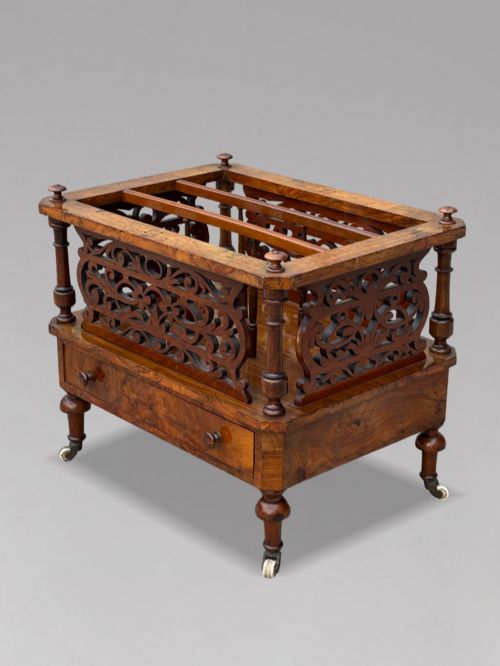
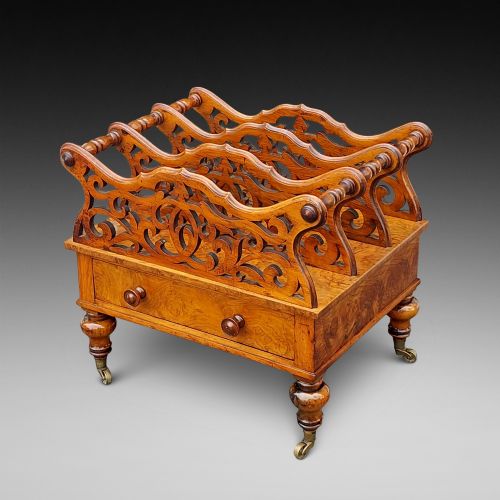
These Victorian fretwork canterbury pieces are versatile nineteenth-century stands designed for sheets of music and magazines, combining compartments with occasional table surfaces.
Victorian Fretwork Canterbury
A Victorian fretwork canterbury brings together partitioned storage and low table designs from the nineteenth century. These pieces appear most frequently in walnut, burr walnut, rosewood, and mahogany, spanning the decades from eighteen fifty to eighteen eighty.
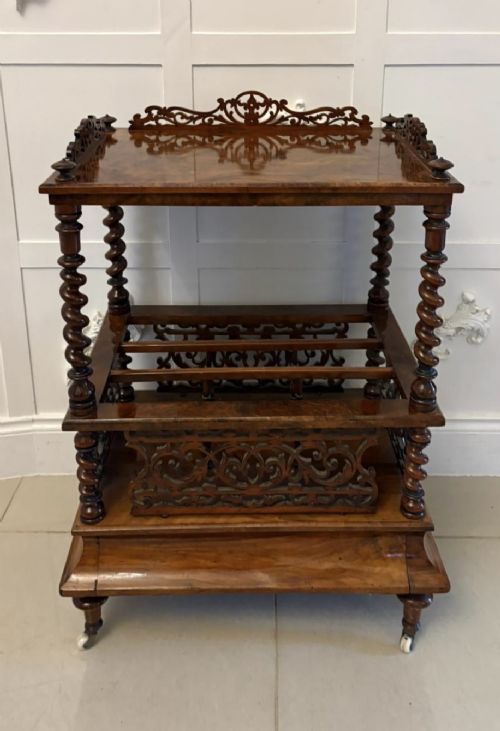
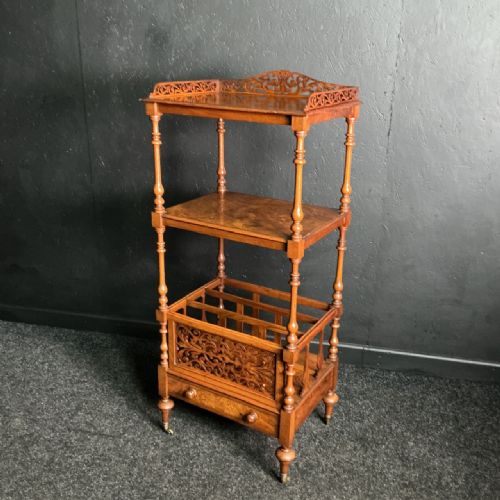
Beyond standard magazine racks and music canterburys, the listings include combined whatnots, lamp tables, and occasional tables with pierced fretwork divisions. Makers often incorporated drawers, ceramic castors, or inlaid details into these multifunctional parlour items.
Materials and construction
Cabinet makers utilised choice timbers such as figured burr walnut, rich rosewood, and dense mahogany to build these canterburys. Surfaces frequently display intricate inlay work, while the structural divisions rely on fine pierced fretwork and scroll cutting.
Many examples incorporate turned columns, brass hardware, and ceramic castors to support the combination of compartmentalised racks and lower drawer storage. The integration of table tops and whatnots demanded precise joinery to balance the open framework.
Some nineteenth-century musicians clearly had heavy reading habits, trusting delicate fretwork partitions to support piles of folios.
Judging quality
Quality rests upon the selection of timber veneers, particularly the grain figuration in burr walnut and rosewood surfaces. The crispness of the pierced fretwork divisions and the precision of any inlaid detailing distinguish finer workshops from simpler production.
Structural integrity matters significantly because the open partitions experience frequent handling. Pieces that combine multiple functions, such as a whatnot shelf above a compartment and a drawer below, demonstrate greater ambition in nineteenth-century cabinet making.
The Victorian Fretwork Canterbury Glossary
- Canterbury
- A low stand with partitions for holding music sheets, books, or magazines, often incorporating a drawer or table top.
- Fretwork
- Openwork ornamentation cut in wood, frequently seen in the pierced vertical divisions of nineteenth-century magazine racks.
- Burr Walnut
- A highly prized timber veneer showing swirling, knotty growth patterns that create decorative surface grain.
- Whatnot
- A piece of open shelving standing on legs, sometimes combined with a canterbury base to hold books and decorative objects.
Victorian Fretwork Canterbury: Frequently Asked Questions
What are canterburys used for?
These nineteenth-century stands were originally built to hold sheet music and folios near a piano or parlour seating. Today they function effectively as magazine racks, lamp tables, or side tables in a living space.
The partitioned sections keep periodicals or books upright and organised, while the top surface provides room for small lamps or decorative items.
How do I date a Victorian canterbury?
Dating relies on timber choices, stylistic details, and recorded production years from the middle to late nineteenth century. Walnut and rosewood pieces commonly date from eighteen fifty to eighteen eighty.
Gothic revival influences, specific turning on legs, and the presence of inlaid fretwork help narrow the period within the Victorian era.
Are all canterburys fitted with castors?
Many nineteenth-century examples feature small wheels to allow easy movement across carpets in a parlour or drawing room. These castors are frequently made of ceramic or brass.
Not every piece includes them, as static occasional tables and freestanding whatnots often rested directly on plain feet.
Can I use a canterbury as an end table?
The flat top surface of many variants makes them suitable for use beside a sofa or armchair as an occasional table. The lower partitions remain useful for books and papers.
Their compact nineteenth-century proportions allow them to fit into smaller spaces where standard tables might overwhelm the room.