

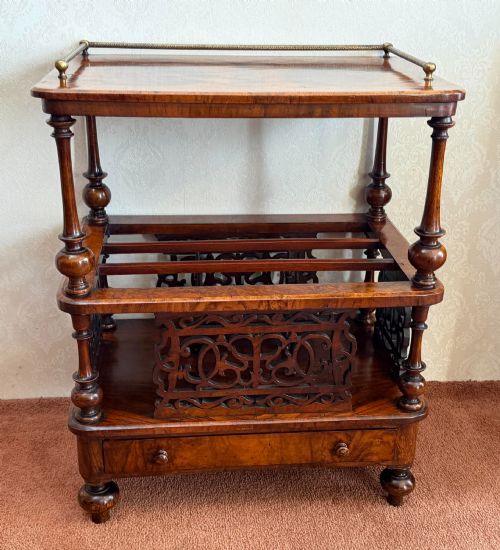

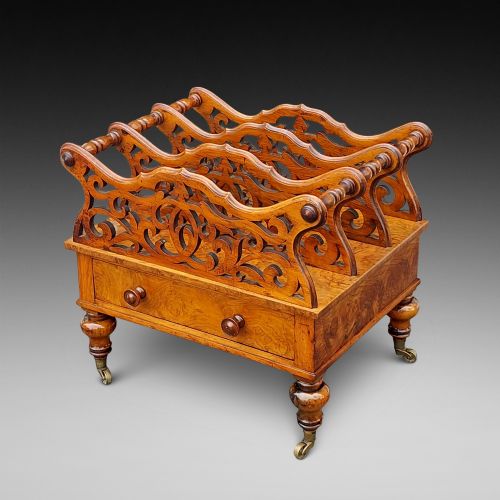
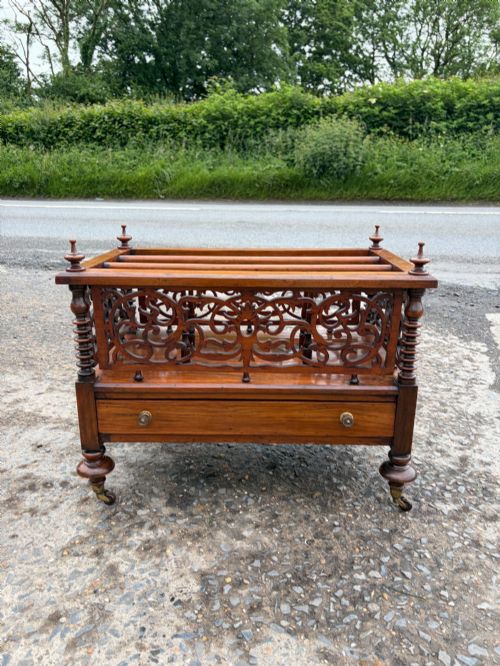


Fretwork Wooden Canterbury
These fretwork wooden canterbury pieces combine Victorian utility with delicate pierced woodwork to organise sheet music and periodicals beside the hearth.
Fretwork Wooden Canterbury
A fretwork wooden canterbury is a low stand designed to hold folios, music sheets, and magazines, usually fitted with vertical dividers and occasionally a drawer or lower shelf. Buyers searching this phrase will find pieces primarily from the Victorian period, spanning the mid to late nineteenth century.
The versions most commonly met on this page take the form of freestanding furniture, frequently combining the function of an occasional table or a small whatnot. They utilise compartmented divisions and pierced scrollwork or inlay to lighten the visual weight of the timber.
How they were made
Cabinet makers constructed these stands using richly figured hardwoods such as burr walnut, mahogany, satinwood, and rosewood, often enhanced with contrasting inlay and pierced fretwork details. The partitions were frequently formed from shaped or scrolled wooden slats, supported by turned pillars or slender legs.
Many examples incorporate brass castors to allow the stand to be easily moved across carpets, while others add small drawers beneath the compartments using traditional dovetailed joinery. The timber surfaces were finished to highlight the natural grain, particularly in burr walnut and rosewood variations.
Fretwork Wooden Canterbury Retail Price Guide 2026
Typical asking prices for fretwork wooden canterbury among the pieces listed under this phrase on Sellingantiques today, from the lower quarter to the upper quarter. They describe what is for sale here now, not the wider market.
Listings span the Victorian era, specifically highlighting the decades between eighteen-fifty and eighteen-seventy.
What varies in quality
The standard of a canterbury rests largely on the choice of timber veneer and the crispness of the pierced fretwork and inlay. Pieces featuring highly figured burr walnut or delicate satinwood sit at the upper end of the scale compared to plainer mahogany versions.
Complexity of form also dictates distinction, with multi-functional designs that serve as a table or whatnot, or those incorporating a functional drawer, showing superior cabinet-making ambition over simpler partition racks.
The Fretwork Wooden Canterbury Glossary
- Canterbury
- A low stand with partitions for holding sheet music, folios, and periodicals. Named after the Archbishop of Canterbury, who supposedly commissioned the first such piece.
- Fretwork
- Ornamental perforated woodwork created by cutting patterns through thin timber. It provides a delicate visual contrast to the solid panels of the stand.
- Whatnot
- An open set of tiered shelves used for displaying small decorative objects. Several pieces on this page combine this form with the lower compartmented canterbury base.
- Burr walnut
- A highly prized timber grain obtained from the wart-like growths on walnut trees. It yields intricate, swirling patterns across the top and sides of Victorian furniture.
Fretwork Wooden Canterbury: Frequently Asked Questions
What was a canterbury used for originally?
These stands were designed to hold sheet music, books, and unbound periodicals near a piano or seating area in a Victorian drawing room.
The partitioned divisions kept papers upright and organised for daily use, while lower drawers stored smaller accessories.
Can a canterbury double as a table?
Certain variations on this page combine the standard compartmented rack with a flat top surface or tiered whatnot shelves.
These combined forms allowed the furniture to serve an auxiliary function as an occasional table while keeping reading materials close at hand.
Where should I place a canterbury at home?
They suit sitting rooms and studies, positioned beside a sofa, armchair, or desk where periodicals and books accumulate.
Their finished backs and freestanding nature also permit placement near the centre of a room rather than strictly against a wall.