

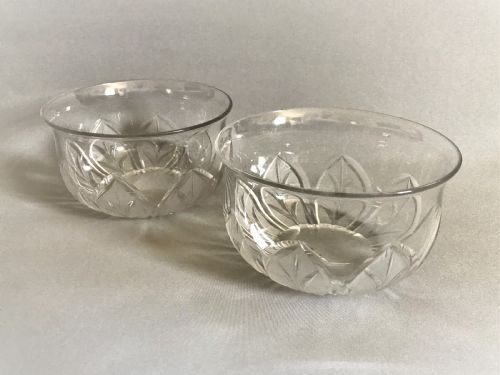


Victorian Etched Glass Bowl
These Victorian etched glass bowl examples combine nineteenth-century clarity with acid-etched ornament, offering a classic table accessory for any traditional interior.
Victorian Etched Glass Bowl
A victorian etched glass bowl encompasses finger bowls, pedestal tazzas, and large table centrepieces originating across the nineteenth century from eighteen-sixty to nineteen-hundred. Buyers inspecting this selection encounter matched sets of rinsers alongside individual pedestal vessels featuring engraved or frosted motifs.
The styles span standard Victorian alongside Bohemian Biedermeier, Grand Regency, and Black Forest Victorian items. Forms range from low sweetmeat vessels to tall centrepieces mounted on carved wood or silver-plated stands.
Materials and Technique
Maker workshops utilised clear glass, lead crystal, frosted glass, and red over crystal, frequently combining acid etching with wheel cutting. Surfaces received detailed engraving depicting fruiting vines, Greek key patterns, or animal decoration.
Support structures incorporated carved wood, such as Black Forest mounts, and silver-plated metal frames produced by firms like Walker & Hall. The combination of heavy lead crystal and delicate surface etching defined the standard production methods.
Victorian Etched Glass Bowl Retail Price Guide 2026
Typical asking prices for victorian etched glass bowl among the pieces listed under this phrase on Sellingantiques today, from the lower quarter to the upper quarter. They describe what is for sale here now, not the wider market.
Among the elegant crystal and silver sits an unusual nineteenth-century Black Forest bear, keeping watch over the delicate glassware.
Judging Quality
Quality rests upon the depth of the wheel cutting and the crispness of the acid etching applied to the glass surface. Superior examples display sharp, well-defined motifs rather than soft or shallow surface marks.
The integrity of combined materials also dictates standing, particularly where glass vessels meet carved wooden mounts or silver-plated frames. Matched sets command attention through uniform thickness and consistent colour saturation across every piece.
Walker & Hall·Baccarat
The Victorian Etched Glass Bowl Glossary
- Finger bowl
- A small vessel utilised at the conclusion of a meal for rinsing the fingers. These frequently appear in matched sets of four.
- Tazza
- A shallow ornamental bowl raised upon a central foot or pedestal stem. They function as centrepieces for serving sweetmeats or displaying fruit.
- Epergne
- A large table centrepiece featuring a central bowl and multiple hanging arms or trumpets. They were positioned centrally during formal dining.
- Lead crystal
- Heavy glass containing metallic oxides that increase brilliance and weight. This material responds well to deep wheel cutting and fine engraving.
- Frosted glass
- Glass treated to achieve a matte, opaque surface texture. Makers utilised this technique to create contrast against clear or cut panels.
Victorian Etched Glass Bowl: Frequently Asked Questions
How do I date a victorian etched glass bowl?
Dating relies upon stylistic markers, material combinations, and the specific motifs utilised in the engraving. Pieces from eighteen-sixty often feature simple cut and frosted designs, while nineteen-hundred examples show broader decorative arts influences.
The presence of associated silver plating from known makers or specific regional styles like Bohemian Biedermeier further narrows the production window.
Are these bowls always sold in sets?
While many functional pieces like finger bowls and rinsers survive as matched sets of four, larger tazzas and centrepieces generally appear individually. The listings reflect both multi-piece table services and singular decorative vessels.
Buyers find complete sets alongside standalone pedestal bowls, depending on the original purpose of the specific form.
What materials are combined with the glass?
Maker workshops frequently paired lead crystal and clear glass with carved wood and silver-plated metal. Black Forest items incorporate detailed carved wooden stands, while other vessels utilise silver-plated frames.
These mixed-media pieces combine traditional glass cutting with sculptural wooden mounts or metal framework to create elaborate centrepieces.