


Victorian Earthenware Dog Statues
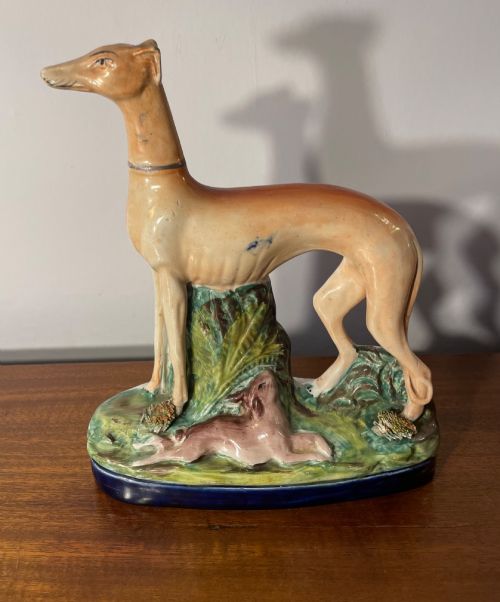
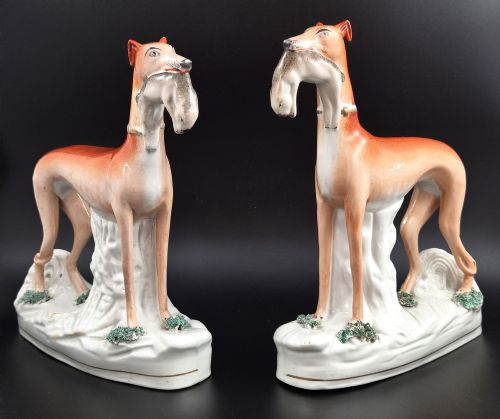
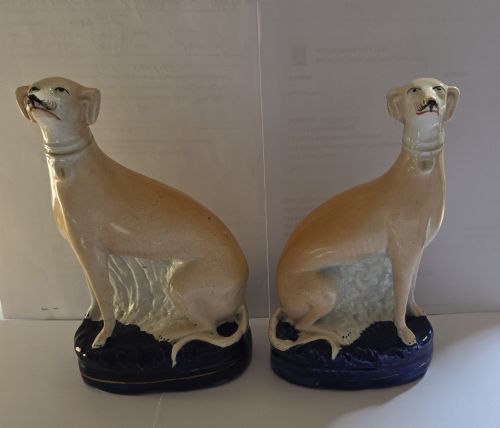
These Victorian earthenware dog statues bring domestic character and historic ceramic craft into a room through pairs of spaniels, poodles, and greyhounds.
Victorian Earthenware Dog Statues
Victorian earthenware dog statues appear chiefly as seated pairs of spaniels, poodles, greyhounds, and pugs modelled in the 19th century. English traditional workshops produced these decorative figures and pottery groups, ranging from miniature models to large mantel ornaments.
The selections span several decades of the 19th century, with pieces recorded from the Georgian era through to the late Victorian period around 1900. Alongside standard mantel pairs, buyers encounter desk accessories such as greyhound quill holders and figures depicting huntsmen with dogs.
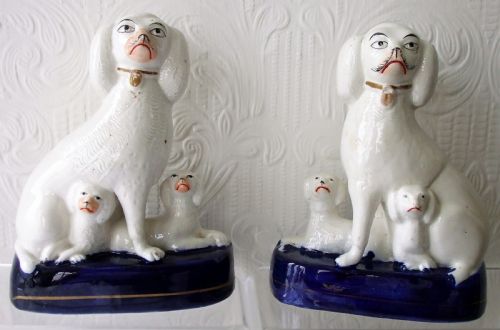
Moulded earthenware forms dominate the inventory, often featuring spaniels on blue cushions or poodles with pups. Many examples originate from Staffordshire potteries, capturing domestic and sporting canine breeds popular during the period.
Materials and technique
Potters shaped these figures from earthenware clay using press moulds, frequently joining front and back sections before firing. The resulting hollow bodies provided a stable base for subsequent surface decoration.
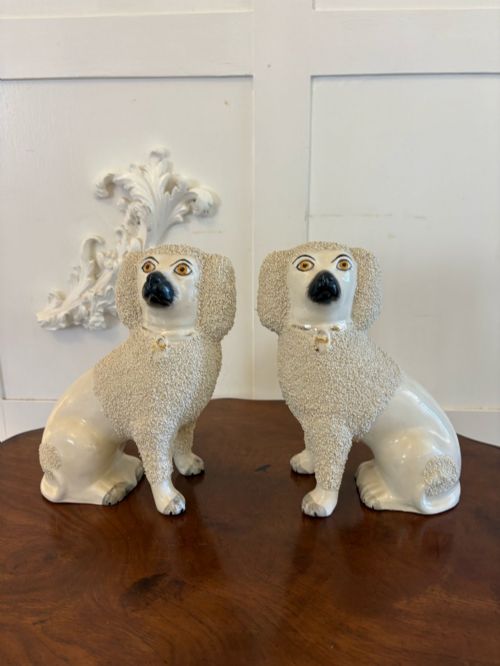
Woolly poodles sport textured clay curls that make them look freshly groomed for a Victorian portrait.
Defining quality
Quality rests primarily in the crispness of the moulding and the finesse of the hand-painted enamel work. Softer contours and blurred markings indicate secondary production runs, whereas superior examples exhibit sharp facial expressions and clean separation of textured elements like poodle curls.
Scale and completeness also influence standing, particularly in matched pairs with substantial dimensions or uncommon breeds such as Maltese terriers and greyhounds with hares. The presence of original gilt highlights and well-preserved glaze surfaces elevates an individual figure within the range.
Bernard Bloch Austria·Beswick
The Victorian Earthenware Dog Statues Glossary
- Earthenware
- Porous pottery fired at lower temperatures than stoneware or porcelain. It forms the standard ceramic body for these 19th-century figures.
- Lead glaze
- A glossy coating containing lead oxide applied to pottery before firing. It produces a smooth, reflective surface across the earthenware body.
- Enamel paint
- Vitreous pigments applied over the fired glaze and fixed by a low-temperature second firing. These paints provide the distinctive black, white, and copper-lustre markings.
- Quill holder
- A functional desk accessory featuring an integrated inkwell or pen rest. Several greyhound figures serve this dual purpose.
- Encrusting
- Applied ceramic clay slip or particles pressed onto the surface to simulate texture. This technique appears on cushions and fur details.
Victorian Earthenware Dog Statues: Frequently Asked Questions
What dog breeds appear most often?
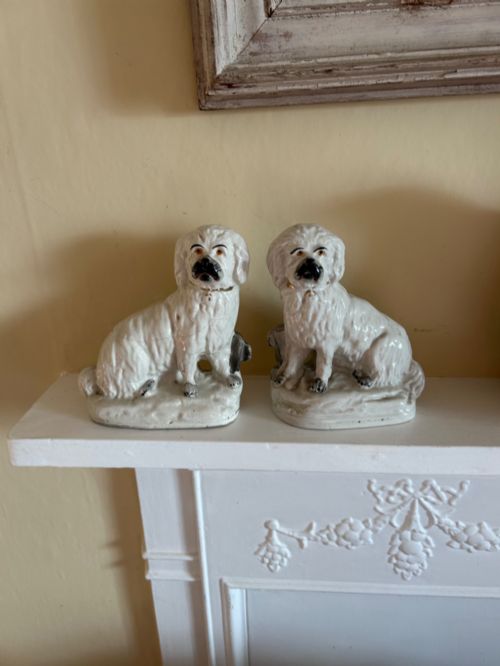
Spaniels and poodles form the majority of the surviving figures, often modelled as seated pairs facing one another on mantels.
Greyhounds, pugs, and Maltese terriers also appear less frequently, sometimes paired with hares or children.
Were these figures meant for display?
Potters created these statues primarily as decorative ornaments for domestic interiors, designed to sit atop mantelpieces in pairs.
Some specialised pieces, such as greyhound quill holders, combined decorative appeal with a practical desk function.
How do I date a figure?
Stylistic details, glaze characteristics, and potting methods help narrow the production period within the 19th century. Earlier Georgian and early Victorian pieces often display simpler hand-painted markings, while later Victorian examples utilise refined enamel palettes.
Makers or specific regional attributes recorded in marketplace titles offer further chronological markers.
Why are most figures sold in pairs?
Traditional Victorian interior display symmetry dictated that mantel ornaments face inward toward a central clock or mirror.
Potters produced these spaniels and poodles as mirrored pairs to satisfy this domestic decorating custom.