

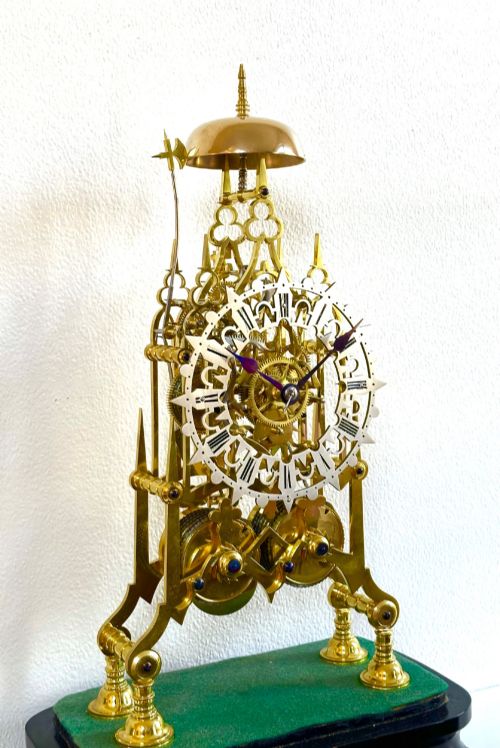


Victorian Double Fusee Clock
These Victorian double fusee clock pieces combine precise engineering with classic nineteenth-century cabinetry, offering reliable timekeeping and period presence for the home.

Victorian Double Fusee Clock
A victorian double fusee clock brings together nineteenth-century horology and substantial cabinetry, with wall, bracket, mantel, and skeleton clock forms appearing across the records. Mahogany, oak, and walnut cases house movements designed to maintain even tension on the gear train for accurate timekeeping.
The pieces on this page span the nineteenth century into the early twentieth century, including bracket clocks, regulator wall clocks, and skeleton clocks under glass domes. Makers signed movements and dials, while styles range from plain mahogany cases to elaborate Gothic revival bronze and carved wood designs.
Mantel and bracket clocks sit on desks or shelves, while dial and wall clocks mount directly to vertical surfaces. The common thread is the dual chain or cord fusee movement, separating them from simpler spring-driven clocks.
Materials and construction
Cases utilise dense hardwoods like mahogany, oak, and walnut, frequently polished to highlight the grain. Bronze and brass form structural skeleton frames, plates, and bezels, while silvered metal provides the dial face surfaces.
The internal mechanism relies on brass wheels, steel pinions, and fusee cones connected by chains or cords to maintain uniform force from the mainspring as it unwinds. Glass domes protect delicate skeleton clocks from dust and disturbance while keeping the movement visible from every angle.
Victorian Double Fusee Clock Retail Price Guide 2026
Typical asking prices for victorian double fusee clock among the pieces listed under this phrase on Sellingantiques today, from the lower quarter to the upper quarter. They describe what is for sale here now, not the wider market.
Listings feature movements housed in mahogany, oak, and walnut cases, alongside exposed brass skeleton clocks protected by glass domes.
Distinguishing quality
Quality rests in the crispness of the movement engraving, the integration of maker signatures on brass plates and dials, and the stability of the timber case construction. Signed work by known retailers or clockmakers demonstrates higher workshop standards.
Subtlety in carving, the presence of original glass domes on skeleton clocks, and clean patination on mahogany and oak surfaces separate standard production from superior pieces.
Geo. Carter, Hackney·Budgen Croydon·Goldsmiths & Silversmiths London·Osborn of Bognor Regis·Edwards Of London
The Victorian Double Fusee Clock Glossary
- Fusee
- A conical pulley used in a clock movement to counteract the diminishing force of the mainspring as it unwinds. This ensures consistent power delivery to the gear train.
- Bracket clock
- A portable clock designed to sit on a bracket, shelf, or mantelpiece. They frequently feature detailed wooden cases and carrying handles.
- Skeleton clock
- A clock with an exposed movement housed between open brass plates, often displayed beneath a glass dome. This design showcases the entire gear train in operation.
- Regulator
- A high-precision clock designed for accurate timekeeping, often featuring a long pendulum and a clear wall-mounted dial. They served as reference clocks in workshops and grand homes.
- Dial clock
- A wall-mounted clock featuring a prominent circular face, frequently used in public spaces, offices, and large hallways during the nineteenth century.
Victorian Double Fusee Clock: Frequently Asked Questions
Where should I place a bracket clock?
Position the clock on a stable, level surface away from direct sunlight, draughts, and sudden temperature shifts. Mantelpieces and dedicated wall brackets work well.
Keep the piece away from exterior walls that experience dampness or heavy vibrations.
How do skeleton clocks stay clean?
The original glass dome protects the exposed brass movement from airborne dust. Leave the cover in place during daily display.
When cleaning the wooden base or surrounding furniture, avoid touching the delicate brasswork beneath the glass.
What indicates an original nineteenth-century movement?
Look for hand-engraved maker signatures on the backplate, substantial brass plates, and matching serial numbers where applicable. Quality nineteenth-century engineering shows individual finishing marks rather than uniform modern casting.
Examine the wood of the case for traditional construction methods and appropriate period patination.